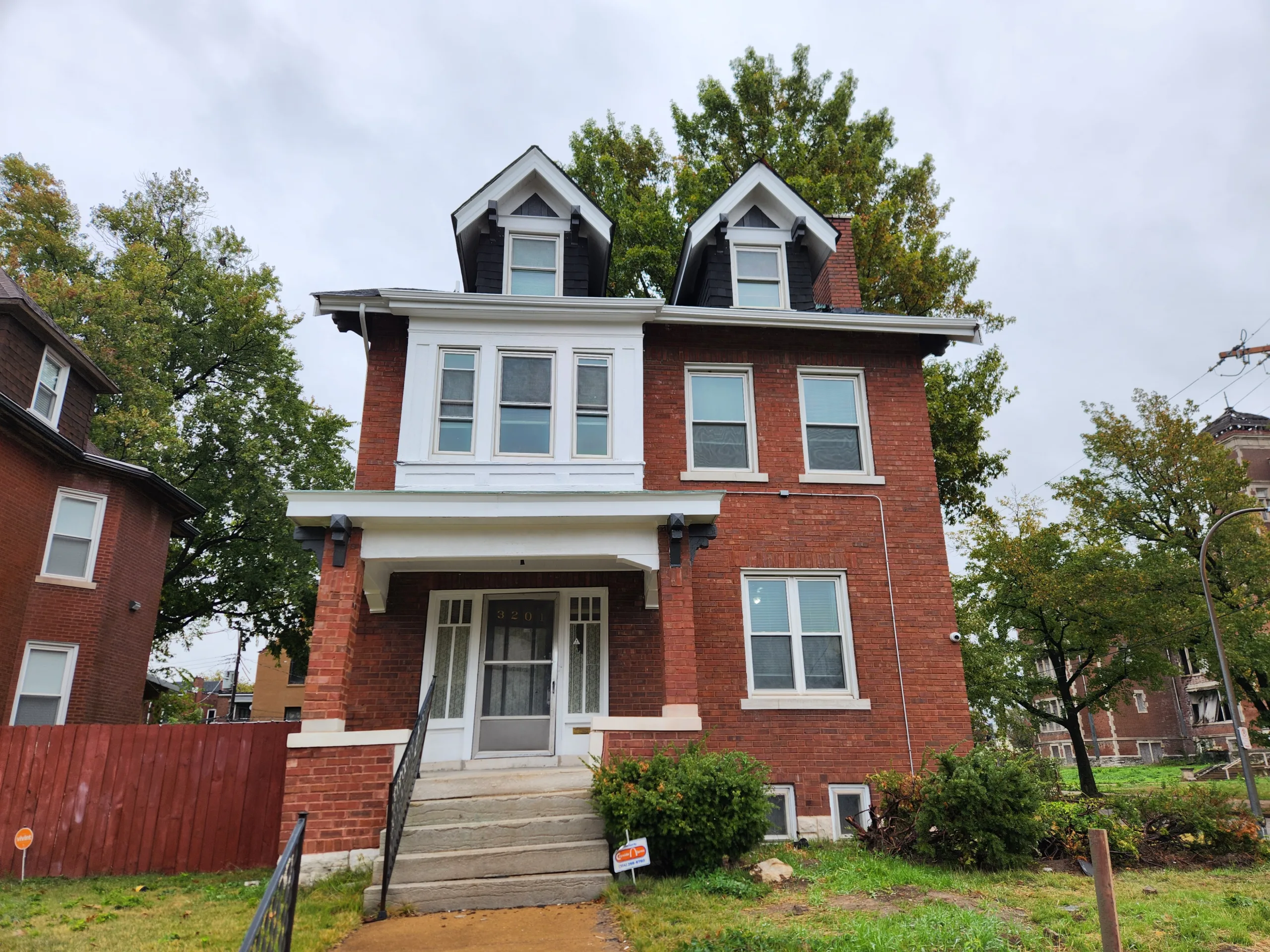
Marquitta Kirwan recently had a “huge epiphany.” Her company, Home Sweet Home Rentals, owns nearly 60 properties in the metro area. One is a spacious brick three-story that was built in 1912 just a block from Fairgrounds Park, on the Northside. Its hardwood floors creak when you step on them and its stained-glass windows glow in sunlight. Kirwan bought it in 2024, hoping to rehab it into a short-term rental for officials visiting the new National Geospatial Agency facility, which is nearby. But at a recent meeting of the St. Louis Metro Housing Collective—a group that connects unhoused folks with willing landlords—Kirwan realized that she had another option. She could convert the house into eight furnished bedrooms, outfit each with a lock, and make the kitchen and three bathrooms communal to keep the rents as low as possible. Her plan now is to finish up the rehab and accept both tenant referrals and rental subsidies from service providers such as St. Patrick Center, a ministry of Catholic Charities.
“The city just passed a law allowing this,” she says. “I told St. Patrick Center, ‘If you show me this works, I’ll keep building these.’”
Stay informed on the area’s civic issues
Subscribe to the St. Louis Solutions newsletter to learn about public problems and possible fixes.
Across the U.S. and now in St. Louis, a near-extinct housing model is getting a fresh look. What were once known as rooming or boarding houses are now described variously as “co-living” or “single-room occupancies” (a.k.a. SROs), but the concept is the same: tenants rent a bedroom and then share the bathrooms and kitchens, generally beyond the short-term. Think of them as college dorms for grown-ups. In some cities, they’re being used as a cheap housing option for medium- to low-wage workers. In Seattle, they have been used to house young, upwardly mobile professionals. In Minneapolis, they’re being used as an exit out of homelessness.
While those municipalities have been outspoken about opening back up to SROs (here and here), St. Louis’ changes have stayed under-the-radar. City Hall watchers will recall how poop puns proliferated when, in 2023, Alderwoman Alisha Sonnier’s plan for an “unhoused bill of rights” foundered over its proposal to let homeless folks defecate in public. What happened next drew less notice: Sonnier succeeded, the following year, in pushing through a different bill making it easier to open emergency homeless shelters in the city. And tucked into that bill was a provision that overturned a 75-year zoning ban on SROs in most areas of the city. Now, thanks to the new ordinance, they’re permissible again almost everywhere, albeit with certain restrictions, including no more than two per block, and only after a conditional use hearing.
Some advocates laud the change. Hannah Policy, a landlord engagement manager at the nonprofit Youth In Need, sees SROs as “a creative solution” that diversifies the bottom of St. Louis’ housing market. “It doesn’t always make sense for a single person to move in somewhere by themselves,” she says.
And indeed, there are worrisome signs that that segment of the market will soon tighten. The recent boom in construction of new multifamily units in the region appears to be over, even as median rents keep rising. The average monthly number of homeless people known to service providers is already up year over year, from 1,723 in 2024 to 1,994 in 2025—and St. Louis hasn’t even seen its first post-tornado winter. Meanwhile, the Trump administration has signaled its desire to make deep cuts in 2026 to federal funding of permanent supportive housing for the homeless. All of this suggests that rents and homelessness are likely to rise. SROs could, in theory, relieve some of that pressure.
Yet SROs can be a tough sale, Policy says, even for her young clients: “A lot of people want their independent living space.”
Standards weren’t always so high. A hundred years ago, as rural Americans and European immigrants poured into U.S. cities, they found all kinds of SROs, from residential hotels to rooming houses (which are lodging-only) to boarding houses (which offer lodging plus meals). By one estimate, as many as one-half of urbanites shared their homes with boarders or were boarders themselves.
But by mid-century, the public was souring on SROs. In St. Louis, the 1950 comprehensive zoning code restricted boarding and rooming houses to what the Post-Dispatch estimated to be 15 percent of the city’s residential area. “Rooming houses are not compatible with one- and two-family districts,” wrote the editorial board in 1957. “When the rooming houses come in, the families move out and the whole area starts down hill.”
The zoning failed to stanch the demographic bleeding: The city kept losing residents over the next 60 years, and unauthorized SROs survived here and there. In 2009, one across the street from Benton Park in South City became such a nuisance that the alderman at the time, Ken Ortmann, shepherded into law a requirement that SROs obtain licenses and permits before operating. He later discovered a second one nearby. It had been managed so well that he hadn’t even known about it. His takeaway: The problem lay not in the SRO model per se but rather in its execution. “I think any model will work as long as it’s managed,” Ortmann says today.
One way to make SROs work is to build them atop subsidies and services from homeless providers, who either coordinate with private landlords or become landlords themselves. This set-up, sometimes called “transitional housing,” is what Peter and Paul Community Services is doing in the St. Louis Place neighborhood. The agency acquired a former hospital and began turning 115 rooms into bedrooms. Nearly all are full, according to executive director Anthony D’Agostino. He says that rent is covered mainly by Medicaid, and behavioral-health care is available on site. “There’s just a huge benefit for someone not to have to go to 15 different places to get what they need,” he says. The low cost of SROs, says Jonathan Belcher at St. Patrick Center, enables providers to get more people off the street. “If we had more SROs,” he says, “we could spread our [subsidy] dollars further.”
Another way to manage SROs is like any other hotel or motel, though for that to succeed, managers must be competent and the city must hold them accountable when they’re not—and neither outcome is guaranteed. Downtown has at least two legacy residential hotels: the Lincoln Hotel, on Olive at 23rd, and the Mark Twain Hotel, on 9th at Pine. The latter, which as of last week was renting rooms for $145.50 per week, is viewed by some as a source of disorder. Denis Beganovic, who has lived in the neighborhood since 2017, says it’s undeniable that many people who reside there and hang out on the front sidewalk are dealing with addiction and mental-health problems. The solution, he says, is tighter management and better access to help for those residents. “There’s a place for these,” he says, “but they have to be actively run by a reputable firm.”
What has recently emerged, however, is an altogether different regime for managing SROs and holding them accountable: tech platforms. Several such companies, including WeLive, Starcity, and Common, crashed and burned post-pandemic, but one has expanded: PadSplit.
PadSplit targets “workforce” tenants—say, teachers, nurses, security guards, or gig workers—with bedroom leases that start at 12 weeks, then go week-to-week. Applicants, all of whom undergo background checks, don’t need to have a minimum credit score and can have one eviction (but no more) within the last seven years. Like short-term rental platforms such as Airbnb, PadSplit relies on feedback and ratings from both owners and tenants to quickly weed out bad actors, but one unusual policy is to allow tenants a free transfer to another PadSplit unit if they encounter problems. That’s meant to incentivize owners to keep tenants happy. Logically, it will only work if there’s a healthy number of PadSplit listings in the area. A 2021 feature in The New Republic, which catalogued various member complaints, reported that the platform had about 1,600 listings at that time; it now boasts more than 24,000 in at least 31 states. (Kansas City has 89 listings; St. Louis still has zero.)
Atlanta, where the company is based, has nearly 900 listings. Annie Hyrila, the chief programs officer at Partners for HOME, the city’s homeless-response system, says that the platform has been “instrumental” in rapidly rehousing people and has added diversity to the housing stock, allowing for quicker move-ins for people who have high barriers.
Marquitta Kirwan, for her part, plans to operate her eight-bedroom rooming house near Fairground Park the old-fashioned way: by showing up and communicating. Provided city approval, which she’s working on, and a steady stream of tenants and housing subsidies from providers such as St. Patrick Center, she believes she can make it work—indeed, as a Christian, she thinks God wants her to.
And Kirwan wants other landlords to step up and try it so that St. Louis has more exits out of shelters. Folks sleeping in those facilities “think they can’t get out of it. They can. But they don’t think they can. So I want them to come, I want them to build confidence, and then I want them to grow out of me.”