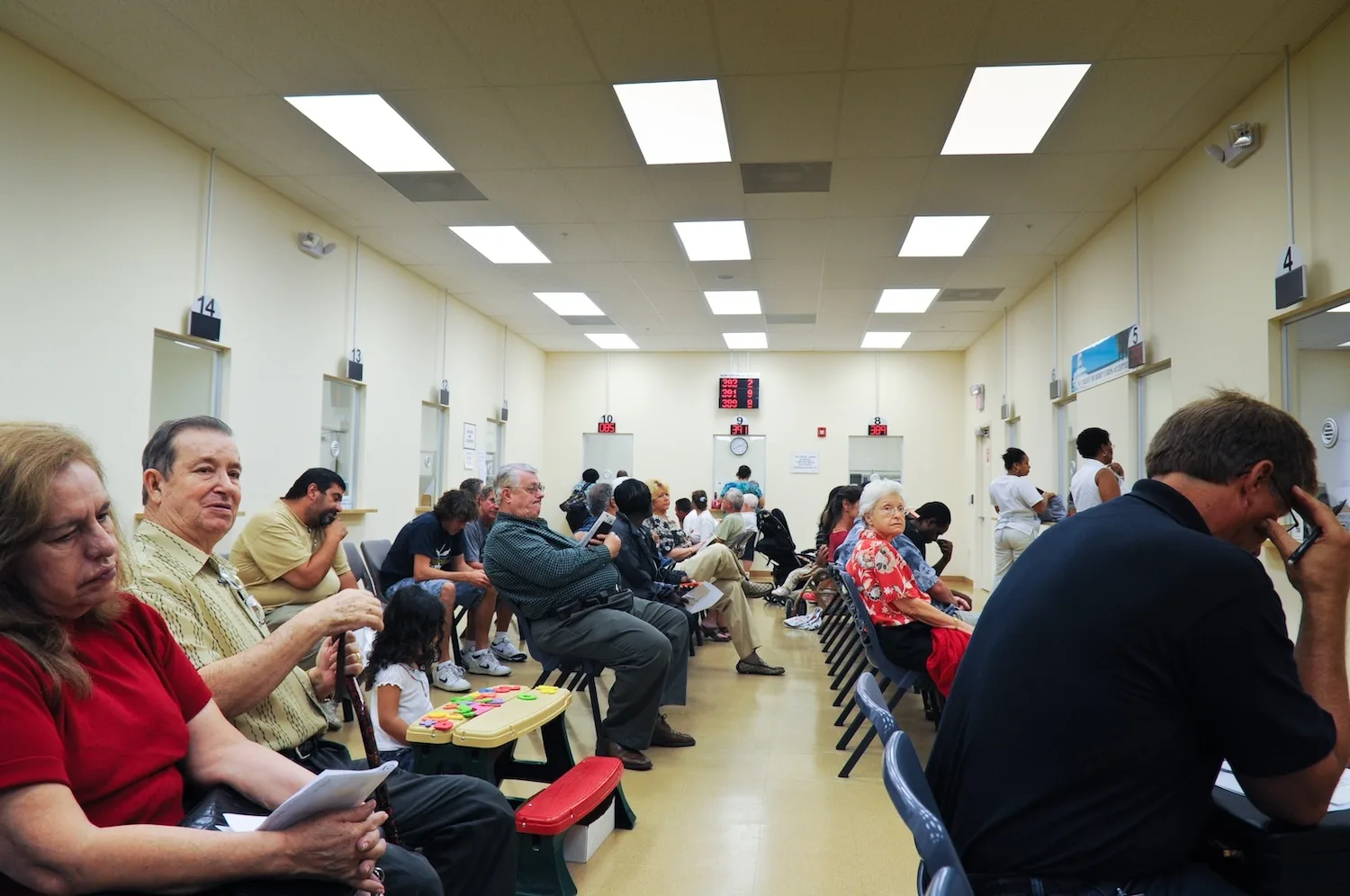
If your goal as a government is to get in the way of a homeless person striving to be self-sufficient, then charging that person fees for new or duplicate identification documents is a good way to do it—and with birth certificates at $15 and non-driver state IDs at $24, Missouri is doing it.
“In the grand scheme of things, that cost doesn’t seem like a lot if you have a regular income,” said Christine Dragonette, who directs an ID clinic at Saint Louis University’s St. Francis Xavier College Church, in Midtown. “But that’s always the biggest barrier people name.” In a recent survey of nearly 600 people seeking help with IDs or birth certificates at a half-dozen organizations across Missouri, 80 percent said they couldn’t afford new ones, and 72 percent said their lack of ID blocked them from getting jobs.
Stay informed on the area’s civic issues
Subscribe to the St. Louis Solutions newsletter to learn about public problems and possible fixes.
Because IDs are both tough to hold onto for someone sleeping in precarious settings and necessary for that person to secure employment and housing, many states—including red states—have shrunk or eliminated the fees for applicants living in shelters, on the street, or in their cars.
South Dakota and Kentucky, for example, now waive the fees for non-driver state IDs as well as birth certificates when the applicants are homeless. George Eklund, a staff member at Coalition for the Homeless in Louisville, recently told a conference on ID access that he and other advocates in his state had found success persuading Republicans in Kentucky’s legislature that free IDs were a “bootstrapping” issue. “This was about helping people help themselves,” Eklund said.
Ohio—another red state—waives fees solely for the IDs, but Republican Rep. Jodi Salvo is trying to change that: She’s co-sponsoring a bipartisan bill in Ohio’s legislature to make birth certificates free as well for anyone of any age who can show they’re homeless. (They’d do this by presenting affidavits from professionals such as service providers or school officials.) Salvo’s argument to her conservative colleagues is that keeping someone in an emergency homeless shelter bed in Ohio costs taxpayers around $60 a day—quite a bit more than the $21.50 for a duplicate birth certificate. “I’m going to sell this as a cost savings,” she says.
In Missouri, there’s a similar way to look at this issue. Imagine that, in 2024, the state waived fees to allow a homeless St. Louisan to obtain a duplicate birth certificate and non-driver state ID. If she then used those documents to get a full-time minimum-wage job and worked that job for a year, she would end up paying the state $426 in income tax. (This assumes that she was single, had no dependents, and took both the standard deduction and Missouri’s federal-income-tax deduction.) That’s a tidy profit for the state, well beyond the $39 it would get in fees for those documents.
Dragonette said she’s unaware of any formal push for this kind of legislation in Missouri. Her clinic on SLU’s campus has been helping folks with ID issues for more than 30 years, and in 2024, operating mostly by word of mouth, it assisted 3,505 people in obtaining IDs, birth certificates, or both, by covering those costs (with a budget of $70,000 for that purpose) and helping with paperwork. “On the best days, we help someone take a deep breath and get through all this, and we see a weight taken off their shoulders,” Dragonette said. “But there’s some stuff we can’t fix. We’re often the bearers of bad news from systems that are broken.”
In 2019, Missouri began issuing REAL IDs—state-made cards that meet federal security standards. This triggered rule changes that the clinic and other organizations had to navigate. They began meeting on a regular basis, and out of that emerged the Missouri State ID Access Coalition. Its working groups are now looking for fixes to systemic problems.
Last April, the coalition sent a group to Jefferson City for the first time to engage with legislators. “We weren’t pushing a particular bill, but we were meeting legislators and introducing this idea of cost being a barrier,” Dragonette said.
One common reaction from Missouri legislators, Dragonette observed, was to point to a state law passed in 2022: It requires photo IDs to vote and also waives fees for those who don’t have an ID but want one for voting purposes. Yet that law isn’t always helpful, Dragonette said, for a couple of reasons. First, the vast majority of her clinic’s clients do, in fact, have unexpired state IDs; it’s just that they’ve been lost or stolen. That appears to make those clients ineligible under the voting program. Secondly, she said, many clients feel awkward walking into an office and framing their needs around voting when in reality, their more urgent need is a job, or housing, or cashing a check. But not all legislators seemed aware of such nuances.
So the coalition’s first strategic goal is reducing or eliminating the fees. “I think there’s not a particular legislator we could name at this point who’s a champion of it,” Dragonette said, “but I feel optimistic that legislators see that this is something that’s important for people getting jobs.”
Ohio shows that not all changes need be made at once. Because of a voting-related law in 2023, it effectively stopped charging all adults for ID replacements, duplicates, and reprints. Ben Sears, executive director of the Columbus Coalition for the Homeless, said that this alone cut down on the hassle, time expenditure, and frustration that both homeless folks and homeless providers had to endure when seeking new IDs. No more running around town trying to get vouchers and get them faxed to other offices. “Now, anybody—whether they can pay or not—can just show up and get treated the same,” says Sears. But when asked about Salvo’s idea of making birth certificates free as well for homeless people, Sears said: “Gosh, that’d be amazing.”
Birth certificates are crucial in many states, including Missouri, because you can’t get a state ID without one. But it’s not the only required document, and that’s why there’s only so much a certificate fee waiver would do: An applicant must also verify their social security number. If a Missourian has had a valid ID since 2009, they can verify their social verbally. If not, and they don’t have their social security card, they may need an appointment with a perennially backlogged federal bureaucracy. This can be, Dragonette says, a “big problem”—one that befalls the chronically homeless, those who’ve been incarcerated a long time, and homeless youth who don’t know their socials and can’t easily access their cards.
But there’s still plenty that Missouri could do. Dragonette said that the coalition will stay focused on the cost barrier because that’s what the clients pointed to as a problem. “We really need to prioritize this because this is what people are telling us they need,” she said. “And I think especially at a time where affordability, cost of living, everything is just feeling really stretched, identification is just one other thing on top of everything else.”