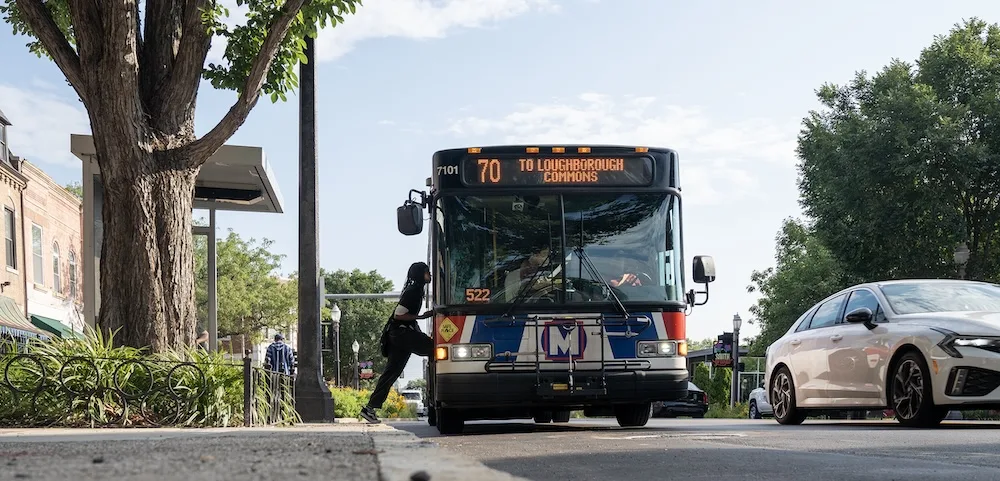
The 70 Grand bus route running from Broadway to Loughborough Commons services an average of 5,000 riders each weekday. However, the route boasting the highest ridership in the city is also frequently plagued by reliability issues, according to the grassroots transit advocacy group St. Louis Transit Riders.
In an effort to draw attention to Grand’s bus inconsistencies, Transit Riders launched an online petition to compel transit authorities to address punctuality problems on the route. Addressed to Bi-State Development CEO Taulby Roach, the petition demands changes such as dedicated bus lanes, transit priority signals, and bus boarding islands.
Get a fresh take on the day’s top news
Subscribe to the St. Louis Daily newsletter for a smart, succinct guide to local news from award-winning journalists Sarah Fenske and Ryan Krull.
Noah Goldman is a co-lead of the St. Louis Transit Riders group, which is an offshoot of the St. Louis Urbanists advocacy organization. He sees Grand’s buses being on time just around 70 percent of the time as of April 2026 as an urgent issue. “We hear from riders who say that nearly every single workday the bus isn’t showing up, or is showing up late, or gets canceled, especially in the afternoon and evening,” he tells SLM. In St. Louis, where bus service is not as frequent as in denser cities, a cancellation means waiting 30 minutes or more for the next bus.
And often, Goldman says, it is more. After a cancelled bus, he says, riders report seeing as many as three buses pass without stopping—as drivers attempt to get caught up to where they’re supposed to be.
Metro Transit’s chief operating officer, Ron Forrest, says that since April, Bi-State has improved reliability on the Grand route from 70 percent up to 77 percent. He believes the best means of increasing bus consistency is hiring a robust staff of full-time and part-time drivers. “What we’re dealing with systemically is a lack of operators, and so we’re trying to build that up,” he says.
Metro Transit is now seeking to improve the route’s reliability to around 85 percent, he adds.
As for the transit group’s requested changes, such as dedicated bus lanes, transit priority signals, and bus boarding islands, Forrest says Metro is considering them, but that the petition’s stated timeline is not feasible. The group wants the modifications to be studied, funded and implemented by 2027.
“Nothing’s ever easy in our business,” Forrest tells SLM. “We do have a lot of local partners and planning departments that we would have to collaborate with … there is some potential there [for dedicated bus lanes], but again, that would take a lot of collaboration with a lot of different partners.”
However, Metro Transit is currently working on a network redesign plan to overhaul the entire bus system in the next two to 10 years. Forrest says they will consider implementing Bus Rapid Transit (BRT) on the Grand route, which includes dedicated bus lanes and traffic signal prioritization, depending on constituent interest and funding.
“If this is something the city wants, then we certainly think that it’s a good idea,” Forrest says. “If it’s something the city wants and something that the city and regional partners are interested in investing in.”
But Forrest notes that the Grand route is particularly challenging due to some of the traffic calming measures installed by the city. Those features are supposed to constrict traffic; they’d have to be scrapped in some cases and redesigned in others to accommodate dedicated bus lanes.
Goldman says the petition directly addresses Bi-State Development CEO Taulby Roach because they see his organization, under which Metro Transit falls, as directly responsible for improving the route, versus the city or other partners. Understanding that structure, he says, is important in advocating for change.
Goldman adds, “Something that we’re trying to do is not only advocate for riders but teach transit riders. How do we advocate for ourselves? We’ve got some educational content that we’ll be pushing out later this summer to teach people how to do that.”
The Transit Riders are framing bus reliability not only as a means of practicality, but also as an economic mobility issue, since reliable and affordable transportation is often necessary for gainful employment. Goldman said Grand riders’ response to the petition has been “encouraging.” (As of July 23rd, the petition has 103 signatures). He says some riders tell him that they often turn to Uber after waiting 30 minutes or more for a bus—a phenomenon covered earlier this year in SLM.
The St. Louis Transit Riders also believe that if St. Louis residents see the Grand route functioning well with BRT features, they will be more likely to support the Greenline BRT project, an estimated $360 million to $590 million project that Mayor Cara Spencer is pushing to connect the North and South sides of the city.
“I believe people may not support it if they don’t have an idea of what it might look like, so doing a smaller project first on Grand, where it would also deliver better reliability for the thousands of riders who rely on it, would be a good way to demonstrate what this is and why we should support it,” Goldman says.
Goldman says he takes the Grand route in St. Louis a few times a week. He first got interested in advocating for better transit after experiencing the ease and reliability of Montreal’s public transit system during his two years there. It was, he says, a “much better” system than here: “I was able to rely on transit there in a way that I can’t here.”