A north-south Bus Rapid Transit line is likely one stop closer to becoming a reality, as this morning St. Louis Mayor Cara Spencer will present the city’s final route plan to the East-West Gateway Council of Governments.
The regional council’s approval is an essential step toward securing federal funding for the project, says Scott Ogilvie, a planning executive for the city. He says that, if all goes according to plan, the Federal Transit Agency will provide about half of the project’s funding. Preliminary estimates put the project’s total price tag between $360 million and $590 million.
Get a fresh take on the day’s top news
Subscribe to the St. Louis Daily newsletter for a smart, succinct guide to local news from award-winning journalists Sarah Fenske and Ryan Krull.
In 2017, city voters approved a new tax to raise money for a third MetroLink line, the Green Line, that would run south and north. Thus far, the tax has brought in about $110 million—however, construction of even a stripped-down light rail line would cost an estimated $1.1 billion. So the city pivoted to BRT.
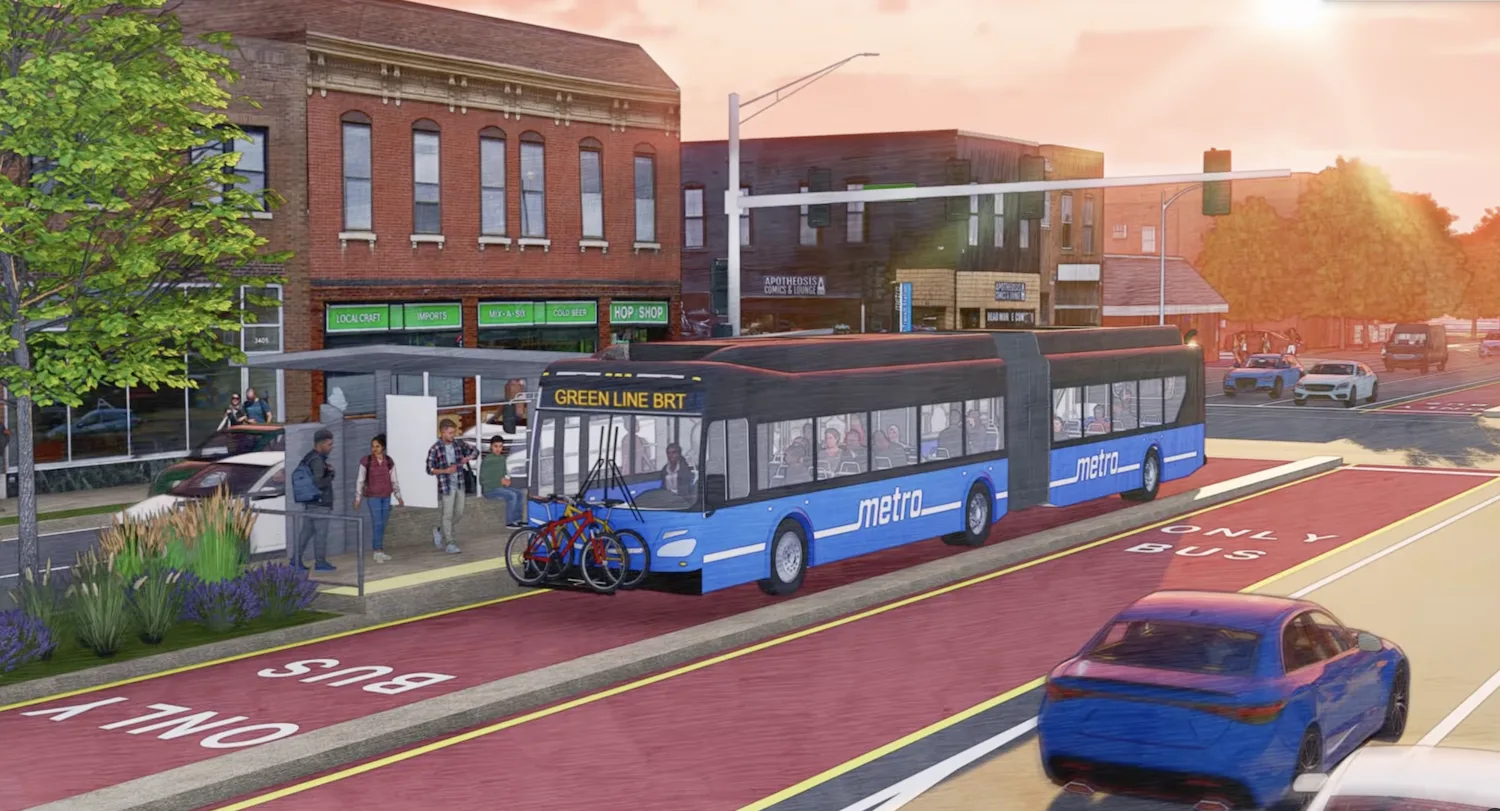
“Bus rapid transit is the way of the future,” says Spencer, citing its lower construction cost and the route’s flexibility. Bus rapid transit is operated more like a hybrid between a bus and a train. The buses run in dedicated lanes, stop at raised stations, and often have priority at traffic signals to make trips faster.
At this morning’s meeting of the East West Gateway Council of Governments, Spencer will present on the city’s chosen route, which has its southernmost point at Meramec and South Broadway, near Minnie Wood Park in Dutchtown. It runs north to Jefferson, with stops at Chippewa, Gravois, Arsenal, and Park Avenue, among others. It then turns east on Chouteau and north on 18th Street, before entering downtown along Tucker Boulevard. The north half of the line runs along Florissant to Jefferson and Natural Bridge, with eight stops along Natural Bridge before ending at Goodfellow. The regional council will vote on the proposal after Spencer’s presentation.
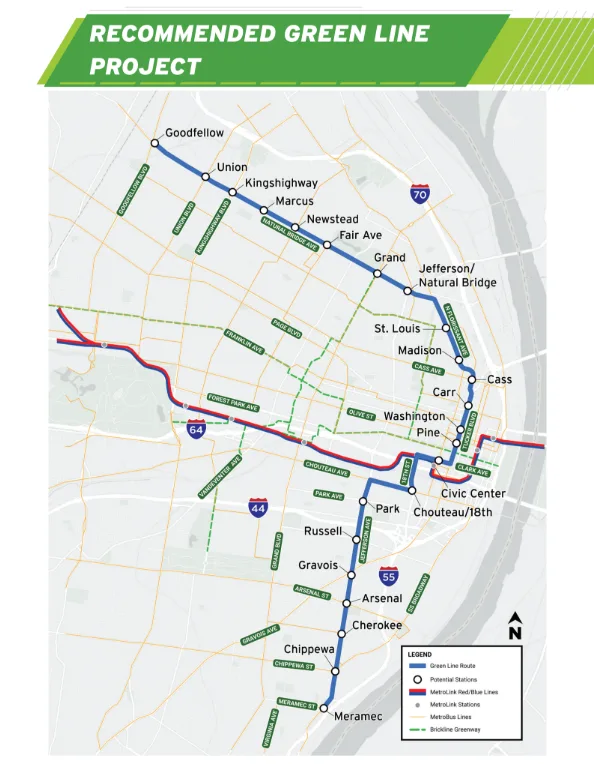
“The ridership will be from the ends into the center, into downtown,” says Ogilvie.
This route was one of two finalists, with the key difference that the runner up had far fewer stops downtown, with much more of the route running along Jefferson instead of Tucker. “I think that would have been a missed opportunity to connect folks more directly to downtown,” says Spencer.
Ogilvie says that both routes were feasible, but the one that was ultimately selected better aligns with current transportation patterns and is closer to more affordable housing, which tends to generate riders. He adds that the BRT line runs longer than the proposed light rail would have and extends on its north end to within a stone’s throw of the county line. That will hopefully enable the county to construct its own project that would link with this one. “Thinking long term, that’s been the main vision that the region has had,” he says.
Ogilvie says that the city will start to hone the exact price tag over the next year as it begins preliminary engineering, figures out where curbs need to be moved and what sort of buses will run the line, as well as what exactly the stops will look like. If all goes smoothly, the BRT line could be complete by 2031.
One point of contention remains the $110 million collected via the tax approved in 2017. Spencer believes that money can be directed towards bus rapid transit without issue. However, some city officials, Aldermanic President Megan Green among them, believe the matter needs to be put to another vote so that voters can explicitly approve the money once intended for light rail to go to BRT. A spokesman for Green said as of right now there’s no timeline as to when the question will be put to voters.