
St. Louis city leaders got a win in court today in their ongoing battle with the state-appointed Board of Police Commissioners. Judge Joan Moriarty denied the board’s request that $67.5 million be added to their coffers this fiscal year, which ends in about a month.
The Police Board had sought to lay claim under state statute to not just 22 percent of the city’s general fund, but also the city’s Rams settlement funds and 22 percent of its fiscal reserves Moriarty wasn’t buying its argument. “The court finds that general revenue only includes current income of the fiscal year in question and does not include income from prior years,” she wrote—which “uncontradicted evidence” shows both the Rams funds and accumulated reserves to be.
Get a fresh take on the day’s top news
Subscribe to the St. Louis Daily newsletter for a smart, succinct guide to local news from award-winning journalists Sarah Fenske and Ryan Krull.
Mayor Cara Spencer had previously said that moving that sum to the police away from other city services in such a short timeframe would be absurd.
Both sides argued their case on May 19, in a long hearing that was very much in the weeds and saw testimony from City Budget Director Paul Payne as well as a slew of accounting experts.
City attorneys cited the meaning of general revenue in the context of generally accepted accounting practices. Police Board attorney Chris Graville cited a Missouri Supreme Court case from 1955 that bolstered his point of view.
Judge Moriarty seems to have laid down a definition of general revenue going forward, specifically that it is money brought in during the current fiscal year, not money that entered the city’s books in a previous year, as was the case with the Rams settlement funds (which entered the city coffers in 2022). This largely tracks with the definition of the term put forth by Payne.
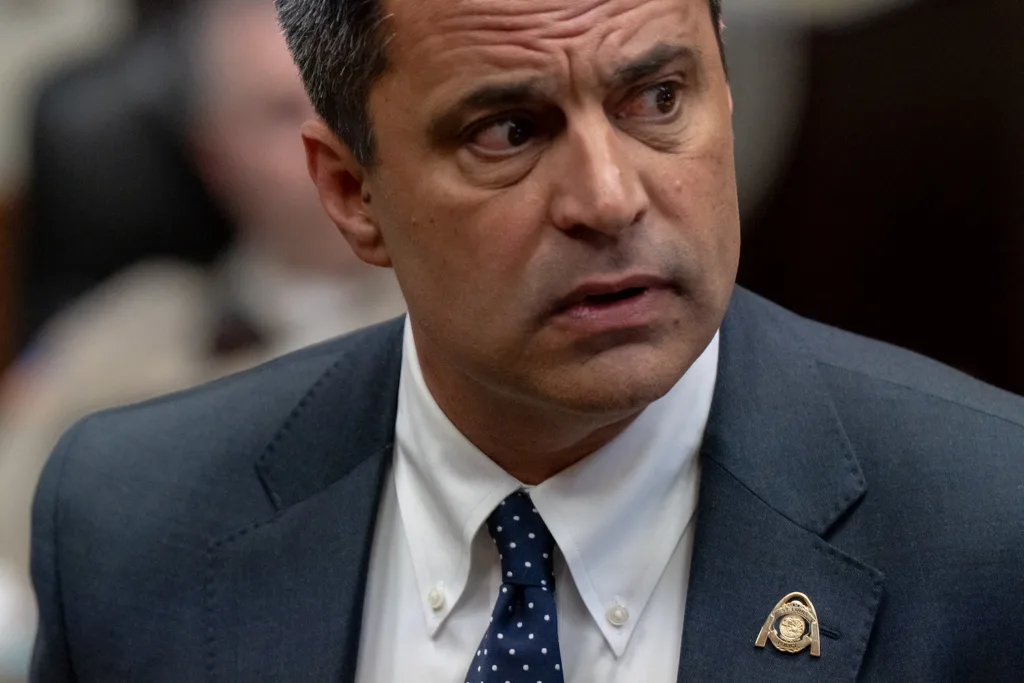
The showdown in Moriarty’s courtroom last month was just one front in the increasingly fraught battle between the city and the state-appointed Police Board. It’s one of five different lawsuits challenging various aspects of the state’s new governance—the only one filed by the Police Board.
Critics of the state-run board have noted that Graville gets a 40 percent increase in his hourly fee when handling litigation matters, setting his hour rate at $390/hour for partners and $350/hour for associates. The Police Board, however, has argued that it has a unique ability to get a fast ruling in court, something it argued was essential as the end of the fiscal year looms.
The Police Board seems likely to appeal Moriarty’s ruling, but that may become a matter for discussion at its hearing Wednesday. The Board will also consider a host of new raises for command staff, with salary increases of 16 percent for lieutenants, 18 percent for captains, 20 percent for majors, and 22 percent for lieutenant colonels on the agenda. Spencer fired back angrily on that proposal last night, noting that it did not come with a fiscal note—and would require, due to the rules mandating parity, similar raises for Fire Department officials.
Update at 12:56 p.m. The Police Board apparently didn’t wait for a meeting to decide on its next move in the lawsuit. Says President Chris Saracino, “The St. Louis Metropolitan Police Department continues to provide quality public safety services despite staffing shortages, heavy overtime demands, aging infrastructure, and ongoing recruitment and retention challenges. Although we are disappointed in today’s ruling, we remain committed to our mission and to serving the people of the City of St. Louis with professionalism and integrity. We intend to appeal this case to the Missouri Supreme Court.”
Mayor Cara Spencer also weighed in, saying, “It is absurd to claim that City reserves and Rams funds are somehow current-year revenue, and I’m pleased and grateful that the courts have now ruled as much. This is a win for St. Louis, for residents who rely on city services, and for common sense.”