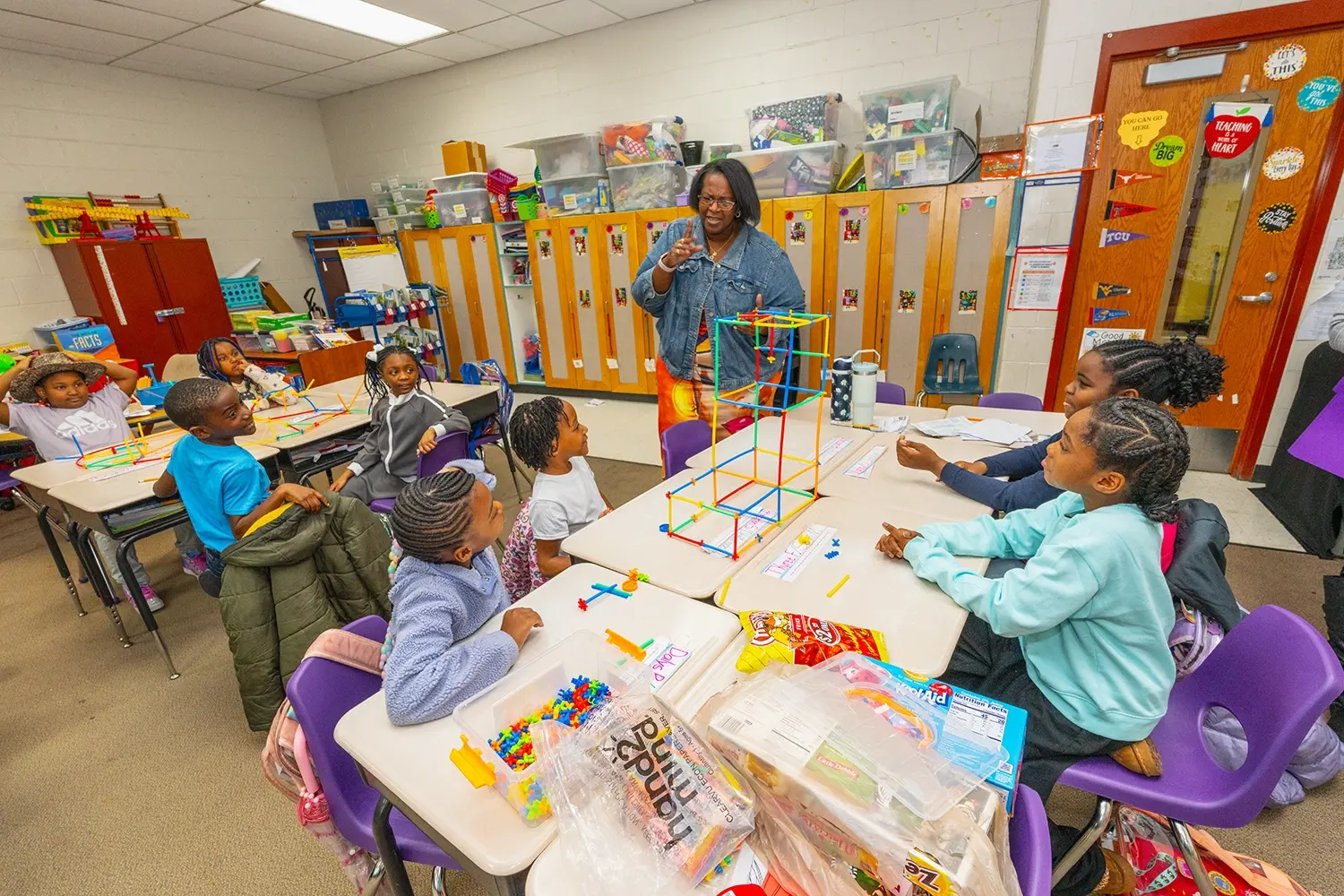
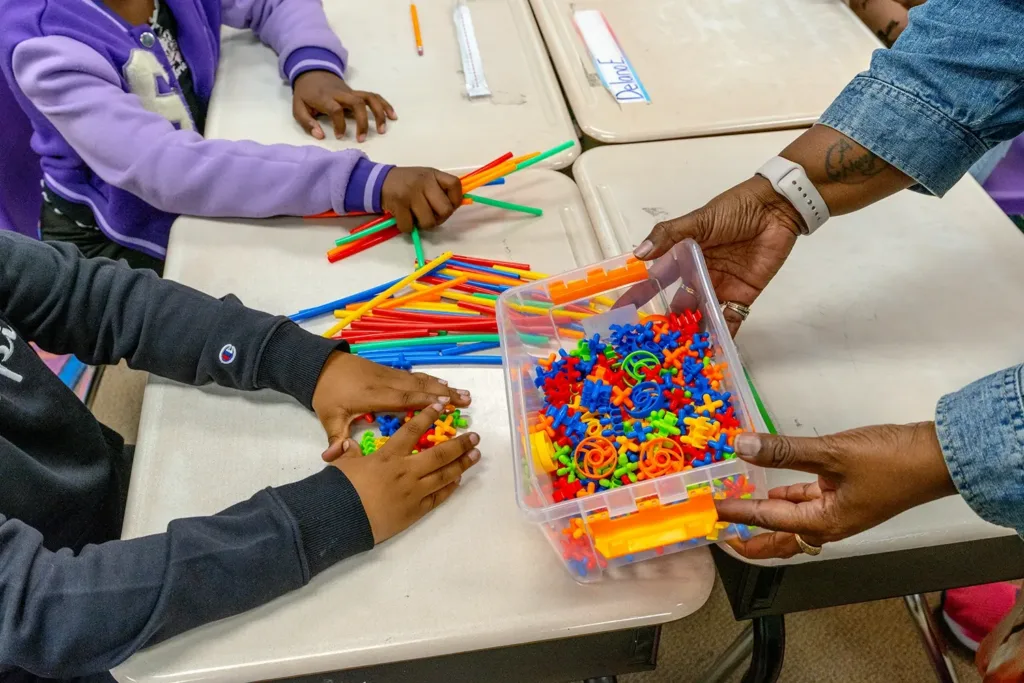
It’s a bit after 4 p.m. in early March at Officer Elementary School in East St. Louis, and in Margaret Carey’s classroom, second-grade students have just finished a 10-minute exercise using their imaginations to build big structures with colorful straws and connectors.
“This is a roller coaster, but y’all may see y’all gotta have y’all seatbelts on, because this big thing could hurt y’all,” says eight-year-old Diary, showing off her group’s construction to much applause. Two more students present their group’s creations, a house and a beach, to similar encouragement.
Get a fresh take on the day’s top news
Subscribe to the St. Louis Daily newsletter for a smart, succinct guide to local news from award-winning journalists Sarah Fenske and Ryan Krull.
“Clock it!” Carey and the other students respond in unison, making a pinching motion with their fingers.
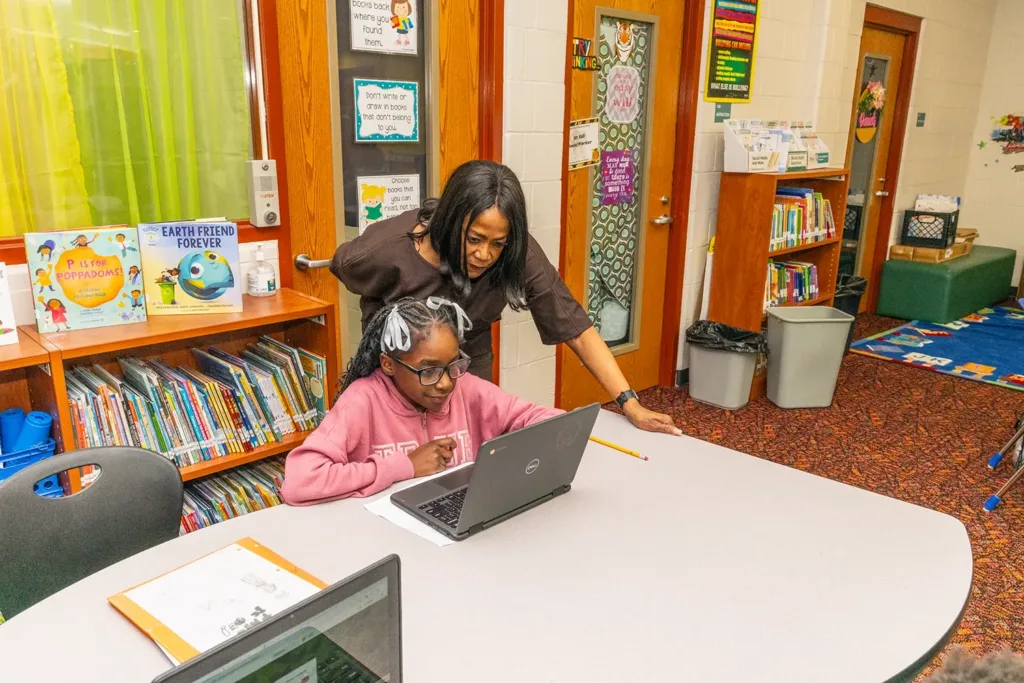
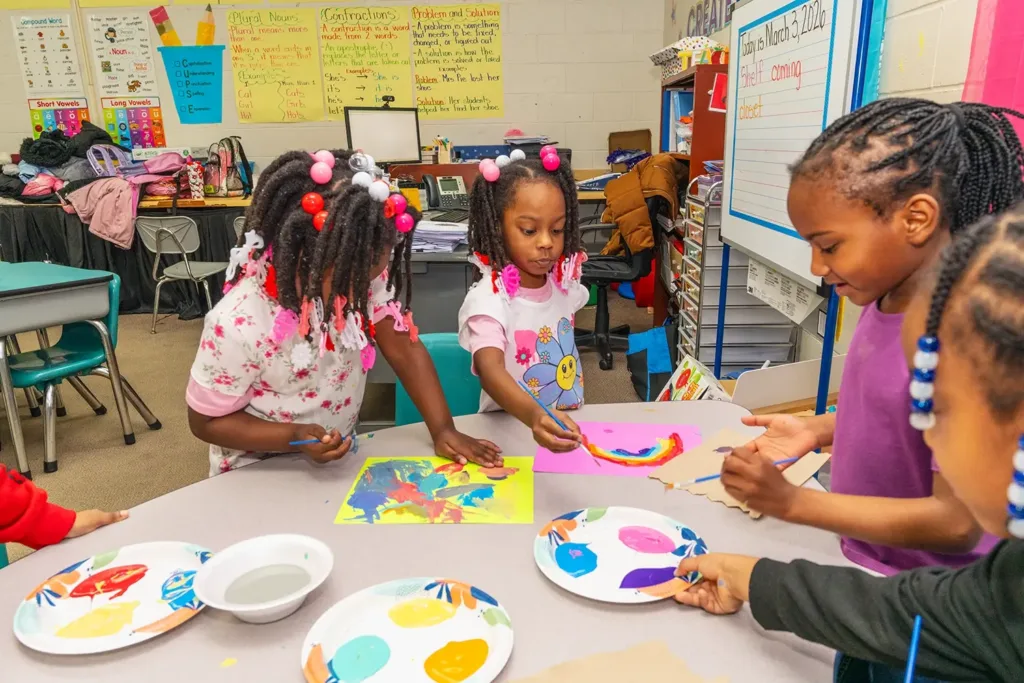
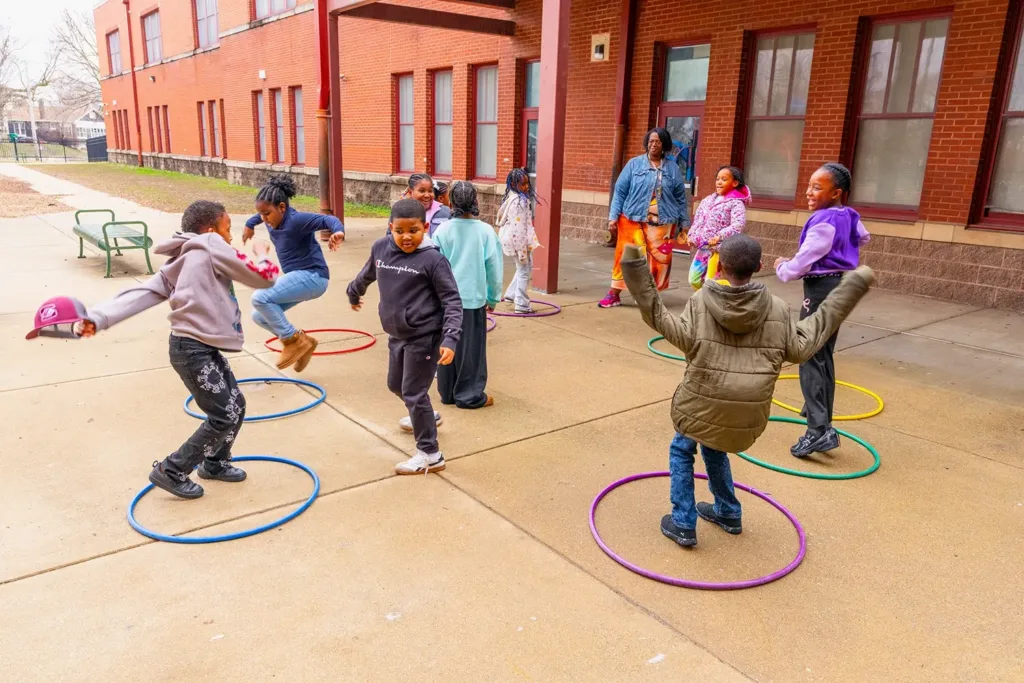
In the classroom next door, Lea Pickens helps her first and second-graders paint rainbows for spring. In the library, Angela Patterson helps her third and fourth-graders work on their homework and i-Ready, an online program that supplements curriculum with tailored instruction. After classes wrapped at 3:30 p.m., all students who stayed at school got a third meal.
This is PAWS Academy, Officer Elementary’s before and after-school program that began in January 2025 after East St. Louis School District 189 received a federal grant to make two of its elementary schools “full-service community schools.” Each school was set to receive $500,000 annually, plus a $100,000 match from the district.
Across the river, Saint Louis Public Schools is working with its teachers’ union to develop its own version of the community school model, one aimed at improving student outcomes at the district’s lowest-performing schools. It’s a return to an old idea for the district, one that’s shown promise in the past.
Yet the same problem that has undercut SLPS’ implementation caught up with East St. Louis this summer: As priorities shift, funding gets cut, and all too often, even programs that are showing results get cast aside.
At its essence, the community school model puts the saying, “it takes a village to raise a child” into practice. “The underlying idea is that communities and schools are intertwined, and that they should be kind of porous, right? The community is part of the school,” says Emily Germain, senior researcher at the San Francisco-based Learning Policy Institute. “The school is part of the community. Everyone should be involved in the uplift of children and giving them a whole-child centered education.”
There’s a misconception that the community school model just provides “wraparound services,” or non-academic support to ensure basic needs are met, Germain says. But that’s just one piece of the model; researchers have identified six key practices of successful community schools, including expanded and enriched learning opportunities and rigorous, community-connected classroom instruction.
What makes community schools work, and unique, is the community school coordinator. The coordinator serves as the bridge between the school and community, doing the “systems thinking” to understand what resources the community has to offer that students and families want or need and then building partnerships to connect the school with those resources.
The coordinator’s salary is one of the main costs of implementing the community school model. But that investment can pay off: A 2019 case study found that $1 invested in a community school coordinator returned about $7.11 in net benefits. “It’s actually a really efficient way to provide resources,” Germain says.
Many of the services that come to the school, like bringing a mobile dental clinic twice a year, don’t cost schools anything, as the services already exist and are often already paid for through county or state money or private fundraising. “It’s a matter of having someone who has the capacity and knowledge to actually bring those partnerships to the school itself, which is why the coordinator is so essential,” Germain says. “A principal doesn’t have time to do that work.”
Support for community schools has grown in recent years, as advocates see the model as a way to address longstanding social inequities. Most notably, California has invested $4.1 billion in community schools since 2021, establishing the largest state-level community school initiative in the country.
The federal grant program grew from $25 million in fiscal year 2020 to $150 million in fiscal year 2025, although some of those grants found themselves in the Trump administration’s chopping block, including East St. Louis’ grants. ACT Now Illinois, the nonprofit distributing the federal funds in the state, fought a legal battle restoring nearly $6 million for affected schools through June 30, but as of now, the funding is gone.
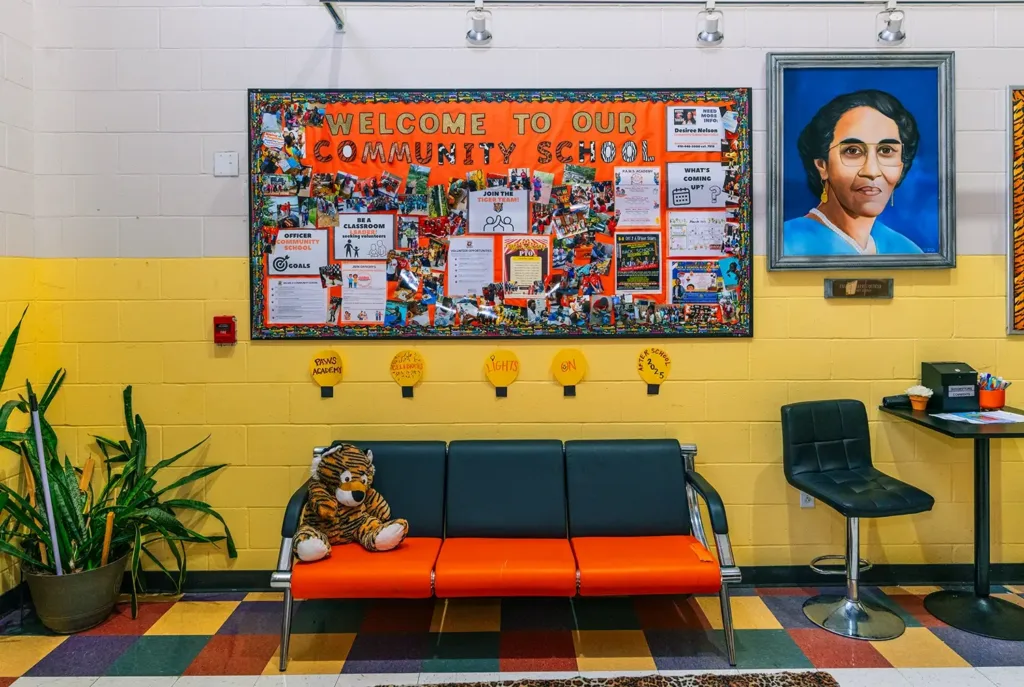
With its grant dollars, Officer Elementary added a before and after-school program, hired two reading teachers and two math fellows to work with struggling students, purchased the i-Ready program, and started a food pantry that served more than 100 people, according to Desirée Nelson, community school specialist. (Until recently, Nelson was Officer’s coordinator, but she’s been covering a second school since its coordinator resigned amid ongoing funding uncertainties.) The pantry also serves as an example of the collaboration required for the community school model, she says. Families were selected from a referral survey of classroom teachers and then reviewed by the school’s administrators, truancy officer, social workers, and lead cafeteria employee, who offered first-hand testimony about which kids ask for seconds or for food to take home.
Nelson says she amassed a network of about 65 organizations ready to partner with the school in various ways. Southern Illinois University Edwardsville’s STEM Center taught students robotics and coding; The Black Rep and COCA provided theater and dance instruction; a retired East St. Louis fire captain ran a mentorship program; and three different nonprofits provided mental health services. Third and fourth graders took a trip last April to the Ozarks, where students kayaked, rode horses, and roasted marshmallows. “It was just so fantastical, because there’s some kids who’ve never even crossed over into St. Louis,” Nelson says.
“I’m really a systems builder and a convener, bringing various resources and opportunities, not just for the student, but for the whole family,” Nelson says. Case in point: When a family’s house caught on fire, she was able to tap into her network to provide clothes, food, money, and temporary housing. “That’s just an example of the power of community partners,” she says.
Principal Darla Walls, who has been with the school district for 22 years, says she’s seeing more families coming into the school building and that they’re more engaged. “I think that we have become more of a family with our community,” Walls says.
The community school model has also freed her to focus on instructional opportunities for students. “It just makes it so I feel like I can breathe,” she says. “When I go home at night, I don’t have to go and do 50 other things.”
The precarity of funding, however, makes things difficult. It’s hard to communicate the uncertainty to parents, who have come to view the school as a trustworthy place where they can send their kids, she says.
Walls says to parents that the school will continue with the model and the district is going to keep trying. “We’re limited with funds, but we’re going to keep trying to do all the things that we can,” she says.
What the Research Says
As support for community schools—both in terms of funding and zeal from teachers unions—has increased in recent years, so has research on their efficacy. A 2017 review of 143 studies published by the Learning Policy Institute and the National Education Policy Center found that well-implemented community schools improved attendance, academic achievement, and school climate and discipline.
“The caveat is implementation matters,” Germain says. “If you’re doing this only in name, a lot of those outcomes aren’t going to follow.” Implementation means using all six practices in an integrated way, such that they reinforce one another, she adds.
Many outcomes can take two to three years to see, but there’s one area where results are more immediate. “We are starting to see community schools make great strides along chronic absence pretty quickly, and it’s because they’re built to attack that problem really well,” Germain says.
At Officer Elementary, that rings true. The school nearly halved its chronic absenteeism, from 53 percent last year to 28 percent this year, as of May 4—no small feat in a post-pandemic landscape where absenteeism has soared. “Which is significant, because obviously, if the kids aren’t here, they can’t receive the services. They can’t learn,” Nelson says. “Getting them here is the first step.” At the district’s other full-service community school, Avant Elementary, chronic absenteeism dropped from 35 percent last year to 32 percent this year. That impact is a “direct result” of the community school strategy, including family engagement and wraparound services, according to a district spokeswoman.
In recent years, research has begun looking at whether community schools can work at a larger scale.
Perhaps the strongest research comes out of New York City, which launched a community school initiative in 2014, starting in 45 schools before expanding into more than 400. Peer-reviewed research published last year found that, over the first four years, community schools had immediately reduced chronic absenteeism by 5.6 percentage points, which continued over the following three years, and improved math and reading scores by the third year. The authors concluded: “Our findings suggest that improved attendance is a leading indicator of success of this turnaround model and may be followed by longer-run improvements in academic achievement.”
In California, where the state has infused billions into its community school initiative since 2021, a study looked at outcomes in 450 community schools after the first year. The Learning Policy Institute found that the schools “significantly” reduced chronic absence within the first year, reduced suspension rates, and improved student test scores. The most substantial test score improvements were in schools that most reduced chronic absenteeism. And while all students benefited, Black students, English learners, and socioeconomically disadvantaged students made the largest gains.
In the Midwest, Chicago started implementing its own initiative, Sustainable Community Schools, in 2018 as a joint effort between the district and teachers union in which 20 high-poverty schools receive $500,000 annually. (It expanded to 36 schools this year and will expand to 70 by 2028.)
There doesn’t appear to be any public-facing evaluation of that initiative’s impact on student outcomes. A Chalkbeat Chicago analysis, though, found that the 20 schools involved in the initiative since the beginning failed to outperform other schools in the district with similar demographics in terms of attendance, high school graduation rates, and test scores. Chalkbeat found that was partly due to COVID-19 disrupting rollout, but also a lack of clear goals and guidelines, tensions between schools and partners, and more than $6.6 million left on the table. Enrollment, which some supporters believed the initiative could improve, actually declined more in the initiative’s schools.
Several schools did, however, improve student outcomes and stabilize enrollment. Chalkbeat found these schools had some things in common: “consistent leadership through the seven years of the program, teacher and staff buy-in, and a clear vision for how to make the most of the added dollars.”
SLPS Explores the Model
At a board meeting last December, a group of Saint Louis Public Schools staff and students reported back on a trip they took to Drake Elementary, one of the sustainable community schools in Chicago.
Carron “CeeJay” Johnson, president of the American Federation of Teachers Missouri, says she brought the group to see what she had on prior trips. “The first time I saw a village. I saw leadership connecting with staff, and not just sitting and having meetings, but I heard them listening to each other and being able to collaborate effectively,” she says.
She adds, “I wanted them to see it and actually feel and touch it, instead of just hearing me talk about it.”
The group’s ask of the board: to pass a resolution requiring SLPS to implement its own version of sustainable community schools, starting with the lowest-performing schools.
The term “community school” can mean different things to different people, especially to folks in St. Louis, since the district has implemented the model in different ways before. That’s why Ray Cummings, president of American Federation of Teachers Local 420, says he’s been working diligently with the district to get everyone to understand what it is they’re working toward: a “St. Louis model” that addresses the specific needs of St. Louis students and their families.
The goal: to improve student outcomes by developing a model that focuses on the whole child—addressing not just students’ academic needs but also their social, emotional, physical, and mental needs—and involves their families. Cummings thinks that work can be the starting point for something bigger.
“The school system can lead the way to revitalizing all of St. Louis. That’s what we’re trying to do,” he says.
Cummings sees the model as connected to the broader issue of declining city population and school enrollment. Rather than closing buildings, especially in north St. Louis, Cummings argues SLPS should reimagine them. The goal is to open new “21st century” educational opportunities in their place. “It’s our belief that with the correct education opportunities in the city, it would be a magnet to draw families back to the city,” he says.
He notes that there are elements of the community school model sprinkled into the restructuring proposal that could close at least 17 schools by 2027, with some potentially being repurposed to host affordable housing, community hubs, or health clinics.
That will take money, Cummings says, which is why the union is “elated” about the data center proposed for Midtown. SLPS will be the largest tax beneficiary, generating $35.8 million in the first year of operation and about $206 million for the district over 10 years of operation. The union endorsed the deal early on—despite significant pushback from many city residents—as a model for future development in the city where developers pay their “fair share to schools.” (A recent report found that tax incentives for developers have cost SLPS almost $240 million over the past eight years. The St. Louis Development Corporation disputed the findings, saying that many projects would not have happened without the tax breaks.)
Cummings believes the current SLPS administration is committed to developing a St. Louis-specific community school model. “We’re just trying to get this thing right,” he says.
At an April board meeting, Myra Berry, who was then interim superintendent but took the position permanently on July 1, told the board that Local 420 had reached out to her about working together to develop a community school model that works for SLPS.
Board member Robert Harvey said he had no objections to the process. “I’m an absolute supporter of the community school model,” he said.
Harvey did, however, express hesitation around the timing. Federal funding cuts are gutting the very community partners the model depends on, he said, citing federally qualified health centers and their current uncertainty around Medicaid as one example. “Every partner you need for a full-service community school is under attack right now federally,” he said.
Board president Karen Collins-Adams shared that concern. “If we don’t have partners to be able to start this, we won’t have a community school at all,” she said. “They have to actually invest in it and move into our schools.” It will also hinge on the budget, she added.
Board member Donna Jones, who had been on the Chicago trip and thought “it was a very workable model,” framed the funding concern differently. “I understand the state of the government right now,” she said, “but right now we can’t wait for the White Horse to come and rescue us anymore.”
A Nearly 60-Year History
“Renewed interest is not new interest.” That’s the bolded takeaway from a policy brief about the history of community schools in SLPS by PRiME Center, Saint Louis University’s education research and policy group. In fact, Saint Louis Public Schools has implemented versions of the model for nearly 60 years. The problem has been the way its interest in them has ebbed and flowed.
SLPS’s journey began in the 1960s with the broader “community education” model. (The terms community education and community schools are often used interchangeably, but John Windom, former longtime director of community education at SLPS, says community education refers to a larger concept, while community schools are a vehicle for implementing it.)
“There was a view that the Saint Louis Public Schools and the city of St. Louis and its citizens were not aligned in terms of their goals for the district,” Windom says. City leaders were also concerned about waning taxation support for schools. The fundamental premise, as he explains it, was that the city and school district had “a common constituency”: taxpaying citizens. Rather than sitting dormant outside of school hours, the buildings could be used to deliver services from both public and private sources to stretch tax dollars.
Led by Civic Progress, an influential coalition of top corporate executives (later folded into Greater St. Louis Inc.), a committee of school board members, foundation staff, and corporate leaders came together to see what other communities were doing. Their first stop: Flint, Michigan, “the birthplace of the modern day community education movement,” Windom says.
Inspired by Flint and funded by the school board, the Danforth and Rockefeller foundations, and later the federal government, the district launched its first community school in 1968 at Ford Elementary. By the early 1980s, the model had grown to 15 schools plus satellite locations, each with a community school coordinator, programming shaped by community surveys and advisory councils, and a mix of staff from the schools and community, according to Windom. Programs for students and parents ranged widely.
“We were successful because we were [at] the right time, and there was a strong belief in the capacity of the everyday citizen to be embraced, and a desire to see the quality of life for everyone improved,” Windom says.
But support for the community schools waned over the following decades. After court-ordered desegregation began in 1980, community schools staff “found themselves left out of the loop,” as Windom and a co-author wrote in a 1995 academic article. As part of the desegregation plan, the district rolled out parent involvement, summer enrichment, and after-school programs that overlapped with what community schools were already doing. By the early 1990s, the community schools were widely viewed as a recreation and enrichment program, and city officials were “frustrated” enough to question whether to keep funding them.
After an 18-month review, the district relaunched the community schools in 1994 as “community education centers.” The new model was designed to do what the original hadn’t: integrate community education with the K–12 curriculum and respond to the priorities the needs assessment had surfaced, like economic development, employment training, and concerns about crime and safety. Yet Windom says overall funding for the programs declined.
Running alongside the community education efforts was Caring Communities, which began in 1989 at Walbridge Elementary and later expanded into 20 schools. Khatib Waheed, the program’s founder and director, says it was funded by four state agencies and the Danforth Foundation as a response to the Anti-Drug Abuse Act of 1986, which led to kids being removed from their families and placed in foster care. Caring Communities zeroed in on the families that were at risk, Waheed says, providing case management, behavioral therapy, pre-employment services, and more with the goal of keeping kids out of the juvenile justice system and improving student outcomes. The program drew national attention, including from a 1994 documentary series hosted by Walter Cronkite.
Around 1997, however, state funders pivoted Caring Communities from delivering services directly to a community partnership model—rebranded as ARCHS, which still operates today —that Waheed thinks watered down an approach that was working well in St. Louis.
By the time SLPS lost accreditation in 2007, support for community education was waning, Windom says, with a focus narrowed to students rather than the parental and community dimensions that had once defined it. In the next decade, as funding ran out, all the full-service schools closed.
SLPS still identifies some buildings, like Walbridge and Hamilton elementaries, as full-service schools with health programs and community partnerships, according to Charles Poole, the district’s executive director of communications. But the district has focused on delivering services like vaccine clinics and mobile dental services system-wide rather than at specific locations.
Thinking about a renewal of community education in SLPS today, Windom acknowledges that what worked in the past won’t work today. “It’s a matter of the new reality and addressing it as it exists,” he says.
For Windom’s brother Jackson, a retired Army vet-turned-SLPS principal, that means being more responsive to the developmental needs of kids—not just cognitive development, but also character and civics development. Social workers should play a greater role in assessing those developmental needs, he adds.
John and Jackson Windom would like to see a re-emergence of a partnership between the city, school district, business community, and community at large with a clear understanding that they serve the same people and that, just as Civic Progress leaders did decades ago, they say, “Time out, we’ve got to do something about this.”
“It’s the will to do it right. That’s what it’s about,” John Windom says.
At the Margins, the Model Persists
LaCrisa Crenshaw first encountered the community school model in 2010, when the charter school KIPP St. Louis sent her to New York to study the Children’s Aid Society and the Harlem Children’s Zone, two organizations widely considered the gold standard. After establishing the model at KIPP Inspire over five years, Crenshaw moved to Grace Hill Settlement House where, under the direction of then-CEO Roderick Jones, she was tasked with implementing the community school model in SLPS. (Grace Hill was part of a movement in which middle class people moved to urban areas to provide social services. It merged with the Urban League of Metropolitan St. Louis in 2020.)
Grace Hill had started this effort in March 2014 at Clay Elementary, where it had been running an attendance and mobility-focused program since 2012. SLPS was working to regain accreditation, and improving attendance was central to that effort. “A child can’t learn if they aren’t in school,” Crenshaw says.
Jones came to Grace Hill from New York, where he had seen the community school model implemented in a way that involved having enough “mentors” in the school working with families to help stabilize students’ home lives. (“We decided not to call them case managers, because I feel like kids and families are not cases to manage,” Crenshaw says. There’s also a stigma in communities of color around case management, she adds.)
Grace Hill hired three mentors to support families around-the-clock at Clay, and by the end of the 2015–2016 school year, the attendance rate was up to 92 percent from 77 percent the previous year.
From there, the program expanded into Bryan Hill Elementary, where Grace Hill hired an additional three mentors to help families there. By the end of the 2017–2018 school year, attendance had increased from 94 percent the previous year to 97 percent, the highest in the district.
“We had proved what was possible,” Crenshaw says. Based on those successes, Grace Hill got a $500,000 annual contract with the district in early 2020 to expand into eight schools, although SLPS cut the number of mentors to two per school, and later to one per school. During the COVID-19 pandemic, the mentors “became the boots on the ground,” she says, bringing equipment for virtual learning and food to students’ houses and helping families navigate utility cut-offs.
The contract ran through the 2023–2024 school year. When it came up for renewal, the board declined. Crenshaw thinks some leaders may have perceived an overlap between the mentors and the district’s family support specialists.
According to Poole, SLPS currently employs 34 family support specialists who integrate resources for students and families with a focus on attendance, academic performance, and literacy. Schools deemed “comprehensive” by the state each have one specialist; other schools share one across two buildings.
Crenshaw says the family support specialists typically help families connect to their child’s learning and manage in-school resources like uniforms or food pantries. The Urban League mentors, by contrast, act primarily as resource brokers, drawing on the League’s network of partner organizations to bring in external support the school doesn’t have on its own.
The Urban League still provides one mentor each at four schools (three of which are now slated for closure): Herzog, Walbridge, Jefferson, and Bryan Hill elementaries. Those mentors still do a lot, but the model isn’t as effective as it was when each school had three, Crenshaw says.
Her goal is to grow the program back to what it was in its most successful years, “if we could find the right funding to do it,” she says.