What do channels 2, 5, and 11 have to do with what’s going on on channel 30*?
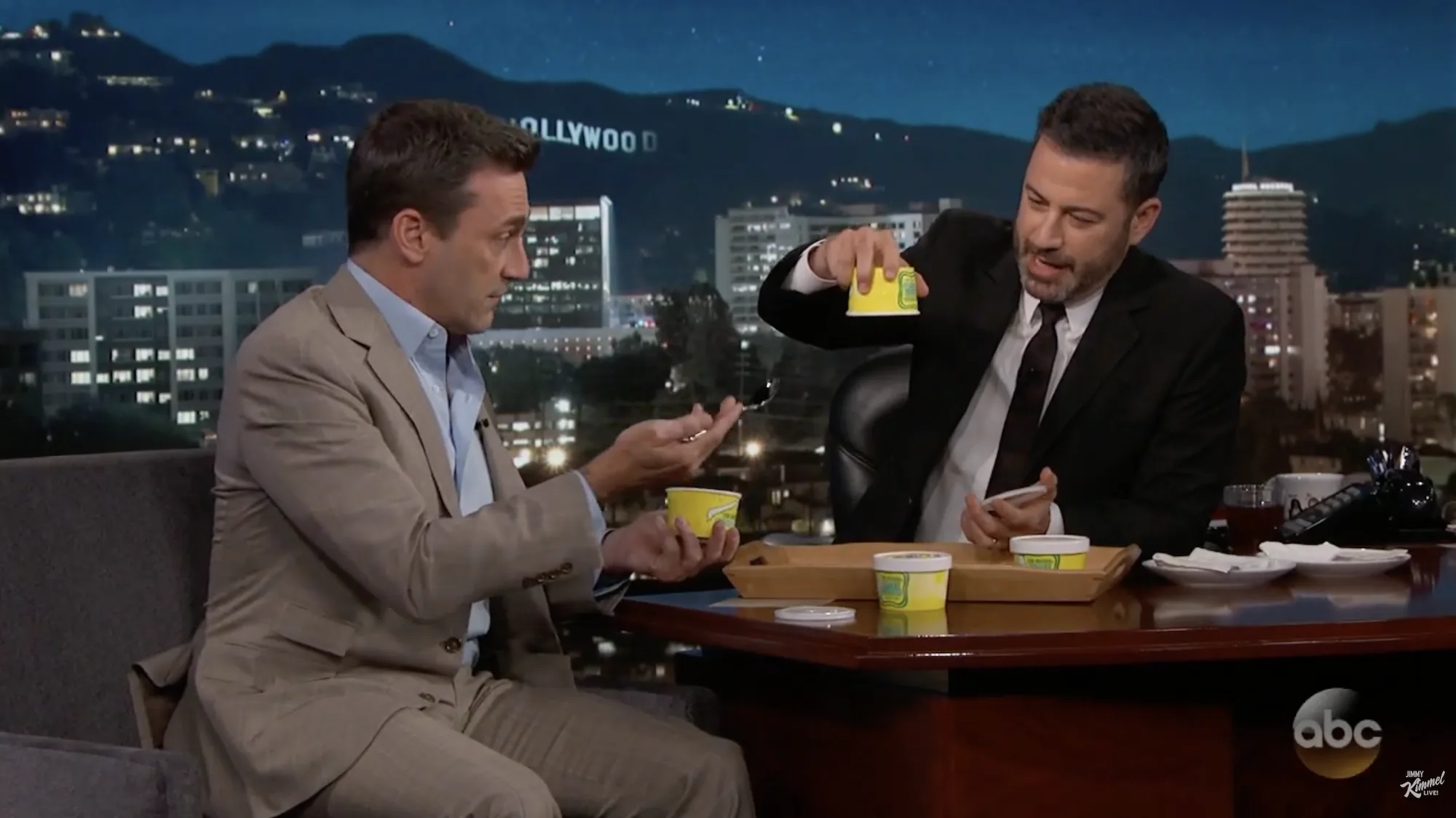
For now, funny man Jimmy Kimmel is off his Jimmy Kimmel Live late night show, which airs on ABC. That’s not unrelated to what’s going on down the dial: a proposed merger between the broadcast television groups Nexstar (parent of Fox 2 and KPLR 11) and Tegna (parent of KSDK Channel 5).
Get a fresh take on the day’s top news
Subscribe to the St. Louis Daily newsletter for a smart, succinct guide to local news from award-winning journalists Sarah Fenske and Ryan Krull.
Five days after the assassination of conservative activist Charlie Kirk in Utah, Kimmel took MAGA leaders to task for what he said was their disingenuous reaction to the murder—referring to their response as more finger pointing than grieving. (Watch the monologue here.) Two days later, Federal Communications Commission chairman Brendan Carr weighed in on The Benny Show podcast, saying the agency might take action against the host but suggesting that in the meantime, it would be easier affiliates did so on their own: “Frankly I think it’s past time that a lot of these licensed broadcasters themselves push back on Comcast and Disney, and say, ‘We are going to preempt—we are not going to run Kimmel anymore until you straighten this out.’ It’s time for them to step up and say this garbage … isn’t something that serves the needs of our local communities.”
That same day, affiliate Nexstar did just that, issuing a statement saying they wouldn’t be carrying the show for the foreseeable future. The two media companies distribute the show in dozens of markets, including San Antonio, Austin, and Connecticut. ABC later suspended Kimmel “indefinitely.” Not coincidentally, Nexstar wants to buy Tegna, a move that would locally put KSDK, Fox 2, and KPLR all under the same ownership, as well as create a broadcast behemoth. The move requires FCC approval.
Celebrities and non-celebrities being booted from platforms after controversial remarks has become routine, but what’s drawn the ire of free speech enthusiasts is that Kimmel’s suspension seems to have flown directly from the head of a government agency threatening a crackdown otherwise.
“A decision made by a private company is not generally going to be a First Amendment issue,” says Dave Roland, litigation director of the Freedom Center of Missouri, a legal nonprofit with a libertarian bent. “The problem is when you have the government in a position to apply pressure … All of a sudden, you’ve got a scenario where the decisions that are made by these private entities are not necessarily the decisions that they would make, but for the fact that you’ve got the government potentially applying pressure one way or another.”
Roland stressed this wasn’t the first time in recent memory that a private media company seemed to capitulate to President Donald Trump’s will—and is perhaps not the last. He cited a settlement CBS News paid to Trump in a case the news organization would have almost certainly won in court, but could have threatened their parent company’s hoped-for merger.
“Every time someone bends the knee, every time someone folds under this kind of pressure, it emboldens the government to push harder and farther,” he said.
Says Roland: “I don’t think the Founders ever anticipated that so many private decisions would be inherently dependent on governmental approval. The fact that we’ve set up a system that makes those decisions dependent on approval invites the very kind of abuse we’re seeing now.”
Missouri Senators Eric Schmitt and Josh Hawley applauded the Kimmel cancellation even as their Republican colleague Senator Ted Cruz compared Carr’s behavior to the gangster film Goodfellas. “That’s right out of a mafioso coming into a bar going, ‘Nice bar you have here, it’d be a shame if something happened to it,’” Cruz said on his own podcast.
While Kimmel is by far the most high-profile person to lose his job following comments about the Kirk killing, he is hardly the only one. Close to home, an educational aide in Jefferson County resigned her job after commenting on Facebook that she was celebrating Kirk’s death with a glass of wine. In Dent County, a sheriff’s deputy was placed on unpaid leave for posting that she refused to “feel sorry” for Kirk’s death. (Out in STL reports that the deputy is facing so much vitriol from the town where she’s lived for two decades that she and her husband are now planning to move to St. Louis.)
Vice President J.D. Vance warned on Fox News last week, “The First Amendment protects a lot of very ugly speech but if you celebrate … Charlie Kirk’s death, you should not be protected from being fired for being a disgusting person. If you are a university professor who benefits from American tax dollars, you should not be celebrating Charlie Kirk’s death and if you are, maybe you should lose your job or your university should face a loss of funding.”
The next day, both University of Missouri System President Mun Choi and University of Missouri-St. Louis Chancellor Kristin Sobolik sent messages out to university employees cautioning against social media posts that could cause “workplace disharmony.”
“Employees do not have unlimited rights to speak as citizens on matters of public concern,” read a statement included in both communiques. “If an employee’s speech can cause disruption such as workplace disharmony, impeded performance or impaired working relationships, the university’s interest in the efficiency of its operations may outweigh the employee’s rights of free expression.”
Roland stressed that he didn’t have any special insight as to what motivated university leaders to send out the mass emails, but that it seems possible it could have been a preemptive move to appease the state legislature or the governor out of concern that Jefferson City could take away university funding if a professor’s or a staff member’s reaction to the Kirk assassination runs afoul of elected leaders. “It may be that this letter from the president of the university was kind of a preemptive effort to show the legislature, ‘Hey, we’re, we’re looking out for this kind of thing. We’re going to be ready to take action if we need to.’ So it may have been a subtle indication to a legislature or maybe to the governor, I don’t know.”
Roland stressed that he’s not aware of any legislators who have threatened to pull money from the state university’s budget if they don’t crack down on professorial speech they don’t like.
“But,” he adds, “the White House has certainly paved the way for using the availability of public funds as a cudgel to force institutions of higher learning to conform their policies to the preferences of those in power. It is not crazy to wonder whether state officials might attempt to follow the same playbook here.”
*Those numbers refer to the local stations when they are received via rabbit ears, as well as our city’s penchant for preserving the names of things in amber.
Editor’s note: Ryan Krull is an adjunct professor at University of Missouri St. Louis. Also, a previous version of this story provided incorrect information about which affiliates issued statements last week saying that would stop carrying Kimmel’s show. The statements were made by Nexstar and Sinclair. We regret the error.