July 7, 2020.
Missouri Governor Mike Parson is at the White House. He’s wrapping up three and a half minutes of praise for President Donald Trump, who is seated at the same table just two chairs down, during their livestreamed Summit on Safely Reopening Schools. Trump lets the governor finish, then veers off topic to ask: “And you won’t be changing the name St. Louis, will you?”
Get a fresh take on the day’s top news
Subscribe to the St. Louis Daily newsletter for a smart, succinct guide to local news from award-winning journalists Sarah Fenske and Ryan Krull.
“No,” Parson says with a chuckle, “we will not be.”
“Thank you,” Trump says. “Thank you very—that’s very important.” He grins.

June 16, 2020 (three weeks earlier).
A petition appears on the website Change.org under the title “Change the Name of St. Louis.” Its sponsors claim that a new civil rights movement is underway. Triggered by the Ferguson unrest of 2014, the movement has succeeded in toppling “statues of racists, slavemasters, and Confederates from public spaces.” Locally, it has won the removal of the Confederate Memorial from Forest Park, in 2017, and then that of the Christopher Columbus statue from Tower Grove Park, that very morning.
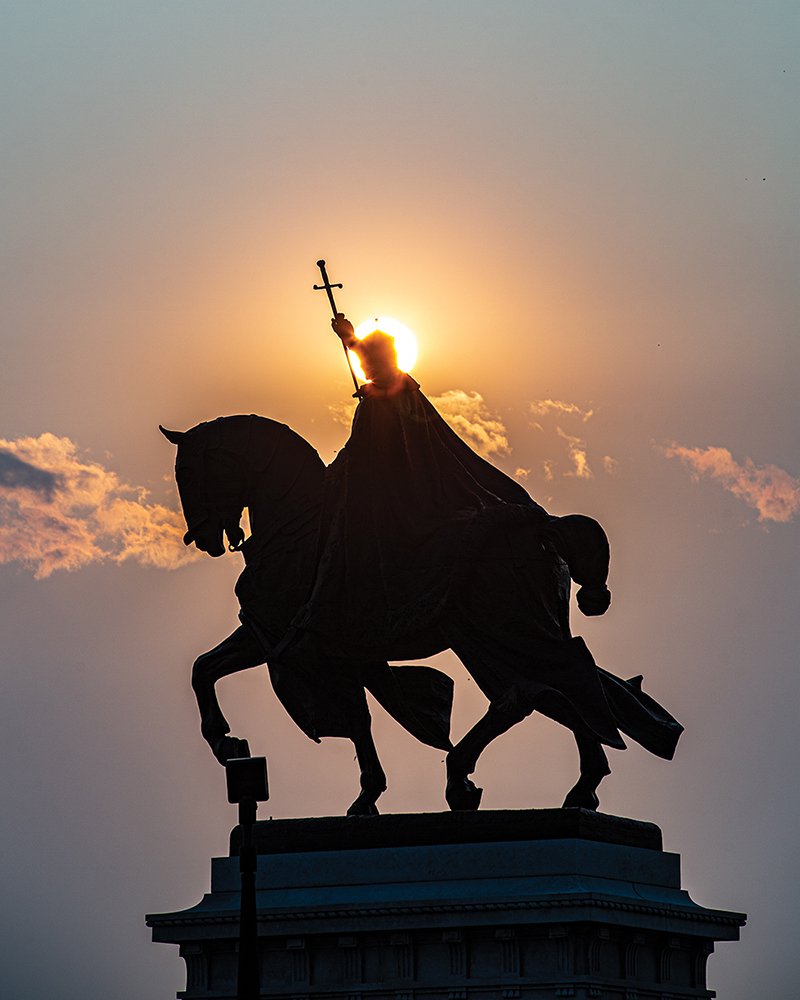
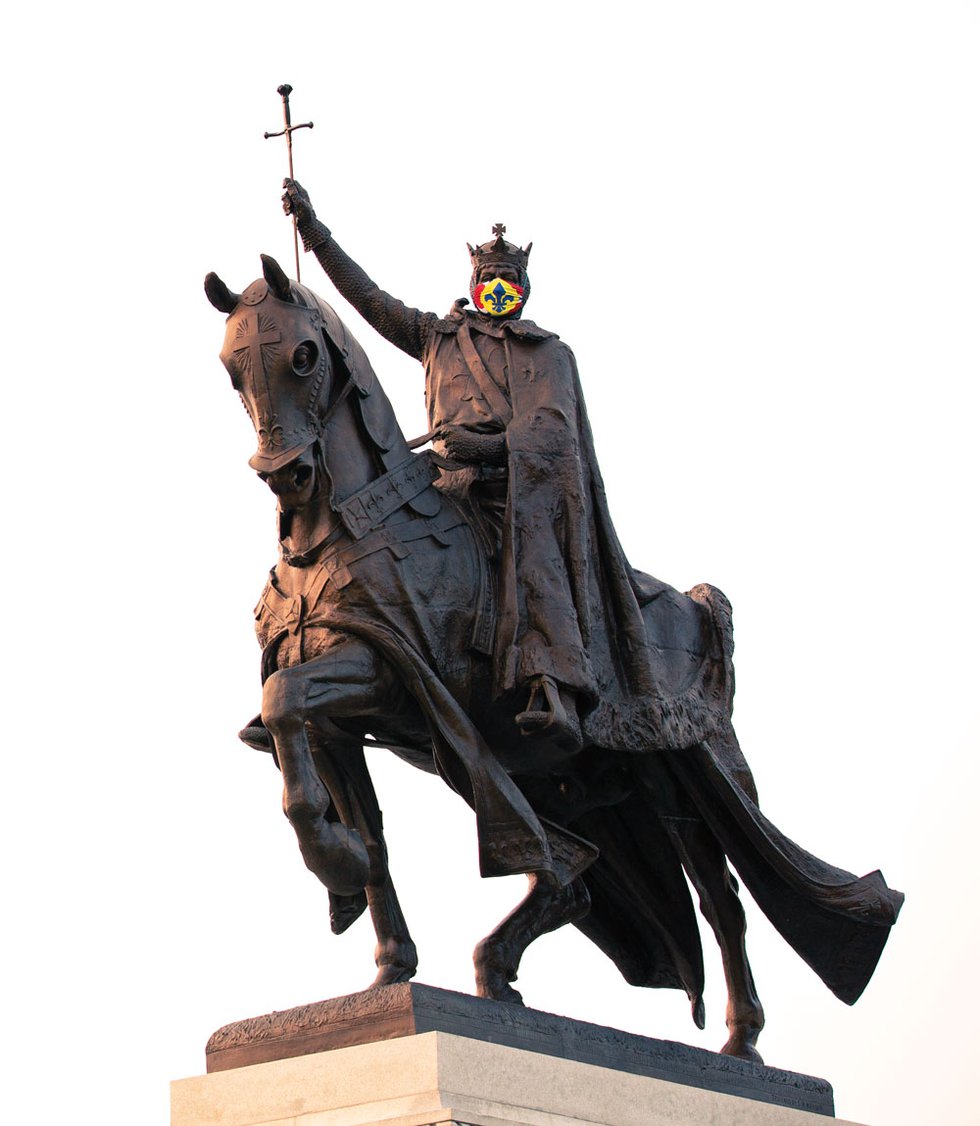
The moment has finally come, the sponsors declare, to reckon with the historical figure of Saint Louis: our city’s eponym, King Louis IX, who ruled France in the 1200s and was canonized by the Roman Catholic Church. A giant bronze statue of Louis on horseback presides over Art Hill, in front of the Saint Louis Art Museum. That statue needs to go, the sponsors write, and the city needs a new name.
The problem with Louis, according to the petition, is that he was a “rabid anti-semite” who persecuted the Jews, not to mention a “vehemently Islamophobic” king who “led a murderous crusade against Muslims.” Therefore, they posit, the commemoration of him is an “outright disrespect” to the metro area’s Jewish and Muslim communities.
The petition’s author is activist Umar Lee. He grew up, he says, on the wrong side of the law, but after reading Malcolm X he converted to Islam. He spent years on the East Coast ensconced in Salafism, a reactionary strain of Islamism. He then became disillusioned with it, returned to St. Louis, and adopted a more secular and largely progressive outlook. An autodidact with the trash-talking style of a pro wrestler, Lee has drawn press coverage over the years for fighting the arrival of Uber (which he panned as an ally of the “techno-libertarian right wing”) and for his unofficial mayoral bid in 2015.
In June, when protests erupted over a policeman’s killing of George Floyd in Minneapolis, Lee sensed an opening. He went to the home of his friend Ben Poremba, a native of Israel who’s launched multiple restaurants here, including Elaia, Olio, Nixta, and The Benevolent King. (They’d met by chance years earlier when Lee overheard Poremba speaking Hebrew in the Delmar Loop.) Both men harbor a longstanding discomfort with the saint-king’s record. “I said to Ben, ‘This is the right time to bring up Louis IX,’” recalls Lee. “Things that seemed impossible are becoming possible.”
So Lee posts the petition, adds Poremba as a co-sponsor, and then adds a third co-sponsor, Muslim activist Moji Sidiqi. It generates some buzz. It also rankles Jim Hoft, the blogger behind the far-right site Gateway Pundit. Hoft issues a call to Catholic and Christian men to meet at the statue, pray the rosary, and oppose “the continued assault on our country, our history and our culture.” Concludes Hoft: “We must make a stand. This can’t go on.” In response, Lee and his co-sponsors call on their own supporters to show up and “Stop Hate and Racism in Forest Park.”
The two camps converge at the statue on the overcast afternoon of June 27. They nearly fill the plaza. Police officers stand between them as a buffer. The pro-statue demonstrators—who include Hoft, members of the alt-right group the Proud Boys, some lay Catholics, and several priests—recite the Hail Mary aloud. The anti-statue protestors chant, hold aloft Black Lives Matter signs, chalk graffiti on the statue’s pedestal (e.g., “Genocide≠Saintly”). At one point, Lee cedes his bullhorn to the Reverend Stephen Schumacher. Clad in a black cassock, Schumacher perches over the crowd and defends Louis, arguing that he “willed to use his kingship to do good for his people,” but the protestors are shouting questions. Lee takes back the bullhorn.
The crowd thins out as people drift away. The sky darkens. So does the mood. Brief scuffles ensue. One protester, Terrence Page, punches a man he believes to be a racist skinhead. He will later be charged with assault—and tell KMOV he has no regrets. These developments wind up not only on local newscasts but also on Fox News and, therefore, on Trump’s radar.
And all this over a king of France who died 750 years ago.
In some ways, it’s no surprise. Many attendees likely processed the dispute through the lens of America’s rancorous politics in 2020, taking their cues less from an independent dive into the history than from a look at how their co-partisans were lining up. And on this issue, their alignment jibes with recent research by political psychologists: Folks on the left tend to be more open to the unfamiliar (such as a renamed city), whereas those on the right generally show a preference for order and tradition.
Yet the left-right prism only reveals so much here. Place names—or “toponyms,” to use the technical term—are the fruit of a primal human impulse. Nearly every language has them. Place names are so crucial to cooperation that governments at the highest levels have set up bodies to standardize them and resolve disputes. (In the United States, most flashpoints over the past half century have been racist or sexist names for land features, such as Squaw Peak in Montana.) Scholars Lisa Radding and John Western wrote in the Geographical Review in 2010 that when it comes to toponyms, “we sometimes are prepared to fight. We care about names differently from how we care about other words.”
Indeed, place names are like fossils—relics of the past, preserved today in our conversations, our text messages, our road signs. The meaning a name carries when it first circulates may fade with age, observes Tjeerd Tichelaar in a training manual issued by the United Nations Group of Experts on Geographical Names, “but somewhere inside its iconic image and sound, in a fossilized form maybe and only extractable by the trained eye, it remains there to tell its own unique story to anyone who can see through the scars of time.”
The name St. Louis is no exception. Dig into its past, layer by layer, and you begin to see why we’re talking about a French king, who he really was, and why we probably won’t be changing the name anytime soon.
October 4, 1906 (113 years earlier).
At Grand and Lindell, the sun warms the back of a police horse as it begins striding west, kicking off an epic civic celebration. Behind the horse rolls a carriage carrying Mayor Rolla Wells, and behind him, stretching 4 miles, is a parade of roughly 9,000 policemen, firemen, postal workers, and municipal employees, most on foot. There are “two gigantic avalanches of humanity banked on either side” of Lindell, the Globe-Democrat will later report, and as the city workers pass, their friends and acquaintances call out to them in “a continuous interchange of greetings, raillery and banter.” The cops give up trying to clear the parade’s path; traffic is a mess; vehicles clog the side streets.
The head of the parade at last arrives, around 2:30 p.m., atop Art Hill, where an estimated 25,000 spectators have gathered. Wells steps up onto a reviewing stage to hear a speech by David Francis, president of the Louisiana Purchase Exposition Company. On behalf of his fellow shareholders, Francis is about to bestow upon the city a large statue, at that moment draped with a large cloth.
Francis explains the meaning and motivation behind the statue—and religion, it turns out, has almost nothing to do with it. He gushes instead about the financial and educational benefits of the World’s Fair, which is still a fresh memory, and says that the statue “has been erected to mark the site where were congregated the representatives of the thought and progress of all ages.” It is “a present,” he says, “to the city of St. Louis in appreciation of the interest manifested” by the city and its residents in that huge undertaking.
He mentions Christianity only indirectly, and even then he connects it to America’s civic tradition: “The gallant crusader whose name our city bears, panoplied in martial attire, and holding aloft his inverted sword, forming the cross, the cause to which he devoted so much time and treasure and effort, might be regarded as typifying that period in the history of the Louisiana territory during which its early settlers braved the dangers and hardships of frontier life, and by courage and sacrifices advanced the outposts of civilization, felling the forests, tilling the soil, establishing homes and extending commerce. Right well did they perform their duty, it was a glorious heritage they left us.” (By “they,” he means white settlers, and by “us,” he’s likely not including the Black St. Louisans then living under segregation and certainly isn’t including the Native Americans pushed out long before.)
Francis urges public and private funding for an art museum, then ends his remarks. The mayor’s daughter steps up and pulls a cord. The cloth falls, unveiling the statue. “A mighty cheer [can] be heard for miles,” the Globe later reports. The band plays “Dixie.”
Mayor Wells gets the last word, and it’s brief. He calls the statue “a monument of remembrance to generations to come” of the hard work performed by the Exposition Company. He concludes: “Well may we all, as long as time permits, look upon the statue of St. Louis as our most cherished work of art.”
December, 1763 (142 years earlier).
Two men plunge their oars into icy dark water, rowing north along the edge of the Mississippi. They’re in a canoe fashioned from a hollowed-out tree trunk. Soaked with sweat and wintry weather, they keep looking to the left, scanning for an ideal place to set up a trading post.
The more mature man, Pierre Laclède (whose last name rhymes with “ahead”), is 34 years old. He’s a francophone, though his maternal language is Béarnais, the one spoken in the mountain village where he grew up, in the French Pyrenees, near the border with Spain. He comes from a distinguished family. As a second son, he was never going to inherit much, so he’s come to America to seek his fortune.
Laclède is not a rigid Catholic; he’s a man of the Enlightenment. (His uncle had even been a good friend of the famous philosophe Voltaire.) He owns books banned by the Church. Back in New Orleans, he has a life partner, Marie Chouteau, whom he can’t marry under Church law because her husband has abandoned her without officially divorcing her, so she and Laclède have been living in sin. Laclède has taken her 14-year-old son, Auguste Chouteau, under his wing and, now, on this grueling canoe trip. They heave upriver, flanked by woodlands and mystery.
They reach the mud gushing from the mouth of the Missouri River, then head back downstream to a spot that had seemed promising: a 2-mile-long limestone bluff on the west bank. They step ashore, climb to the top, look around. There are several earthen mounds, including one rising 34 feet above the ground. The people who built these structures are long gone, having dispersed centuries before. Their true name has vanished, too, but later they’ll be referred to as Cahokians. What the explorers are seeing is just an outpost of a much larger and equally uninhabited capital across the river.
Laclède wastes no time deciding: This is the place. For one thing, it’s lifted off the river and therefore immune to flooding. It’s also endowed with hardwood, a prairie, and a freshwater spring. He grabs a blade and notches some trees. Then the pair heads back downstream to Fort de Chartres, where they have five plankboats of equipment and supplies awaiting them.
Their goal is to erect a fur-trading post that will serve as a commercial satellite to New Orleans—and to get it humming tout de suite. The Crescent City badly needs an economic boost. Its royal sponsor across the Atlantic, France, has just ended a long war with Britain that’s sapped the city’s strength. Businesses are wrecked; inflation is soaring. Officials in New Orleans have therefore granted Laclède and a business partner exclusive rights to set up shop at the mouth of the Missouri to tap into the vast wilderness there. This is all happening without prior approval from the royal government at Versailles—a sort of “rogue colonialism,” as one historian will later put it. Still, the trading post must be situated on the west bank: Under the treaty that has ended the war, all the French land east of the mighty river, including the Illinois country, now belongs to the Brits.
So in February 1764, as Laclède is busy making other preparations, Chouteau returns to the site above the river where they’ve notched the trees. He’s brought a work crew with him. They construct a warehouse and, later, huts on scaffolds raised 6 feet off the ground to offer protection from the prowling wildlife.
In April, Laclède—having negotiated a trade alliance with the Osage Indians—makes it back to the site and finally gives it a name: St. Louis.
There’s nothing unusual about this choice, says Frederick Fausz, author of Founding St. Louis and retired history professor at the University of Missouri–St. Louis. In the age of European exploration, he notes, French colonialists were naming all kinds of things St. Louis—even the Mississippi itself, which they called le fleuve St. Louis.
But in this case, it may be a political calculation. The French monarch of that moment, Louis XV, considers his North American holdings a boondoggle and a “useless wilderness.” The king’s lack of interest had become crystal clear in New Orleans when he declined to send much help during the war. So, Fausz believes, Laclède—ever the smooth diplomat—likely names his semilegal trading post after the king’s patron saint to flatter the monarch and maybe gain his favor and protection.
Yet if that’s true, the gesture proves futile. Years earlier, unbeknownst to Laclède and everyone else in New Orleans, Louis XV had secretly ceded all of France’s land west of the Mississippi to his cousin King Carlos III of Spain to prevent it from falling into the hands of the British. Therefore, it appears, Laclède has in effect christened his site St. Louis to flatter a monarch who doesn’t even rule the territory anymore.
Would Laclède have chosen another name if he’d known the truth? Probably not, opines Fausz. He would’ve felt no pressure to ingratiate himself to the Spanish, who didn’t even arrive to administer their newly gained territory until several years later. But it’s impossible to peer directly into his state of mind with the evidence that has survived. Much of what we know comes from Chouteau’s journal, which isn’t comprehensive. If Laclède kept notes, they’ve not turned up. Fausz suspects that he never took any. “Because they were violating so many laws,” Fausz posits, “they didn’t put a lot on paper, but I wish he’d written things down.”
November 29, 1226 (537 years earlier).
A 12-year-old boy is crowned king. His name is Louis. There, inside the unfinished Reims cathedral, he feels the weight of his royal coat and crown, smells the incense, listens to the chants. Adults have prepared him for this. His father has been dead two weeks, but his strong mother, Blanche de Castille, is guiding him through the endless pageantry. As the late French historian Jacques Le Goff writes in his toaster-sized 1996 biography Saint Louis, the boy-king certainly will keep “a weighty and poignant memory of these hours, of these days when so many events, countrysides, decorations, and gestures paraded in the fading light of short, late autumn days.”
The boy inherits the richest and most populous kingdom in Christendom. It encompasses about 10 million subjects, nearly all peasants, about whose joys and sufferings we know little today. The king lives in the walled capital of Paris, where laborers are stacking the stones of the Notre Dame cathedral into the sky, and students at the fledgling Sorbonne, on the left bank of the Seine, study theology. The streets are shared by beggars, the bourgeoisie, and everyone in between, including those who fascinate Louis the most: the mendicant friars. They wear simple robes, live off charity, and preach the word of God.
Indeed, one of the first acts by the young king and his mother is to build a monastery for the Cistercian order. Louis travels to the site with his brothers and friends. He grips the handles of a stretcher holding stones for the construction and helps carry it—a chore far beneath his station. He orders his entourage to join in. When they goof off, he tells them to stay silent like the monks.
Louis is exasperating to some people. At age 20 he marries 13-year-old Marguerite de Provence. Theirs is a diplomatic union. Louis doesn’t trust her political allegiance, so he restricts her freedom by forbidding her to accept gifts or even to employ servants to care for their children. She considers him “divers,” which translates loosely to “bizarre” or “difficult.”
Louis is known to have soft dove eyes, and he grows to be a head taller than most Frenchmen. He earns a reputation as a military leader while battling the English and tamping down a rebellion in what’s now the South of France. (In that region, the Church conducts an inquisition to bring Cathar heretics into the Catholic fold; royal forces provide the muscle for this effort, burning some stubborn Cathars at the stake, but historians note that Louis plays no role in this.)
In battle, Louis contracts a disease that will plague him over and over: dysentery. He gets it again in 1244, and this time it’s so bad that an attendant thinks he’s dead and wants to cover his face with a sheet. But he mutters a vow that if he recovers, he’ll go on a crusade. Louis does recover, and he honors his vow: He will head to the Holy Land.
Muslim forces have just invaded Jerusalem. They’ve slaughtered Christian residents, torched churches, and shrunk the gains of previous crusaders to a clutch of ports on the coast. Louis’ goal is to reverse that reversal, thereby restoring Christian authority over the land where he believes Jesus walked and died and rose again.
Is such crusading a righteous defense against Muslim aggression, or is it itself an act of aggression? According to history professor Brian A. Catlos of the University of Colorado, it’s neither. In his book Infidel Kings and Unholy Warriors, Catlos argues that Latin crusaders are minor challengers from a “rustic and underdeveloped” land on the outskirts of the Islamic world, which at the time is huge and highly sophisticated. Catlos finds that the Mediterranean of the period is a complex brawl in which Christians and Muslims ally against common adversaries—and that the worst atrocities are committed between militants of the same faith.
“These were violent times,” Catlos writes. “Warfare, raiding, piracy, civil war, enslavement and gruesome capital justice were part of people’s daily lives.” He observes that although religion may serve as a justification for these wars, it’s rarely the true cause; to a large extent, the real triggers are “power, lust, greed and fear.” Yet Louis, Catlos writes, is a “fanatical Catholic.”
Louis doesn’t want to just retake Jerusalem. As Princeton University history professor William C. Jordan points out in his book The Apple of His Eye, Louis and his fellow Catholics believe that the Apocalypse is at hand, and they yearn for mass conversions to prepare the way. One way to convert is to crusade. Jordan points to strong evidence that Louis will insist that if his commanders encounter a Muslim man defending his family, they should take him captive, if possible, instead of killing him, and should never slay Muslim wives and children. This policy, theorizes Jordan, will be for Louis “the initial step in proselytizing entire Muslim families.”
Louis’ project gets a lukewarm reception at best. By 1244, crusades are seen by many Europeans as outdated. Other Christian rulers decline to join him. His mother begs him not to go, but he’s unmoved. He designates her head of state in his absence. Before leaving, he attends the dedication of the Sainte-Chappelle, a masterpiece of Gothic architecture in Paris. He has commissioned it to house holy relics that he’s purchased, at enormous expense, to infuse himself and his people with extra holiness.
In August 1248, he sets sail with thousands of horses, knights, foot soldiers, and crossbowmen—perhaps as many as 20,000 men in total. They regroup in Cyprus, then launch for Egypt.
It’s a debacle. The crusaders seize the town of Damietta but then fall prey to illnesses that blacken their skin and rot their gums. They end up surrendering to the Egyptians, who kill the wounded and hold everyone else hostage. Queen Marguerite cobbles together a huge ransom to free them. (Famously, Louis grows incensed upon learning that his team has cheated the Muslims out of part of this ransom; he believes his word should be kept.)
The Egyptians free the king and some advisers but are slow to release the troops. Louis travels to the Christian port of Acre, north of Jerusalem, where he spends several years fortifying Christian territory and monitoring from afar progress toward his troops’ release. News of his mother’s death arrives, racking him with grief. France, he realizes, has no strong leader. He decides it’s time to sail back home. He also, according to Jordan’s book, arranges for as many as 1,500 Muslim warriors, slaves, and poor people to be baptized, brought to France, and resettled as free Christians under his sponsorship.
While sailing home with his entourage, Louis discovers his brother playing backgammon on the boat. It’s a game of chance and therefore sinful. He angrily seizes the board and tosses it into the sea—a preview of a changed king.
Louis is not the same man back in France. He thinks his crusade failed because of his own sinfulness. To purify himself and make penance, he engages in some next-level piety. He wears coarse clothing and accepts flagellation with an iron chain. He dilutes his wines and sauces. He abstains from conjugal relations with the queen and avoids laughing on Fridays. He ruins his health by waking in the wee hours to hear prayers. He stays humble by sitting on the floor when chatting with people, and he dignifies his servants by addressing them with the formal vous, the more respectful form of “you.”
The king spends large sums on the destitute and sick, on hospitals and nunneries and homes for women trying to leave sex work, on craftsmen who can’t work anymore. He invites the hungry into his own bedroom and serves them food himself; there are stories of his hand-feeding cooked fish to a blind man and salty chicken to a leprous monk. On Saturdays, he washes the feet of the poor. He does this in secret, not only out of humility but also to avoid the criticism of high society, who find all this wildly inappropriate.
“The king’s behavior disturbed people,” wrote Le Goff. They likely saw him as a “a scandalous hybrid”—an ascetic “monk-king” or “friar-king.”
The deepest impact, though, comes from Louis’ efforts to purify his kingdom. Some of these measures look, in 2020, like theocratic tyranny. By edict, he bans games of chance, ostracizes sex workers, and outlaws blasphemy. (That blasphemy ban, by the way, is no joke: The king punishes one foul-mouthed Parisian of the middle class by having his lips branded with a hot iron.) But other reforms look today like good governance: Louis declares that royal officials may neither accept gifts nor give any to their superiors, and they may no longer jail anyone for being in debt to the crown. Further, he orders them to render justice without favoritism and to assume a defendant’s innocence until he’s proven guilty.
Louis doesn’t stop there. He dispatches a squad of enquêteurs (ombudsmen), many of them friars, out into the realm to hear commoners’ complaints and offer redress. Especially in the south, where just years earlier the crown crushed a rebellion, the friars seek out widows and orphans, let them speak about their hardships in the vernacular, and make them whole. The friars do this, Jordan finds, “with sincerity and verve.”
Louis formalizes the justice system through a body called the parlement (which sounds legislative but is actually judicial). He travels the country hearing cases himself. There’s an image of him, now iconic in France, in which he’s outside the royal residence at Vincennes, seated at the foot of an oak tree, listening to his subjects’ complaints and rendering justice. Louis earns such a reputation for being above petty politics, in fact, that other European rulers seek him out as an international arbiter; on a dozen occasions, he resolves their disputes.
Yet one community has reason to view him as a despot: Jews, of whom 50,000 to 100,000 reside in France. Louis appears to be inspired by widespread myths that Jews killed Jesus and that they ritualistically murder Catholic babies. According to one witness, the purity-obsessed Louis says Jews must not be allowed to “infect” France with their “venom” and that they should either leave or halt their “filthy practices,” by which he means usury, or lending at interest.
By the 1260s, Louis has already seized Jewish assets to help fund his crusade, and also canceled debts that Christians owed to Jews. He has further ordered roundups and mass burnings of the Talmud—a book considered at the Sorbonne to be blasphemous to Jesus, not to mention a hurdle to converting Jews. “That does not excuse it,” writes Tom Madden, a history professor at Saint Louis University who otherwise defends Louis in the Catholic magazine First Things. Louis’ burning of the Talmud, Madden writes, “is indefensible and certainly constitutes persecution.” Furthermore, during the king’s stint in the Holy Land, he had ordered Jews expelled from his kingdom, though he later clarifies that he had meant only usurers and allows some Jews to return, offering them restitution.
In 1269, Louis enacts the wishes of the Vatican and obliges Jews to wear a scarlet wheel on their clothes. It’s a chilling precursor to the yellow star that will appear centuries later in the Holocaust. Today, scholars debate whether racism, as we now understand it, is the driver of these policies, notes Northwestern University’s David Shyovitz, a historian of the Middle Ages. But they clearly derive, he says, from Louis’ ability and willingness to put church teachings into practice: “They don’t stand in contrast to his sanctity. They’re part of his sanctity.”
In the late 1260s, Louis decides to go on yet another crusade. He appears to believe that the sultan in Tunisia is susceptible to conversion and may give Christianity a foothold. So Louis and his troops attack Tunis, where, once again, they’re thwarted and beset by sickness. Louis’ own son dies. He himself is flattened by dysentery.
A legend will spread among North African Muslims about what happens next. In this tale, embellished over time, Louis is a good man, willing to sacrifice his life to convert his enemies. But suddenly, at Tunis, angels reveal to Louis the truth: that Islam is the one true faith. So he absconds from his camp, becomes a Muslim, and remains in Tunisia.
In Jordan’s view, this oral tradition “does suggest that Muslims retained the memory of precisely what their crusader opponents—especially Louis IX—had been up to. To this extent, they have been more perceptive than many modern students of his reign.”
Perceptive or not, it’s just a legend—and not really how Louis’ story ends.
Sapped by diarrhea, distraught, and lying on a bed of ashes, Louis dies outside Tunis on August 25, 1270. His men boil his body, extract the entrails and bones, and send them to Paris. This journey, at least in the Church’s telling, occasions the first of the 65 miracles that will bolster his sainthood. One purported miracle involves a mother who approaches the funeral cortege with her 8-year-old boy. He has a goose egg–size tumor under his left ear. She’s sought out doctors, she explains, but none can bring any relief. As the story goes, the boy touches his tumor to the reliquary holding the king’s remains and his tumor bursts, releasing “filth,” without visibly causing him pain. Praise be!
By this time, canonization has morphed into a legalistic and costly process, writes Dartmouth professor Cecilia Gaposchkin in her study The Making of Saint Louis. It requires a “powerful lobby with deep pockets.” France has both. Thus Louis becomes a saint in 1297 through a process that is highly political—and useful to the crown. His sanctity will, in the 1600s, equip Louis XIV, the “Sun King,” with an argument for his divine right to rule. Saint Louis’ image grows so intertwined with the French monarchy, in fact, that he is burned in effigy in 1793, the year French revolutionaries launch their Reign of Terror, erect their guillotines, and behead Marie Antoinette and Louis XVI (a distant descendant of the saint).
Yet somehow, in the deeply secular France of today, Saint Louis has survived as a public hero of sorts—at least among those born before the early 1980s, who, as schoolchildren, learned history through key figures and dates (as opposed to today’s focus on broad themes and trends). Professor Marie Dejoux, a medievalist at Paris-Sorbonne University, explains that for people of her generation and older, Louis is, above all, the king under the oak tree, dispensing justice.
“It’s the image of a just king who adjudicates in the same way for the rich and the poor, personally and without intermediaries,” says Dejoux. “This image has even come to symbolize the exercise of justice in France, be it by a king or by the Republic.”
In 1970, when the Republic celebrated the 700th anniversary of Louis’ death with months of expositions, concerts, and events, some activists in the south splashed red paint on Louis’ statue in Aigues-Mortes and passed out leaflets accusing him of cultural genocide for having wiped out their dialect. (One mini-protest even led to a scuffle between activists and a priest.) The Jewish community pushed back, too, Dejoux says. So in 2014, the year of Louis’ 800th birthday, there were expositions at the Sainte-Chappelle and the darker sides of his reign were discussed openly. There was a whole colloquium, for example, on his Jewish policies.
Professor Xavier Hélary of the University of Lyons says both sides of the political divide in France have found in Louis something to admire: The right loves his piety; the left appreciates his concern for the weak and aggrieved. This helps explain why, for example, Le Goff’s 1996 biography became a bestseller, why magazines love putting out Saint Louis issues, why the 2014 expositions were such a success. Jokes Hélary: “Saint Louis sells!”
Present day. The Gateway City isn’t alone in its toponymic soul-searching. Many folks in Columbus, Ohio, for instance, now wish to ditch their reference to the 15th-century Italian explorer. Some would even prefer to honor their native son and celebrity chef Guy Fieri by changing the city’s name to his catchphrase, Flavortown.
The trouble with naming a city after any human being isn’t merely that nobody’s perfect: It’s that “perfect” is an ever-shifting goalpost. Umar Lee, the activist trying to rename St. Louis, half-joked in the Riverfront Times in 2018 that voters should get out in front of history and rename the city Obama. But imagine if, in 200 years, those who today eat meat (as Obama does) are universally viewed with disgust. Will we need yet another replacement?
This is why the geographical names authorities of both the U.N. and the U.S. disapprove of naming land after individuals unless they’ve been dead at least five years: Our views of people change. A more enduring solution, it seems, would be to pick something like Confluence, another of Lee’s suggestions. It’s hard to imagine being angry at rivers.
In any case, a name change wouldn’t be enacted by an administrative board. It would be a feat of politics. Chuck Hatfield, an attorney at Stinson with deep experience litigating political issues, says it’s not obvious how it would play out. If 60 percent of city voters said yes to amending the city charter and recognizing a new name, would that be sufficient? Or would the courts decide that the name-changing process in state statute, which is different, be adhered to instead? Then there’s the possibility of pushback from the Missouri General Assembly. Legislators could preempt the city’s ability to change its own name, just as they preempted the city’s freedom to set its own minimum wage. Another complication: St. Louis was already a city in 1820, when Missouri adopted its Constitution. Therefore all its provisions that refer to St. Louis may need amending, Hatfield says.
“It’d be expensive,” he predicts.
Certainly it would require a groundswell of political support that, for now, isn’t there. Lee’s petition on Change.org had fewer than 1,100 signatories at press time. (By contrast, another petition on that website, demanding police body cameras, garnered 137,000 signatures.) Mayor Lyda Krewson has called it a “distraction”; her spokesman Jacob Long tells SLM, “I’m not going to spend any time speculating or elaborating on what seems like an extremely far-fetched idea. We are not changing the name of the city.”
The lack of support may derive from a linguistic phenomenon. In 1764, when Pierre Laclède named his settlement, he may have been thinking about the saint-king of his homeland—that is, the link between the words “Saint Louis” and the historical figure was “transparent,” as linguists say. But over the centuries, that link has become “opaque,” such that people invoke the place name without thinking of him. This happens, according to Radding and Western in the Geographical Review, because “the toponym picks up new meanings based on the ever-changing community the name comes to represent. The community, as it were, acts back on the name, altering its meaning yet again.”
This is the highest hurdle that Lee and his co-petitioners must clear: that the place name St. Louis has accrued its own distinct meaning. They claim in their petition that preserving the name is an “outright disrespect” to Muslim and Jewish residents. But thanks to linguistic opacity, nobody means any disrespect when saying it or writing it. Those who support a name change, then, are taking offense when none is intended. So they’ll have to reunite, in the popular mind, the toponym with the saint-king, or—in linguistic terms—make it transparent again, to gain leverage.
And even then, reasonable minds may differ over whether, on balance, Saint Louis deserves lionization—the same debate that’s roiling over our country’s slave-owning founders George Washington and Thomas Jefferson.
Ghazala Hayat, a SLU physician and member of the Islamic Foundation of Greater St. Louis, said in a written statement that her group understands the petitioners’ “sentiments and pain,” but she stopped short of endorsing the petition. “The removal of the statue will not change the history,” she wrote, “[but] the spotlight on this issue should be an opportunity for us to start listening to each other.”
Maharat Rori Picker Neiss, executive director of the Jewish Community Relations Council, says she’s heard her co-religionists make offhand references over the years to Saint Louis’ oppressive policies. However, she’s detected a reluctance among them to speak out during this Black Lives Matter moment. “We didn’t want to distract from that,” she says.
Poremba, a co-sponsor of the petition, feels that reluctance, too. He’s not anti-Catholic, he insists, and unlike Lee, he doesn’t want to see the statue destroyed. He believes it has artistic value and should be relocated to archdiocesan property. His goal has been to spark debate and prod Catholics into acknowledging their history. “All I wanted to hear,” he says, “was a recognition that there is some truth in what I say.”
Catholics account for a quarter of the metro area’s population, according to the Pew Research Center. (Protestants make up the majority; Jews and Muslims combined, 2 percent.) Some Catholics look back with nostalgia at Saint Louis’ reign, a time when church and state were fused together and faith permeated public affairs. But these integralists, as they’re called, are a minority.
What do most Catholics think? SLM hasn’t found polling on the question, but in June, the Archdiocese of St. Louis weighed in, observing in a written statement that “For Catholics, St. Louis is an example of an imperfect man who strived to live a life modeled after the life of Jesus Christ.” The statement underlined the king’s good works, eliding his Jewish policies. The archdiocese drew criticism for this from the writer Eve Tushnet, a Catholic convert from Judaism who wrote in the Jesuit magazine America: “If there is one thing a church facing a catastrophic sexual abuse crisis needs, it is willingness to admit the sins of our heroes. If our first instinct is to defend ‘the church,’ not to defend the truth or the victims, have we really learned the lessons of the abuse crisis?”
Some Catholics have begun to pray at the base of the statue in Forest Park—ironic, since it’s city-owned. John Klein, an art history professor at Washington University in St. Louis, points to another irony: The protesters are the ones who’ve aroused awareness of its Christian content. He adds: “I do feel confident in saying that the principal intent of the statue was to commemorate the city of St. Louis, and not to glorify Christianity, but let’s be clear: Since Louis’ goal was to crusade, that can’t be ignored.”
Other cities have tried to reckon with their pasts while also preserving their statues. One solution: add a plaque that explores the history. Another is to build a counter monument, akin to the slave-ship sculpture outside South Carolina’s statehouse. In St. Louis, Klein sees further possibilities for the Information Age: symposia on Art Hill, or even a work of temporary performance art.
“Perhaps the age of the statue has passed,” he suggests, “and a better response would be not a big physical thing, but rather, information that puts the statute in appropriate contexts.”
William Chester Jordan at Princeton University—the unofficial dean of Saint Louis studies in the U.S.—feels the preservationist impulse. In 1306, he explains, Saint Louis’ grandson Philip IV expelled Jews from France. The only traces they left behind, he says, were spaces called Streets of the Jews. These names were widely replaced in the 20th century out of embarrassment. But now, Jordan has discovered, “most French people no longer know that Jews once lived among them in the Middle Ages, instead of wondering (and thinking about) why their villages and towns have such names. There is no awkward conversation, like that of a child to a parent, ‘Why is there a Street of the Jews?’ Everything is forgotten. Even the most important things, like the answer ‘I don’t know, my child. I’ll try to find out.’”
Adds Jordan, “Statues, place names, and the like can be opportunities for reflection.”
Rori Picker Neiss is certainly interpreting it that way. She’s working with the Archdiocese to organize a panel discussion with members of the three Abrahamic faiths to delve into Louis’ legacy.
“I think there’s something healthy and beautiful about having this opportunity to grapple with a person,” says Picker Neiss. “Here you have an individual who is a hero in one story and a villain in another story, and both of those can be absolutely true stories. I love that we’re having this conversation.”