When Letecia Seitz first moved to the United States from Mexico City, 20 years ago, she felt isolated. She sought work with the Mexican consulate as a way to connect with other immigrants and found many experiencing the same issues. “We can’t navigate the system,” she says, “because we don’t know the system here.”
Several years later, she met Fredy Chávez, who’d moved here more than 35 years ago from Juárez, Mexico. Together, the two created the area’s first Latino-run grassroots organization.
Get a fresh take on the day’s top news
Subscribe to the St. Louis Daily newsletter for a smart, succinct guide to local news from award-winning journalists Sarah Fenske and Ryan Krull.
Latinos en Axión got its start when women from the community asked Seitz where they could go to learn English. (Seitz recalls recently reuniting with a former student at a community party: “She told me that she couldn’t continue classes because they were too far but that she learned enough English to help her get around.”)
The organization’s work grew to include Plaza Comunitaria, a program that provides opportunities for adults to receive a high school diploma. Many of the students “couldn’t afford to go to school,” says Seitz. “Some don’t know how to write or read, and some people didn’t even know how to hold a pencil.” The students are taught a Mexican curriculum and awarded a diploma by the Mexican secretary of education. One young man who hadn’t finished grade school, for example, gradually worked his way through the program and earned his diploma.
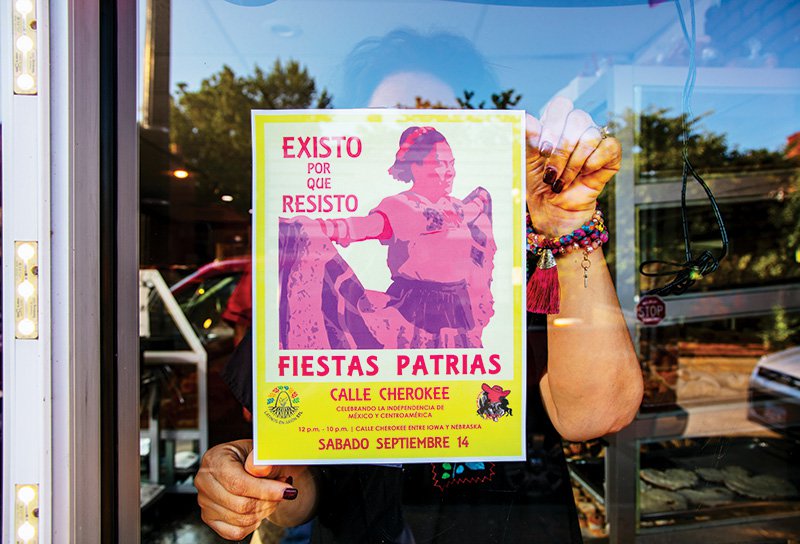
On September 14, Latinos en Axión celebrates Mexican Independence Day with Fiestas Patrias on Cherokee Street. There will be food, dancing, and an opportunity for others to “get to know the community,” say Seitz.
Over time, the grassroots organization has expanded its efforts in other ways, working to provide Latinos in St. Louis with vital resources. In 2015, with support from the Missouri Foundation for Health, Latinos en Axión helped educate uninsured Spanish-speaking community members about how to enroll in the Missouri Health Insurance Marketplace. The group reached out through social media, health fairs, churches, soccer games, and other events.
Seitz and Chávez also launched a digital radio station, airing a program called Know Your Rights. “We’re just trying to inform: where to go, what to do,” says Chávez.
As debate about immigration reform has intensified, they’ve advocated for the rights of immigrants and refugees.
“People are scared,” says Seitz. “They just go to work and then go home—they don’t even go to a mall.”
“People say, ‘Why fight it?’” says Chávez. “‘We are just working and saving all we can, so we can have it when we go.’”
The organization has worked with local churches to provide support, offering workshops to help youth deal with bullying, the separation of families, and questions of faith.
“We have a social justice ministry that services the community in church but also for the [rest of the] community to have a place to feel safe,” says Seitz.
Such partnerships are important to the organization’s success, says Seitz: “We are the brain and the heart of Latinos en Axión, but we need a lot of help.”
The pair’s work continues to evolve as needs change. Seitz and Chávez never know what the next day will bring, but they keep their phones nearby around the clock, ready to assist.
“We try to empower our community in the best way,” Seitz says.