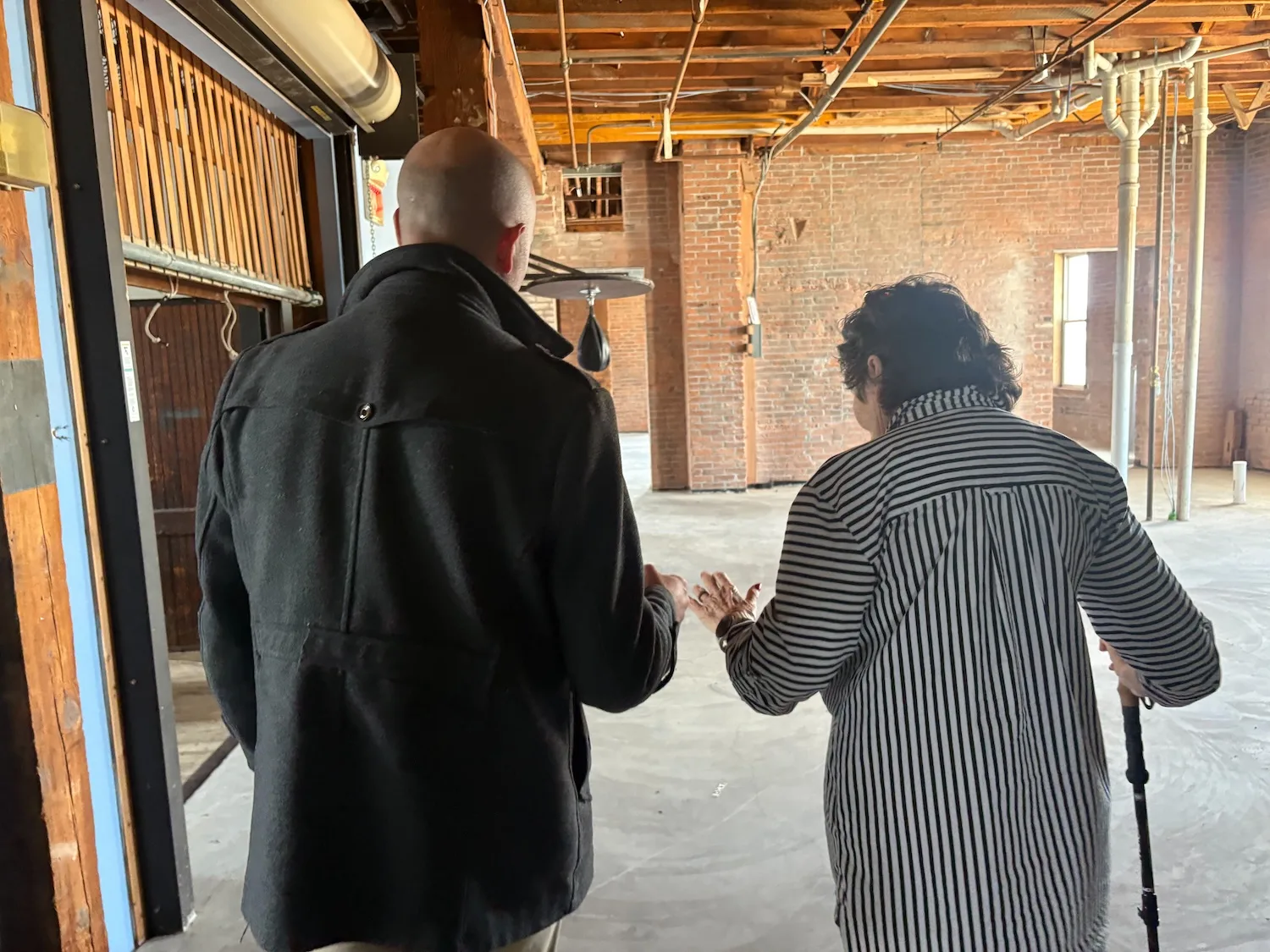
Joan and Wayne Long—the couple who opened their unique, massive home as an emergency shelter during the past three winters—have spent the past few weeks preparing to move. After more than two and a half decades in the former A. E. Schmidt Billiards factory, the couple is transitioning to a much smaller, more manageable apartment downtown.
Their former domicile, one of the only brick buildings remaining in the industrial St. Louis neighborhood of Kosciusko, has a three-story red brick wing, where the Longs have lived since 2000, and a one-story space to the west, which they allowed a nonprofit provider to open as an emergency homeless shelter in the winter of 2024. The couple accessed their home through an ancient pulley-and-switch-operated freight elevator, which requires users to time their alignment with their desired floor manually, and lift heavy wooden doors both to get in and then get out once they’ve reached their desired floor. Joan often invites guests to operate the elevator, quipping, “What other opportunity will you ever have to do this elevator?”
Get a fresh take on the day’s top news
Subscribe to the St. Louis Daily newsletter for a smart, succinct guide to local news from award-winning journalists Sarah Fenske and Ryan Krull.
When SLM visited Joan in the midst of their move on May 22, the pair was down to their final days in their 53,000 square-foot multi-story complex, which had become too difficult to manage for a couple of their age. Wayne’s diagnosis with Parkinson’s disease in 2018 forced the Longs to downsize, selling off parts of their business that included rental properties and a farm tied to the couple’s catering business.
As it came time to leave, Joan was unsentimental about their goodbye.
“I think I’m looking forward to it, because it’s going to make life so much easier,” she says. “Buildings take a lot of time and money and all that, at this point in my life, I don’t need to be doing that.
“It has been sort of bittersweet, but it’s just stuff, you know.”
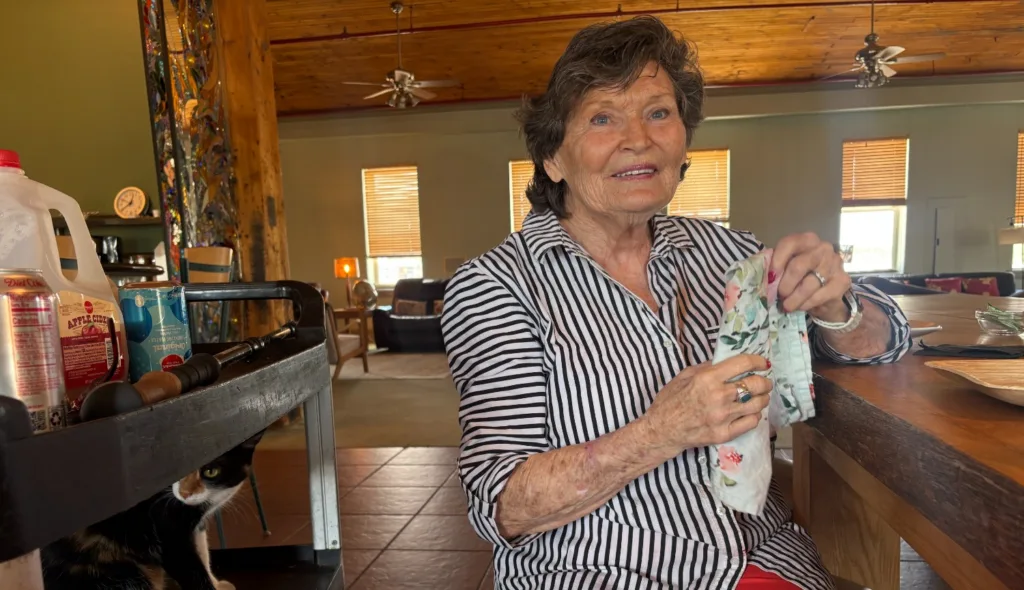
In the time they spent at the compound, though, the couple took every advantage of the space. Not only did they open their home as a shelter, they allowed visitors to come through, hosted a crew filming a Nike commercial about indigenous athletes, and opened up the space to family and friends.
“At Thanksgiving we always had a big throwdown for people who didn’t have places to go, so we just bring them here,” she says. “There might be somebody sitting with somebody from a totally different background.”
Joan spent more than 20 years as a Trans World Airlines flight attendant, but ended up starting a lucrative catering business, Patty Long Catering, with a friend and fellow flight attendant after TWA flight attendants went on strike in 1986. “It was the weirdest thing, we got really big jobs, like from The Muny, and were still working out of our houses and getting our kids to help make cake and stuff,” Joan says of the early days of her catering business.
The Longs moved into the brick industrial building on Sidney Street in 2000 as the catering business was growing. At its peak, she says, the compound could have as many as 30 staffers roaming around preparing catering orders for outside clients, or events in the large banquet hall (formerly a billiards table showroom). Their son was 10 years old when they moved in and spent several formative years in their bustling catering business and home, surrounded by industrial structures and no residential neighbors.
“We had a lot of employees downstairs with catering, and we had trucks leaving and trucks coming in,” Joan says. “I know he had a go kart that he would take up the river and down, and trucks are everywhere. He was like 11 and going on this go kart.”
They retrofitted their wing containing their home extensively, sandblasting the floors and ceilings, adding a thick layer of concrete to level the top floor (and cover up clear burn marks from the building’s pool factory days). They replaced dozens of windows, and added features including a commercial-style kitchen, a glass block island, and a unique tile mosaic in the kitchen designed by Sharon Von Senden, the artist responsible for many of the mosaics that adorn City Museum.
Now they’re downsizing, leaving many of those things behind. But not everything.
“It’s gonna stay,” Joan says of the kitchen’s fixtures. “It’ll be good for somebody.”
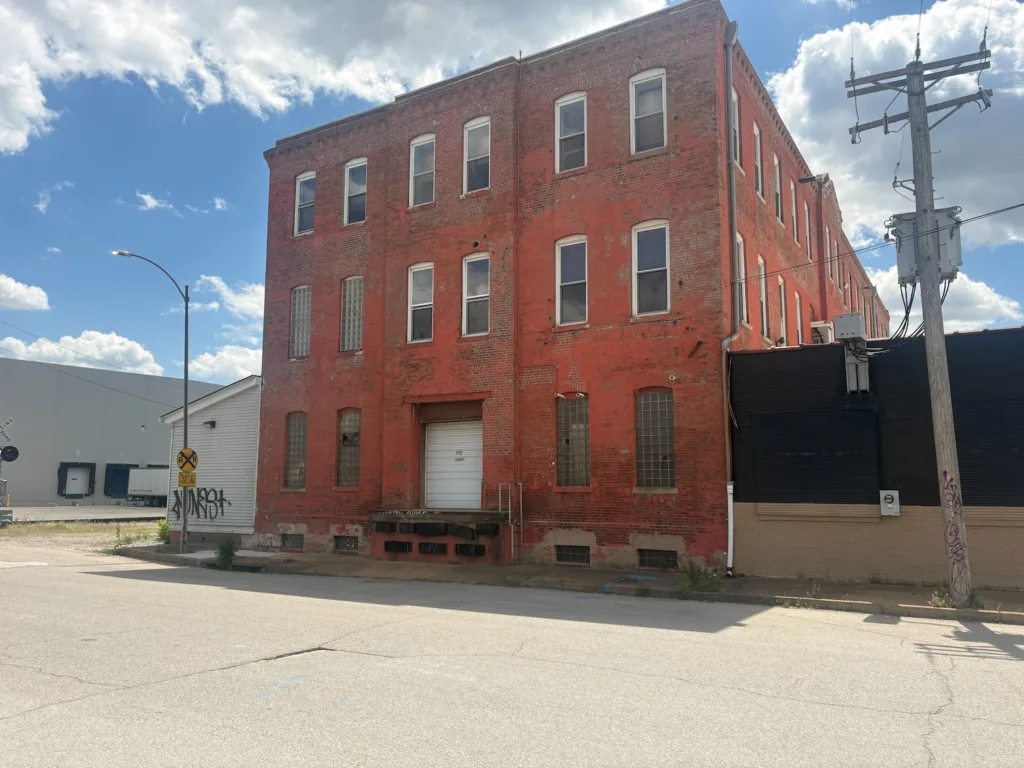
The Longs have tried for years to preserve their legacy of philanthropy and charitable work by looking to sell the building to a government or shelter provider, like Peter and Paul Community Services, who they worked with during the past few winters to provide emergency shelter in the banquet hall space.
But the future of the building’s second status of late as a shelter remains in jeopardy. They’ve heard nothing new, Joan says, in the weeks since SLM published a story about their desire to keep open a shelter that’s already fully permitted (and with few residential neighbors), even as they need to make a sale in order to afford their move. Peter and Paul Community Services has made clear it would need government help in order to buy the building, which doesn’t seem to be in the offing. The Longs have decided to start the process of listing it on the open market.
“Whoever buys this, whatever they want to do with it, it’s their building, but it would be nice to go to a not-for-profit, I think, because of the location,” Joan says. “I think it could be a good place, and there’s a kitchen where they could do meals. I hope somebody gets it.”
In the meantime, the couple is ready to set up somewhere much smaller, and less complicated, where they don’t have to worry as much about warehouse upkeep.
“It’s going to be just fine. It’s a lot easier,” she says.


