The tech world has knitted code into all manner of fixes for life’s little annoyances, such as avoiding wait times at restaurants or finding traffic shortcuts. But this month, more than a thousand programmers, designers, and entrepreneurs will begin hacking away in St. Louis at something much bigger: homelessness.
St. Louis’ largest hackathon event, GlobalHack VI, is awarding $1 million in cash prizes to teams who come up with the best ideas for helping area homeless support organizations operate more efficiently. The large cash prize places the event among just a few hackathons nationwide to put up a million-dollar prize and makes it the first to offer $1 million for a civic-minded hackathon. GlobalHack is partnering with homeless services nonprofit St. Patrick Center for the event, to be held October 21–23 at Chaifetz Arena.
Get a fresh take on the day’s top news
Subscribe to the St. Louis Daily newsletter for a smart, succinct guide to local news from award-winning journalists Sarah Fenske and Ryan Krull.
See also: A Hacker’s Life: Charlie Miller Keeps the Tech World On Its Toes
The size of this year’s purse represents a major shift in the scale of the event. The combined cash payouts of the five previous GlobalHack events was just $275,000. Executive director Matt Menietti says it elevates Global-Hack to a world-class tech event and raises the profile of St. Louis as an emerging tech hub. Event organizers are expecting about 1,500 participants from all over the world. Numbers like those catch the attention of local corporate sponsors looking to recruit software professionals. “Hackathons are becoming the new group interview,” Menietti says.
This is GlobalHack’s second consecutive contest focused on a civic-minded project; last year’s hackathon sought ways to improve the transparency in St. Louis County’s criminal justice system. Earlier contests were aimed at building proprietary software for corporate sponsors, including LockerDome and Emerson.
“We wanted to build software that mattered,” Menietti says. “I think that started with focusing on industries that software typically does not reach—or, if it does, it hasn’t been updated in the last five to 10 years.”
That description aptly fits the realm of homeless services, says St. Patrick Center CEO Laurie Phillips. “One of the things that nonprofits run into trouble with is that we don’t have the money to buy the best systems to do the things we need to do,” she says. “We’re kind of trying haphazardly to get things done.”
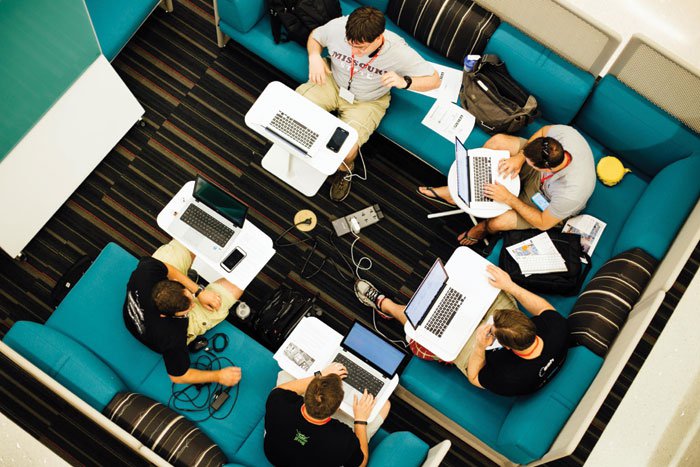
Phillips explained those challenges while serving as a guest panelist at a May event at the T-Rex co-working space. GlobalHack and LockerDome co-founder Gabe Lozano, who also sat on that panel, talked with Phillips afterward about tech needs and GlobalHack. “That conversation…led to his proposal of St. Patrick Center as their partner in GlobalHack,” Phillips says. “It was a pretty organic deal.”
All projects submitted to GlobalHack VI must be open source, meaning that the team that builds the winning software has the potential to improve the services of homeless support organizations throughout the region and country, not just St. Patrick Center.
“It’s not just about the money,” Menietti says. “It’s about bringing these hundreds of people together to solve issues that don’t just resonate with St. Louis but that resonate beyond the city.”
At a Glance
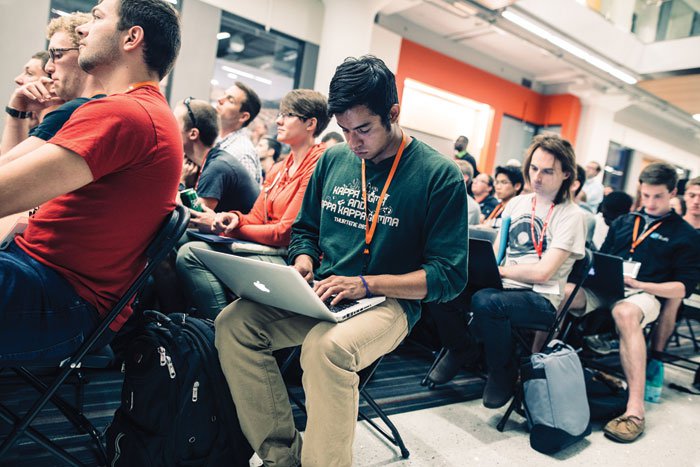
Hackathons are events in which Red Bull–fueled programmers, designers, and other technologists are given a limited period in which to collaborate and develop software projects. Of the $1 million in prizes at GlobalHack VI, $750,000 will be divided among the winners of the youth, college, and professional divisions during the final night of the event. The remaining $250,000 will be set aside to pay for implementation of the winning software.