Federal money that was used by the City of St. Louis decades ago as part of a well-intentioned program to stabilize empty houses is now hampering development at approximately 150 properties across the city.
That’s according to Peter Hoffman, the neighborhood advocacy program managing attorney with Legal Services of Eastern Missouri, who has done more than just about anyone to combat the problem of vacancies in St. Louis.
Get a fresh take on the day’s top news
Subscribe to the St. Louis Daily newsletter for a smart, succinct guide to local news from award-winning journalists Sarah Fenske and Ryan Krull.
Hoffman stresses that the situation isn’t the fault of anyone in power now. He describes them as “historical sins.”
Nearly 20 years ago, the city utilized Community Development Block Grant funds from the Department of Housing and Urban Development to purchase and stabilize vacant properties to prevent them from deteriorating further. The properties were made more structurally sound thanks to those funds, but Hoffman says many of them were never purchased and redeveloped, and have now decayed to the point where they’re vacant lots or barely salvageable.
That’s because the federal HUD dollars came with strings attached, specifically that the properties could only be developed as affordable housing. Hoffman says that for these properties, 20 years later, that just isn’t feasible.
“These buildings are important for the community,” says Hoffman. “The projects’ margins are very, very thin, and as a city, as a region, we need to not be our own enemy and put up barriers to people who want to invest.”
Hoffman is not alone in worrying that the homes will never be redeveloped unless the restrictions are lifted.
“That math isn’t mathing,” says Sharon Clark, of the Indianapolis-based developer Aspire House. “As a small developer, there’s no way.”
Which Clark says is a shame because she’s been interested in developing in St. Louis, specifically North City’s Hyde Park neighborhood. “I look at Indianapolis, and I’m like, ‘Oh my god, these people wish they had neighborhoods that have what you all have.’”
To Clark’s point, the architecture in Hyde Park is very similar to what is found in Lafayette Square, where homes now sell for more than $1 million. Stuart Keating with the Landmarks Association of Saint Louis says that both were German neighborhoods developed around the middle of the 19th century, bringing in the same cultural influences and likely using the same suppliers of materials, architects, and designers. “There were probably more neighborhoods that looked like that as well,” he says. “They just probably got bulldozed.”
But for many properties in Hyde Park, time itself has been slowly doing the bulldozer’s work, enabled by the barrier to development Hoffman is raising alarm about. The neighborhood has perpetually been seen as one on the cusp of a turnaround. The restrictions on many homes may just be one reason why that promise has never become a reality.
“The 1880s giant mansion is probably not the best fit for a first-time homebuyer on a limited income,” says Hoffman, as to why swaths of Hyde Park all ill-suited for the affordable housing requirements they are encumbered with.
Hoffman says that these properties need to be allowed to come online at market-rate. It’s the only way for development to pencil out. And it would actually help spur affordable housing development in the surrounding area by attracting new investment, which increases stock and in turn lowers prices. Developers also look at what the average house sells for in a given area, a number that a renovated historic mansion would help bring up. But right now, any buyer not developing one of the properties into affordable housing would have to pay back the federal dollars the city spent to acquire it. That can be anywhere from five figures to low six figures–and that would just be the price to begin expensive construction on a dilapidated home.
Fatimah Muhammad agrees with Hoffman.
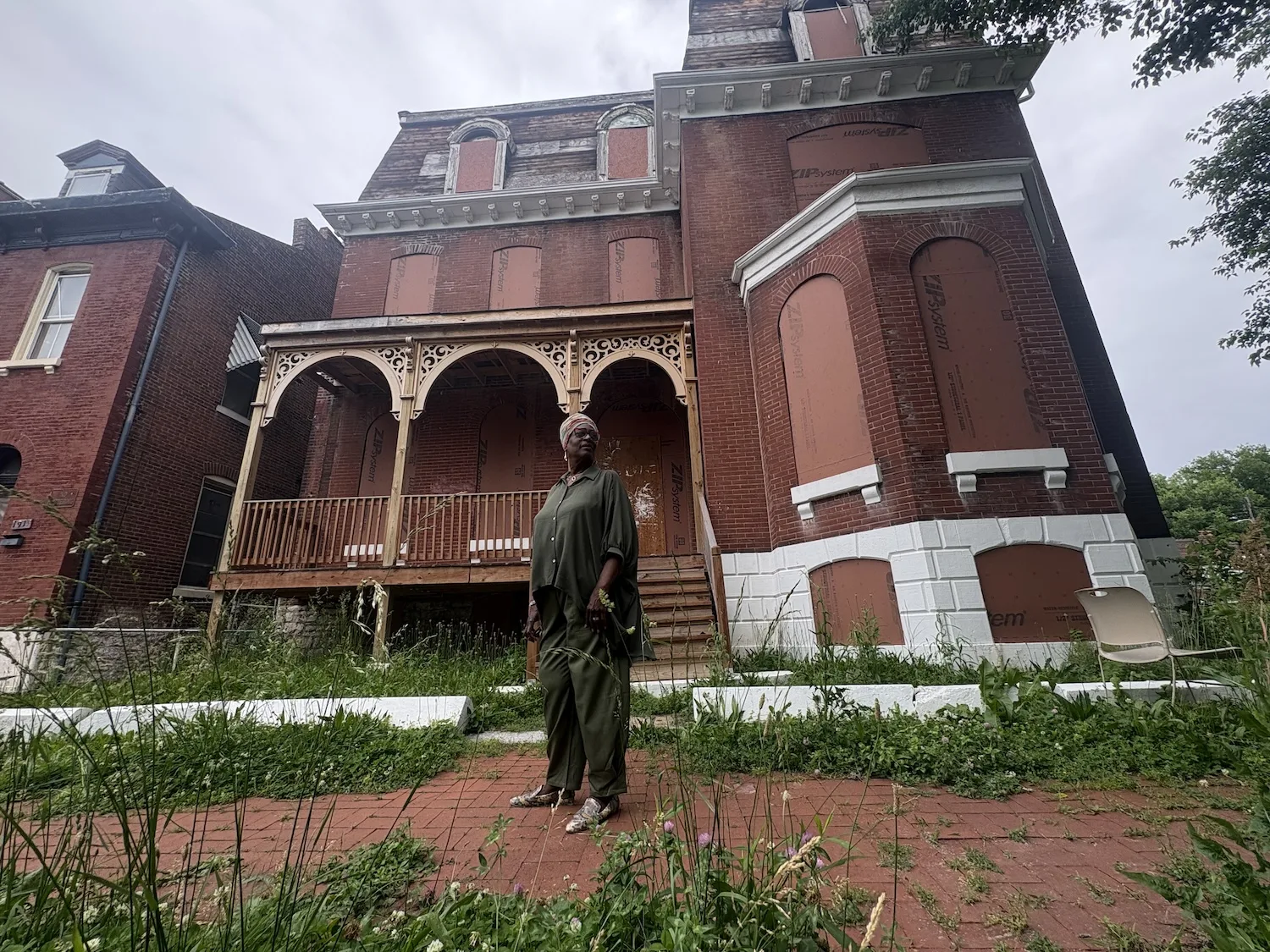
She’s with the Hyde Park Neighborhood Association and has lived in the neighborhood for 25 years. She says that the first property she’d like to see redeveloped is a three-story stately brick home on Bremen Avenue. Hints of its former glory can still be seen in the crumbling mansard roof. It was built in 1895, LRA took possession of it in 2003 for $73,000. The city recently did some additional stabilization on the house, but Muhammad says basically everything about it needs work.
The list of properties held up by the HUD strictures spans virtually the whole city, from Dutchtown in the south to Walnut Park East and West in the north. But in many ways this swath of Bremen is as acutely affected as any. Two of the six houses (and one vacant lot) on the block are encumbered by the federal program. This is also where Clark wants to develop. It’s easy to see why. The other houses on the block—the ones without boards in their windows–are two and three-story red brick charmers that would fit right in Lafayette Square. They sit right across the street from the park that gave the neighborhood its name.
Muhammad—like everyone else in this story—stresses that she is not against affordable housing, but that a building being allowed to crumble to the ground is not helping anyone.
“Those funds were very well intended, as were the decisions that were made decades ago,” she says. “But things change.”
What has changed in particular is the fact that the properties have suffered years of dilapidation even as construction costs have risen dramatically. “The numbers just don’t work any longer,” she says.
The city’s land bank, the LRA, owns the properties, with the city’s Community Development Agency holding an option on the properties to ensure anyone who purchases them either develops the properties into affordable housing or pays the city’s original acquisition cost, per the strings attached to those long ago federal dollars. Technically, a buyer could also develop the properties in a way that meets what HUD calls a “national objective” that isn’t affordable housing, but that’s much less commonly done.
Muhammad’s neighborhood association and Hoffman himself have had conversations with the CDA, but have yet to work out a solution. The assumption is that the city would have to pay the money back to the feds, but Hoffman says it wouldn’t have to be a lump sum. Muhammad and Hoffman float the idea of a pot of money that could be established within the CDA to pay back HUD, releasing the CDA options on various properties one at a time when it prevents an otherwise viable investment from going forward. The money per property should be something in the low five figures to low six figures, Hoffman suggests.
The money could come from fees collected by the Building Division on vacant properties that violate ordinances, the Rams settlement, or the St. Louis Development Corporation. According to city data, the CDA still has $110 million in unspent ARPA money. (One might also wonder if the feds could be persuaded to just forgive the money after all these years, but no one seems too hopeful of that.)
No matter what the mechanism, Muhammad wants the city to find a way. She says, “We don’t care what acronym does it.”
Editor’s note: We updated this story after publication to include an accurate title for Peter Hoffman. We regret our previous error.
Hear more about this story from Krull on The 314 Podcast.