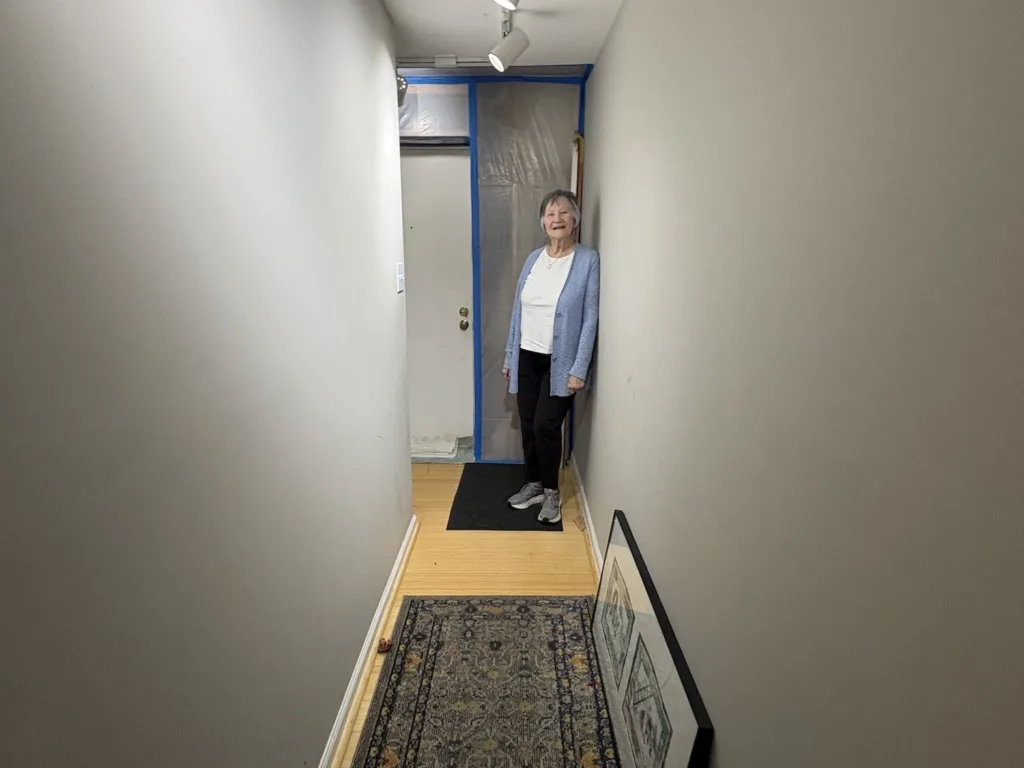
Maria Koerner is an 84-year-old retired art teacher who, for the last 12 years, has adored her condominium in the city’s DeBaliviere Place neighborhood, a short walk from Forest Park. She keeps an easel, a canvas, and her paintbrushes in a room with windows on three sides, which juts out onto the street.
Though really, it’s the people she really likes.
Get a fresh take on the day’s top news
Subscribe to the St. Louis Daily newsletter for a smart, succinct guide to local news from award-winning journalists Sarah Fenske and Ryan Krull.
“We had a great group of people in the building, a really neat community,” she says. “Old people, young people, a lot of medical students. A really good group.”
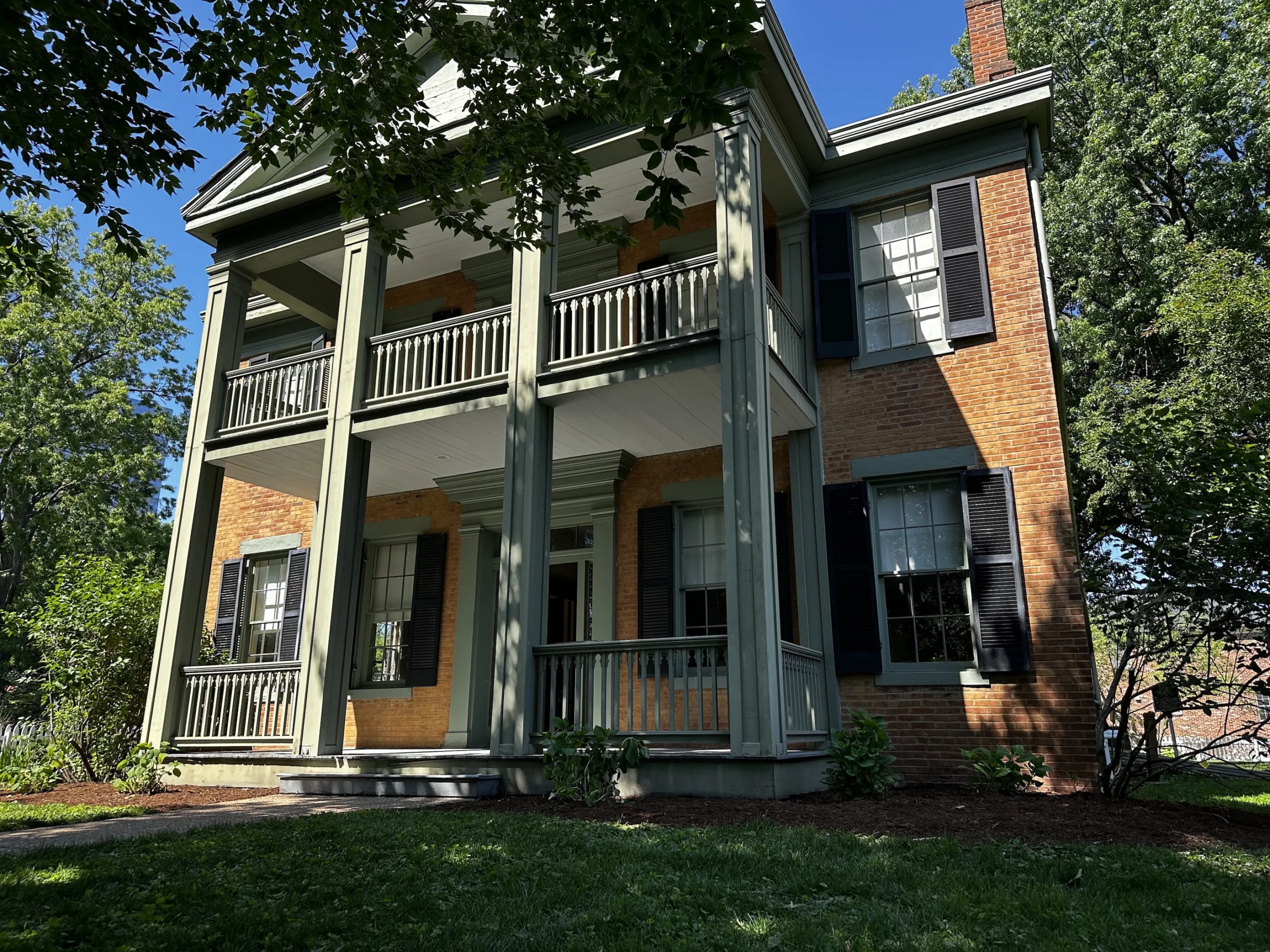
The hidden gem of her building had been a very large back deck—that is, until the May 16 tornado blew it away. Both Koerner and her neighbor Rachel Adams say the deck was a place for residents to hang out in the evenings, a space that struck the perfect balance between private and shared. Some people strung theirs with lights. Others had plants. Because of the slightly unusual way their building was oriented, residents had a view of everyone else’s back deck running down the street, a hidden neighborhood opposite the streetscape. “I would be out there at six o’clock in the morning and watching the cardinals and the birds,” recalls Koerner. “In the summer you could hear the frogs.”
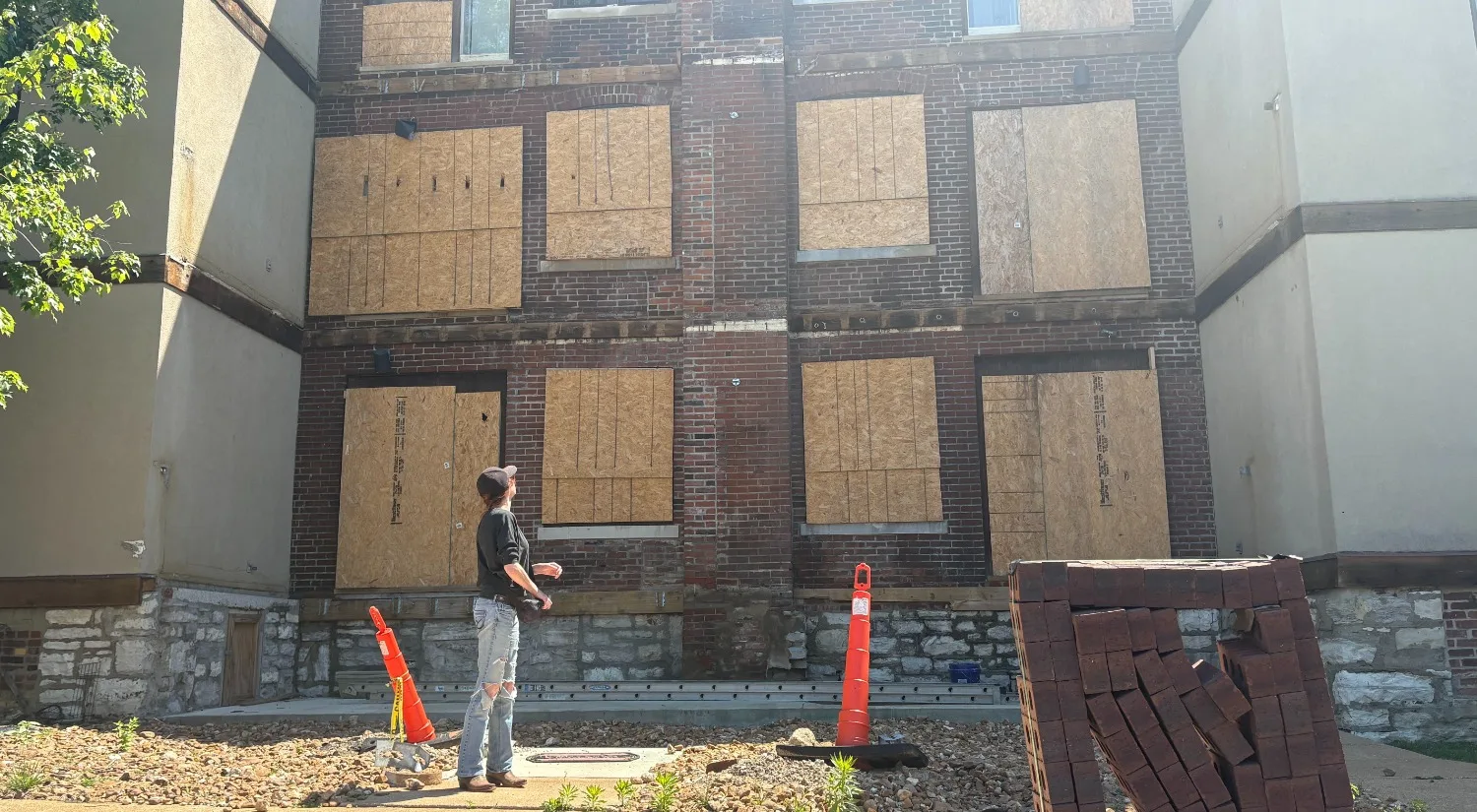
Much of the deck blew away in the storm. Part of it actually flipped over and smashed onto the roof, severely damaging it. Windows blew out and water came into the upper floors. Trees fell on cars both out on the street and in the back parking pad. In the coming months, though, the significance of the damage done to the deck would reveal itself. For a while, after the storm, Koerner was able to still sit outside on her portion of it. But then a tarp that was tied off on it collected water during a storm, weighing down the deck and causing it to collapse further. The city said the rest had to be torn down because it wasn’t safe. Koerner and Adams still haven’t been able to get a clear answer on whether repairing the deck is covered by insurance.
In fact, they have been having trouble getting answers about a lot of things. Both Adams and Koerner acknowledge that, among people whose homes were hit by the tornado, they are among the luckier ones. They both have roofs over their heads. But that doesn’t change the fact that the past year has brought almost daily annoyances related to getting their building repaired. Many of those annoyances are unique to condo life.
Koerner’s building is now mostly empty. In the six-unit building, only one unit other than Koerner’s is occupied. Its second and third floors are empty, save for the occasional displaced resident stopping by to collect mail. (Koerner asked SLM not to identify the exact location so as not to advertise that it is empty. She’s also heard rumors that because the building’s back exit is blocked off, the building is technically not up to code and could be condemned.)
At first, Koerner thought the quiet in her building was temporary. “We thought, ‘Oh, in a couple of months, we’ll be back to normal,” she says. She was shocked it was 2026 and she was still largely alone.
Adams is one of those people who now only stops by every so often. A Washington University writing professor who teaches, among other courses, one based around the theme of “dreams and nightmares,” she is currently living in a house in Maplewood while paying both its mortgage and her monthly fees on the tornado-damaged condo. Asked if her curriculum prepared her at all for the past year’s ordeal, she says, “I am predisposed to think everything is a nightmare and that there is no dream.” So yes.
She’s trying to sell her third-floor unit, currently stripped down to its studs and marked by the occasional protruding bump in the floor. She hasn’t yet found a buyer. “It’s $560 a month for the fees, plus the mortgage, which is like $937,” she says. “It’s more than my current mortgage that I pay for my house.”
She adds, “It’s an albatross around my neck.”
Chris Clark is a St. Louis attorney specializing in complex business litigation. He also used to live in—and still owns—a condo in nearby Koerner. But like Adams, he has decamped to homeownership elsewhere and is currently paying both a mortgage and his monthly condo fees.
Clark says condo owners can face unique headaches after a disaster. First is the tangle of multiple insurance policies each unit owner holds: an individual policy, along with coverage from the HOA or condo association that all owners pay into. If anyone is renting their unit—as is the case for the one other occupied unit in Adams’ and Koerner’s building—they likely have renters insurance too. That means a building with just six units could, theoretically, involve a dozen different insurance companies.
“Just right there you already have this landscape of catastrophe,” says Clark. “Because insurance markets are what they are, and insurance carriers are what they are, and they’re terrible to deal with.”
The overlapping policies give insurance companies another avenue to argue that whatever claim is being submitted is not theirs to handle.
Typically, the unit owner has a policy that covers everything “walls in,” while the HOA or condo board carries coverage for the building exterior. But Clark brings up a not-entirely-hypothetical situation in which a roof is blown off while the ceiling initially remains intact. If rain enters the building days later and damages the drywall inside a unit, is that water damage considered “walls in” or exterior? It’s easy to imagine the two insurers pointing fingers at each other.
There is also something of a collective coordination problem within a condo association. Insurance policies have deductibles that need to be split among several owners, some of whom may not have the cash on hand. This can delay hiring a general contractor and drag out recovery timelines far beyond what, say, a single-family homeowner might face.
Two different associations might each have a $25,000 deductible, but one has 12 units and another has 86. It’s the difference between residents having to each come up with several thousand dollars versus a few hundred bucks—and work can’t begin until everyone has paid. “Everybody’s on their own ship,” says Clark.
For Adams and Koerner, though, the core problem is that back deck.
They were initially told they would have to replace it themselves because the insurance adjuster (who may or may not have ever been on site) said that the deck had problems prior to the tornado. Replacing the deck itself would cost Adams, Koerner, and the other residents well over $10,000 per person.
“None of us can do that,” says Koerner.
And that’s not all. Right now, although Koerner’s unit is made livable with the help of a portable air conditioning unit and a lot of tarp and blue tape, the building isn’t “dried in.”
To be dried in means that a building’s exterior is fully sealed against water, says David Belsky, president of Rodemyer-Christel, a property management company that had 550 units hit by the tornado, including Koerner’s and Adams’. Until that happens, crews won’t start major interior work, lest a heavy rain cause fresh water damage.
A big part of drying in a building that’s had its roof severely damaged is fixing that roof.
But in Adams’ and Koerner’s case, the deck was connected to the roof, and there is an ongoing dispute between the owners and Belsky on one side and the insurers on the other over whether paying to replace the roof should also include replacing the deck.
And until the deck gets sorted out, nothing can be done about the roof.
“So that building has sort of been on hold—finishing the roof, finishing the masonry, getting it dried in,” says Belsky. “Because we need to understand who’s paying for the deck.”
And so Maria Koerner is almost alone in her building. She remembers the nights on the deck, the thrum of conversation. It now feels like a dream.