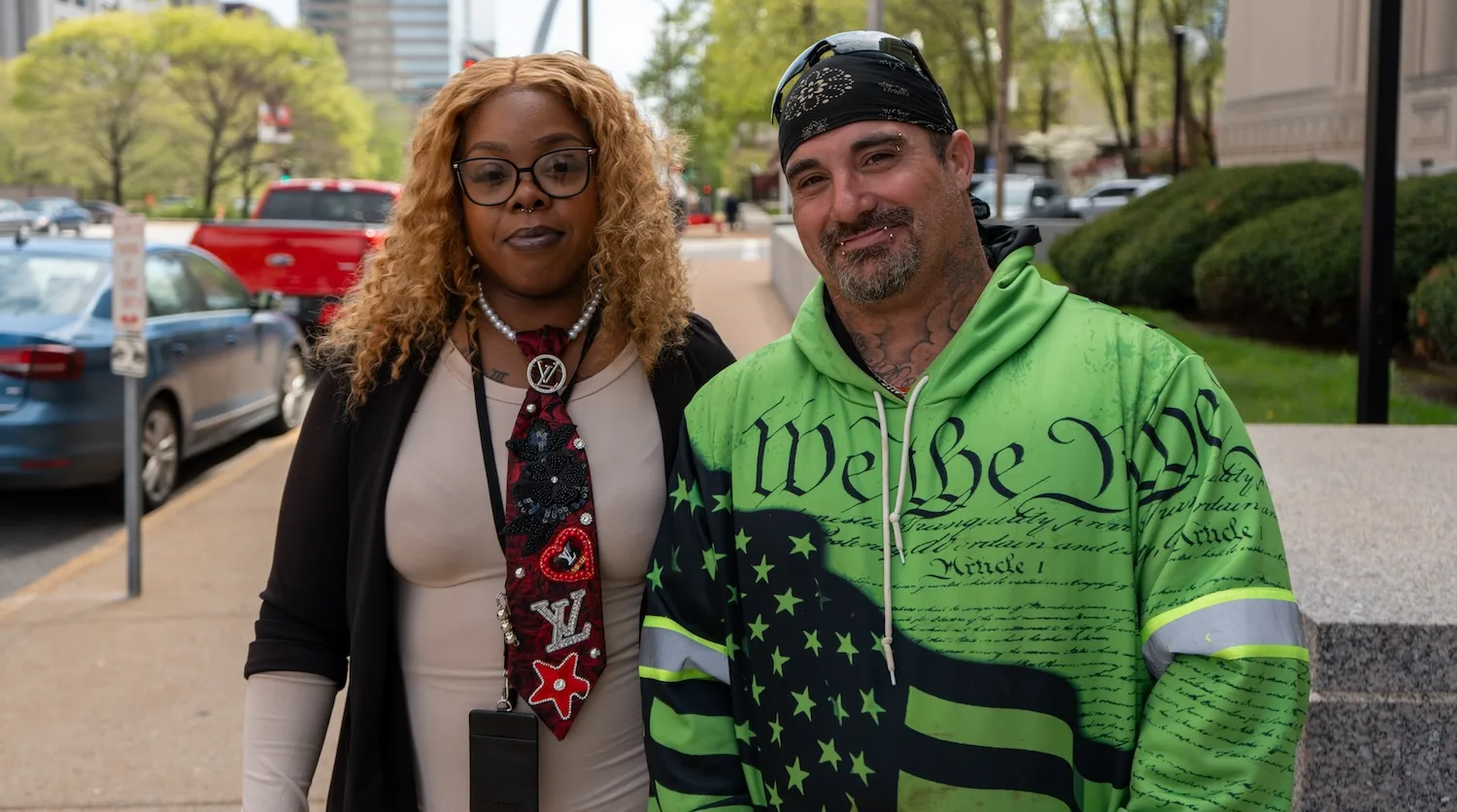
Matthew Richardson says he hears gratifying thanks when he’s on the job as a water maintenance technician for the City of St. Louis. Not that long ago, Richardson was facing down the potential, in his words, of “flipping burgers at McDonald’s.” Now he has a job that’s gratifying and camaraderie with his coworkers, along with notable lifestyle upgrades. A recent job posting for his role lists a salary range from around $46,000 to $56,000.
Richardson is one of the city’s “second chance” employees, someone the city recruited to join its workforce after he served time in prison. Leanndra Cheatham, a senior human resource specialist with the city’s Department of Personnel, has worked diligently to connect with people like Richardson who are itching for a new job and fresh start without judgement.
Get a fresh take on the day’s top news
Subscribe to the St. Louis Daily newsletter for a smart, succinct guide to local news from award-winning journalists Sarah Fenske and Ryan Krull.
Aldermen approved a “Ban the Box” ordinance in 2021, which blocks the city from asking about someone’s criminal history until after a candidate is deemed qualified. However, efforts to mount a dedicated recruitment effort floundered amid staffing shortages, says Aaron Swearngin, the personnel department’s human resources manager. Now that the department is staffed up and there’s more time for forward-looking projects, Cheatham and her colleagues are taking recruitment efforts directly into correctional facilities, a departmental first.
Such efforts have been a win for Richardson. When he met with SLM in late April, he was eager to boast about the perks of having the latest iPhone. He’s also bought his first car outright and purchased a couch for the place where he stays with his girlfriend and a new chair and television for his mother.
“I’m not going back. Like, that place is bad,” Richardson says of prison. “And the fact that I actually got something going for me, that’s the first time I’ve actually heard my mom say she’s proud of me, and can tell that she meant it.” He adds, “You know how moms can be: ‘Yeah, I’m proud of you,’ [but] the whole time they’re like, ‘Yeah, no, you’re fucking up, kid.’”
Of his buying spree, he says, “It felt nice, but damn, my wallet’s hating me right now.”
A criminal record can leave people like Richardson blocked from many employment opportunities even after serving their time. Richardson spent time in prison for being a felon in possession of a gun, a charge that followed a conviction for methamphetamine possession. “To most people, my past still defines who I am, but I’m not that person no more,” he says. “I don’t do drugs no more; I don’t play with firearms no more.”
Richardson started his job with the city last September. As he tells it, he’d been staying at a halfway house, which can require oversight for someone to leave the premises. A clerical error in getting a pass to leave meant Richardson was nearly stuck at the house for the day. Once he was finally reauthorized to exit, he almost didn’t, but ultimately decided to attend a job fair at the MET Center. It was there he met Cheatham, who says he was “the only person that showed up … that day.”
She’s now taken a personal interest in his case. “I tell him all the time, I’m so proud of him,” she says, adding that Richardson initially lacked confidence and was reticent to work for the government.
Cheatham considers helping people like Richardson a major part of why she likes her job: “Doing what I do, I’ve always got to help somebody. I would be so unhappy with my career if I weren’t helping people. … I’m glad he had some faith in me as well.” She credits a situation involving an uncle for giving her a passion for helping “justice-involved” people. (In 1999, he was convicted of burglary and robbery in a trial she describes as “unfair.”) She adds that Richardson passed his “working test period” for the city in four months, while most city employees either take six months or need an extension beyond that.
Richardson serves on a crew at the water department tasked with repairing water main breaks, fixing water valves, and emergency repairs, like when a fire hydrant gets damaged. “The biggest one I’ve seen, I could walk in,” he says of the massive valves underneath St. Louis’ streets he’s tasked with maintaining. His job working on infrastructure in the depths of the city is in contrast with his professed fear of heights.
“He does talk about how him and his crew members are a really big family now too,” his girlfriend, Arianna Pfleger, says.
“We spend more time together at work than … I get to spend home with her,” Richardson says of his colleagues; he says he works two-to-three double shifts a week.
Pfleger notes that, on their trips around the city, Richardson will often highlight areas where subterranean work has been done, or a fire hydrant, saying with pride, “That’s us.”
Ultimately Richardson wants to open his own mechanic’s shop, expressing a passion for working on cars (minus the wiring). He adds, “I do want to start my own business eventually, but for now, I’m happy where I’m at.”
Why It Matters: A 2023 report from The Marshall Project found that an estimated 70 to 100 million people in the U.S. have criminal records, which can hold them back from employment and make it more difficult to obtain housing. In a city government in need of workers, formerly incarcerated people often overlooked for employment can be an eager pool of talent—even as the opportunity to work a city job can provide upward economic mobility for people who might otherwise not get that crucial second chance.
Swearngin says there are only a few city positions they can’t be hired for, like jobs at the airport governed by the Federal Aviation Administration or the St. Louis Metropolitan Police Department. Sex offenses are disqualifying, he adds.
What’s next: Cheatham says she’s “going to every prison in Missouri,” with plans to visit the Missouri Eastern Correctional Facility in Pacific in May and another prison in Charleston, Missouri, in June. By meeting people where they are, fewer people may write themselves off from the chance at a steady job with the city, like Richardson almost did.


