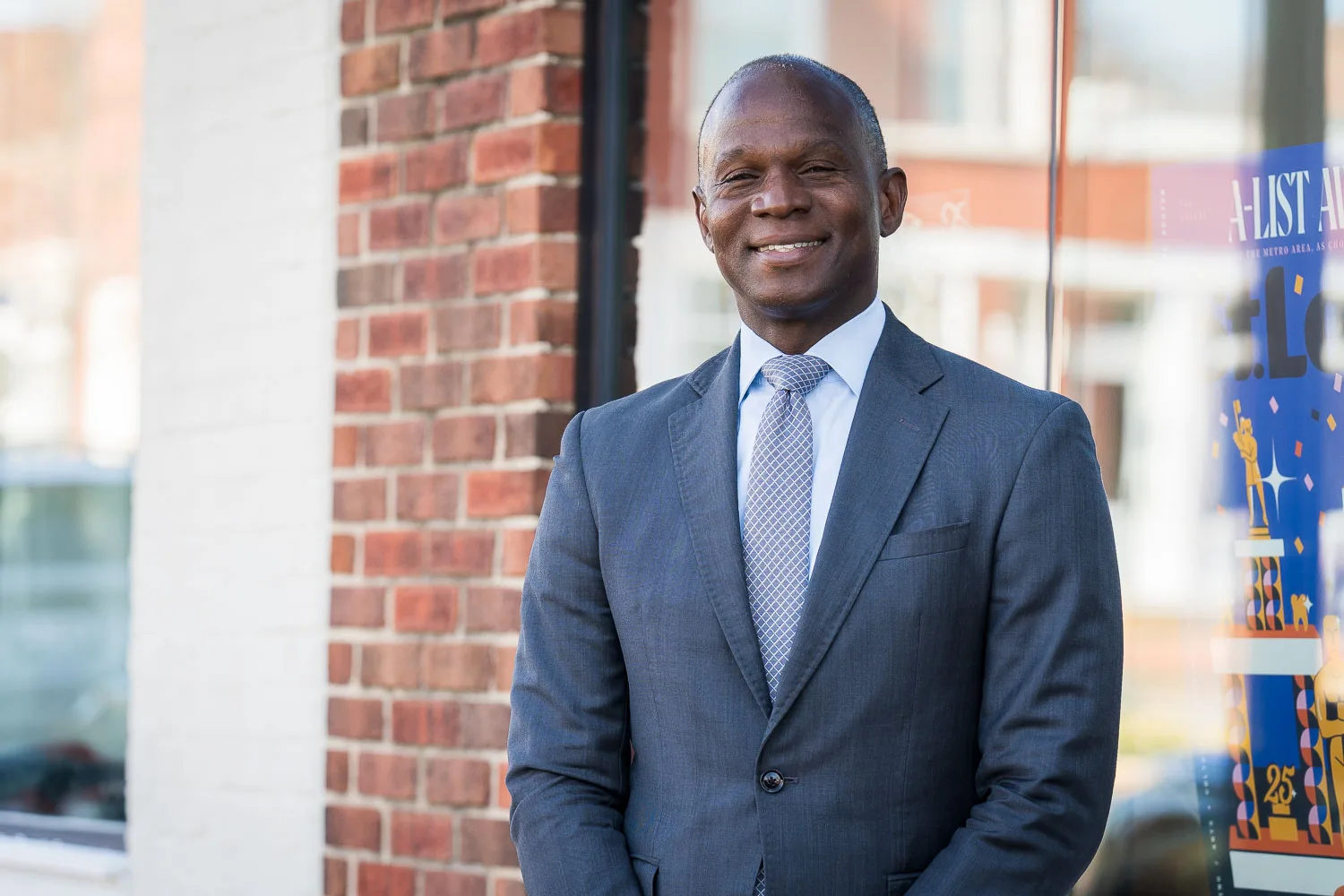
When Gabe Gore took over as St. Louis circuit attorney nearly three years ago, the office had famously been compared to a “rudderless ship of chaos.” His predecessor, Kim Gardner, had been outed as being enrolled in an advanced nursing program even as the office around her devolved into disarray. As Gore recalls, the office had plummeted to 22 prosecutors after having 60 just a few years before.
“I don’t think there was a specified homicide unit,” he recalls in a new episode of The 314 Podcast. “People were handling the cases that they had to handle, and you had some attorneys handling cases that they really didn’t have the experience level to handle. It was a very difficult situation.”
Get a fresh take on the day’s top news
Subscribe to the St. Louis Daily newsletter for a smart, succinct guide to local news from award-winning journalists Sarah Fenske and Ryan Krull.
Under Gore, however, the office has been restored to a model of probity. New hires—some of them experienced former prosecutors who returned to help the office where they cut their teeth, others newcomers eager to make a difference—have gotten the Circuit Attorney’s Office back to 49 prosecutors. The office has cleared a huge backlog of cases and dramatically increased the speed at which defendants get their day in court. There have been no public complaints from the judges, a huge change from Gardner’s day.
And that’s even more remarkable because Gore himself had no experience as a circuit attorney, or even a prosecutor in the Missouri court system, before his hire. He’d worked for five years as a federal prosecutor in the 1990s, but the bulk of his career had been at law firms handling white-collar matters, not at all the bread and butter for the prosecutor’s office in the City of St. Louis.
In addition to managing the office, Gore has made a point of handling his own cases—and not necessarily the high profile ones, either. He pushes back on the idea that the work is somehow humbling after the complex matters he handled at the Dowd Bennett firm, which counts numerous former U.S. Attorneys and a former governor as partners. Of the matters handled by his office these days, he says, ”In some ways, they’re much more complex than the cases I was handling at Dowd Bennett. It is a challenge to get 12 jurors in the City of St. Louis to conclude something beyond a reasonable doubt.” He’s 2–0 in the cases he’s personally tried.
Go Deeper: On The 314 Podcast, Gore discusses how he rebuilt trust with both the St. Louis Metropolitan Police Department, which had a famously hostile relationship with Gardner, and the community, which in some cases grew impatient as cases where loved ones were victims or perpetrators sat for years on end without much action. Last month, he launched a new Neighborhood Collaboration (CNC) to bring prosecutors directly into neighborhoods to “strengthen neighborhood partnerships, support victims, and improve public safety.”
He also shares his desire to get the office back up to an authorized number of 60 prosecutors, versus the 58 now budgeted by the city, which he notes is the same number budgeted under Circuit Attorney Jennifer Joyce, who preceded Gardner.
He believes that, if anything, prosecutions have gotten harder in the years since Joyce retired, citing the discovery demands around body cameras and bystander video. “Even the simple cases now are just more complex because of the video evidence and the discovery issues that arise,” he says.
Gore also opens up on the podcast about his St. Louis story. His family moved to what was then the far-flung exurb of Ballwin when he was a freshman in high school, which he acknowledges was quite a culture shock from a kid from Detroit. He also discusses playing one-on-one basketball with a young law professor named Barack Obama during his years studying at the University of Chicago Law School—and what’s kept him rooted not only in the St. Louis region, but the City of St. Louis, as an adult.
“I love the city, I love Forest Park,” he says. “I love all the city has to offer. I love working downtown. I tell people, I spend probably 12 hours a day downtown. I just enjoy it there. There’s no place I’d rather be.”