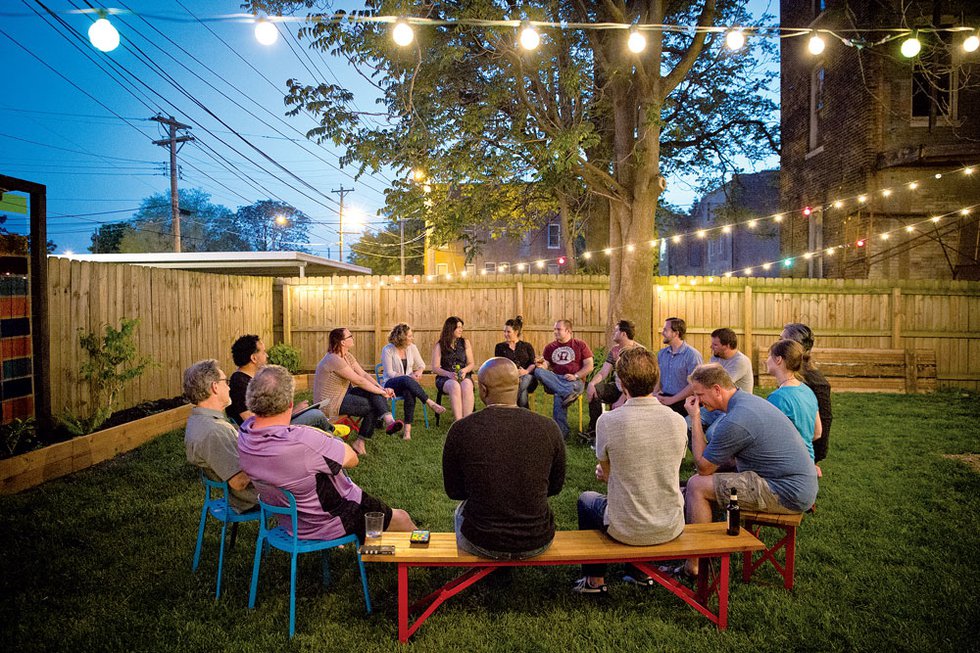
Travis Sheridan came up with the idea of “boozestorming” in Fresno, when a late-night brainstorm over Scotch yielded smart, practical ideas about the ad industry’s future. A friend supplied the tagline: “Drinking outside the box.”
Travis is executive director of the Venture Café, and he’s all about innovation and community. So is his wife, Gina, a librarian. They first met at a boozestorming, he recalls, brushing back a strand of her hair.
Get a fresh take on the day’s top news
Subscribe to the St. Louis Daily newsletter for a smart, succinct guide to local news from award-winning journalists Sarah Fenske and Ryan Krull.
And now, it’s Monday night again. As people arrive, they scribble questions on cocktail napkins and drop them in a fishbowl. Travis clears his throat and reads from a napkin: “How can St. Louis city attract and keep young people, ages 25 to 45, of color?”
“Maybe we could broadcast fewer pictures of them getting their heads kicked in,” someone suggests dryly.
“The way we could have less media is to have fewer people getting their heads kicked in,” someone else counters.
“We’re the lightning rod city right now. Everybody’s watching. But the reason it’s resonating with a national audience is because everybody in every city can relate to it. It is the representation of the American problem. And we have to solve it.”
“There are two different systems. My African-American musician friends say, ‘I would never want to drive my car in your neighborhood.’ It’s a completely different reality. Walking, breathing, sitting in a bus stop…holy f—. Why would people want to leave? Man. Why would you want to stay?”

“I love this city like none other, but it’s hard for me to sell to other young professionals. The North Side has just suffered since Slay became mayor. But when there’s a stadium needed—OK, we will drop everything. I grew up in North City, and it tears me up. It looks bombed out.”
“St. Louis is still large in terms of wealth, yet it’s, ‘Oh, it’s just so hard to clean up these neighborhoods.’”
Travis asks what we already know about the 25-to-45 age bracket.
“They’d like to get laid. They’re looking to reform romantic relationhips and have babies. They’d like to get around town, and they’d like a job. One thing I see as a primary inequity here: The buses and trains suck. People try to defend it, and I say, ‘Have you been to Paris?’”
“Paris also has 9 million people.”
People mention St. Louis’ selling points, above all its authenticity. “You don’t have to sacrifice a sense of place here.”
“It’s such a rich history. Yet at the same time, being a minority in St. Louis—it’s a dark history.”
“But that is anywhere.”
“But we can’t say, ‘Everywhere in America has been f—ked up, but we have bricks.’”
Travis leans forward: “Can people of color between the ages of 25 and 45 really be proud of what their experience is here, now and into the future?”
“People come in and stock up on St. Louis stuff to wear in Atlanta.” (The speaker’s Randy Vines of STL-Style.) “They love St. Louis; they miss it so much.”
“So what are they saying? ‘I want to buy that T-shirt and wear it to a city where I can get a job, get laid, and get public transport?’”
“I like the idea that young people are moving here because they want to be active in the civil rights movement,” Travis remarks. “The thing to do is just acknowledge our warts. Don’t walk out on it. Admit it’s friggin’ broken.” He grins. “I used to be a marketing guy—not anymore. That’d be a horrible T-shirt.”
He and Gina mention all of the young people who are “doing really kick-ass stuff here” already. “We just need to figure out where they can get laid,” a woman remarks. “But once they reproduce, where are the kids going to go to school?”
“There are 105 different municipalities that are cut up on purpose, mostly along racial lines. They’re like a bone that needs to be reset.”
When someone rattles off successes downtown, a cynic adds, “The question’s who you’re redeveloping the city for—they are developing St. Louis for white professionals.”
“Every success the city has seen, almost without exception, has been in spite of leadership. Our leaders like to invest in silver-bullet solutions.”
“The most transformative change would be a north-south MetroLink.”
“The new entertainment district would be Litzsinger in Ladue, watching all the rich people cry.”
Travis sucks in his breath. “I don’t think we are against rich people. I’m not. We need more philanthropy here!”
“Say it’s 2025, and we look back,” someone suggests. “What happened to get us going? The reestablishment of the rule of law. We went through both city and county, and made sure there was not massive lawlessness. And now we are finally building the connector, and there are twice as many buses…”
The discussion ends there. But Travis can’t resist reading another napkin, just for future consideration: “In 1950, St. Louis peaked in population and density. Was it a better city overall?”