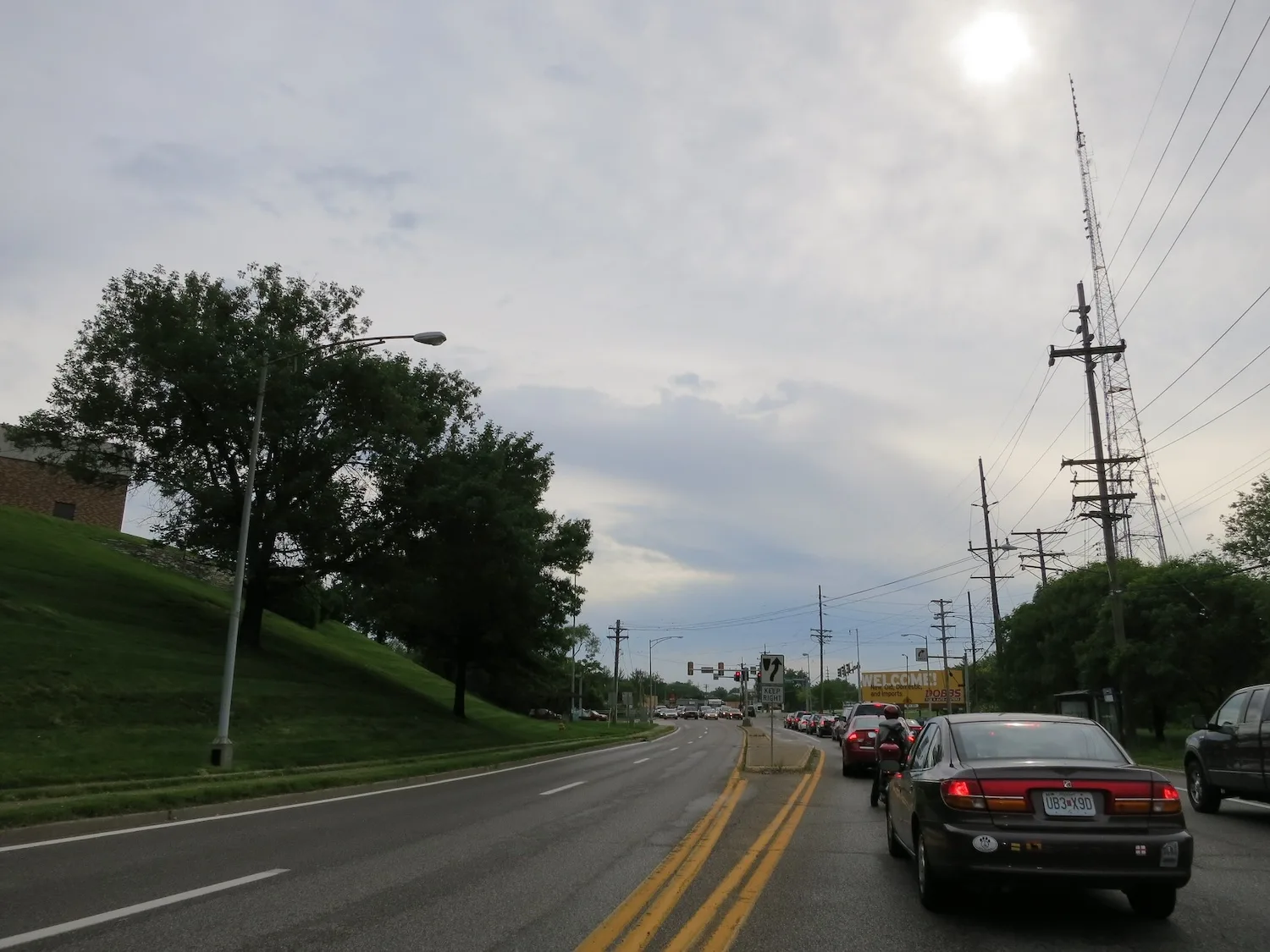
For a bone-rattling experience, steer your vehicle off Manchester in Maplewood and drive south on Hanley. By the time that road becomes Laclede Station and ends in Shrewsbury, you will have passed over multiple stretches of thoroughfare that St. Louis County maintains but rates as “poor” by its own most recent inspection. This is bad for residents and bad for business—and there are spots like this all over the county.
In interviews conducted by Nine PBS and SLM for Race for County Executive: The St. Louis Citizens’ Agenda, the three leading candidates for St. Louis County executive all acknowledged it’s a problem that will cost money to solve—but emphasized different ways to get it.
Get a fresh take on the day’s top news
Subscribe to the St. Louis Daily newsletter for a smart, succinct guide to local news from award-winning journalists Sarah Fenske and Ryan Krull.
County Assessor Jake Zimmerman argued that the path to better roads is paved by regionalism. “The region needs to come together and fight,” he said. Too often, rural interests dominate in Jefferson City and make sure their own roads are prioritized by state funding, suggested Zimmerman, who once served in the Missouri House of Representatives. In his view, St. Louis Republicans and Democrats need to come to the state capital with, say, the same three requests and speak in a more unified voice—and work harder to find common cause with Missouri’s other big metropolis, Kansas City.
For Missouri Senator Brian Williams, the problem has been that St. Louis County has left too many federal grants on the table. “I’m willing to go out on a limb and say that St. Louis County has probably missed out on millions of federal dollars because the [county’s] Department of Transportation, or just county government as a whole, has not been adequately equipped to target federal money,” he said. (Michael Carmody, the activist who leads Safer Streets for Kirkwood and St. Louis County, has repeatedly made this same point.)
Meanwhile, Dennis Hancock, a Republican county council member whose district runs from Chesterfield south to Fenton, suggested that the county should look at the possibility of channeling less money to Bi-State Development, the regional transit system that encompasses Metro Transit buses and MetroLink, and more money to the county’s street needs. And those needs are extensive, he said. For example, Hancock noted that the council took $40 million out of the legal settlement with the NFL over the Rams’ departure and used that to upgrade suburban streets. That $40 million, Hancock said, “got us to page 2 of the 100-page list that the county has.”
When asked about motorist and pedestrian safety, Hancock said that one problem he sees almost every day is that there are “some pretty bad drivers” in the county, and that a public campaign to educate them might cost less than other responses. Before building traffic-calming features such as median islands, rumble strips, curb extensions, and curb bumpouts, Hancock said, you should talk to people who spend time around them—in particular, businesses that count on easy access for their patrons. Zimmerman sounded a similar note: The way to avoid what happened on Clarkson Road, where the Missouri Department of Transportation installed and then removed curb bumpout islands after a resident backlash, is conversation. “When you try to shove something down people’s throats,” Zimmerman said, “[and] when you don’t consult with the community, you get bad results.” Williams, for his part, vowed to assemble a team of “best and brightest” engineers and experts to look at what has worked not only in other parts of the region but also around the country, to pursue safe and smooth arterial routes.
On mass transit, Williams pointed out that he represents a district with many key MetroLink stops, such as Washington University, the University of Missouri-St. Louis and the airport. “I’ve been proud to secure funding that has been the largest investment in this region around mass transit,” he said. Before committing to linking the county up to the Bus Rapid Transit project being contemplated by the city, he said he’d need to see more data, but in general, he favors public transit being “more accessible and most importantly convenient for everyone in this region, regardless of their zip code.”
Zimmerman, for his part, said that he was “a big fan of transit-oriented development” and that BRT seemed to have success in other cities such as Kansas City. “If you can get me a mile of something that feels like track, but costs a lot less money than track, and then in return, I can get you more miles and more people able to get to work on time, I’m real interested in that,” he said. Hancock, too, praised the city for abandoning the north-south MetroLink expansion in favor of the cheaper and more flexible BRT line. But he added, in essence, first things first: “Metro’s not going away. The taxes aren’t going away. So let’s make sure that [the county is] getting our fair share, and let’s make sure that we’re getting our fair share of the services as well.”
Learn more:
Watch our one-hour special Race for County Executive: The Citizens’ Agenda
Read about what the candidates say about the issues that matter to voters:
St. Louis County executive candidates aren’t ready to endorse city-county unification
St. Louis County executive candidates say they can end the dysfunction
County executive candidates on affordability: ‘The No. 1 overarching problem’