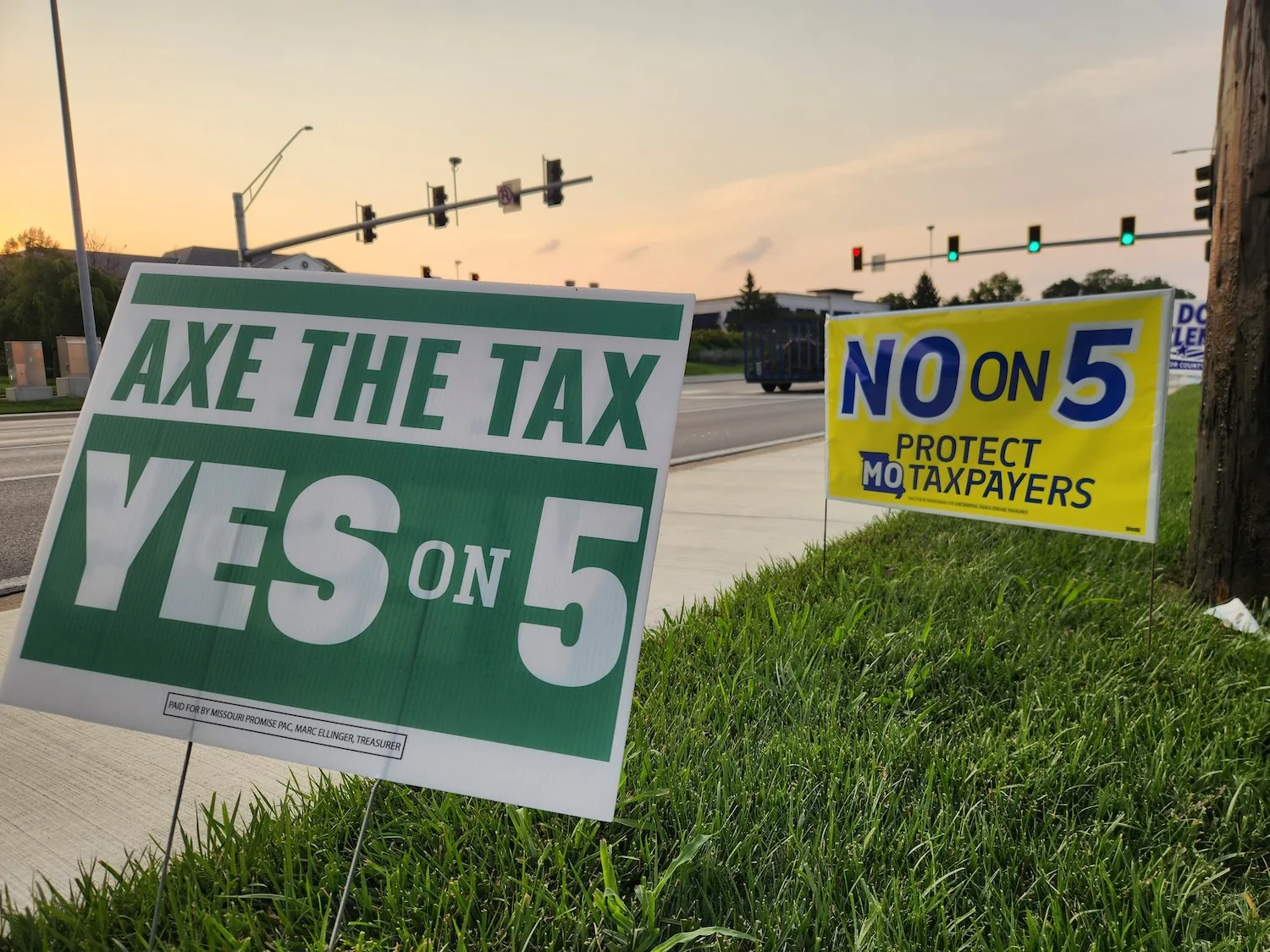
If you’re a St. Louisan out there hustling—trying to get a better job, higher pay, a nicer home, or bigger savings—then you may glance at Amendment 5, the ballot measure to phase out Missouri’s state income tax, and wonder: Will this help me?
The answer isn’t so much that it’s tough to know for sure. The answer is that it’s impossible. Amendment 5 may indeed boost your prospects, or it may not. While there are reasonable (albeit debatable) economic arguments to be made for the overarching plan that proponents want to enact, only part of that plan is in Amendment 5. Left out are the granular details that would need to emerge from future legislation—but only those would allow you to estimate whether your household would come out ahead. And even that estimate would rely on big assumptions.
Get a fresh take on the day’s top news
Subscribe to the St. Louis Daily newsletter for a smart, succinct guide to local news from award-winning journalists Sarah Fenske and Ryan Krull.
The tax that Amendment 5 is targeting
Before we explore the strongest cases for and against, first understand: We all get valuable stuff from Missouri’s government. We get roads and bridges, schools and teachers, prosecutors and public defenders, nurses and behavioral-health clinics, protected forests and streams—the list stretches as long as the Katy Trail (which is a state park, so it’s on the list, too). The federal government pays for a lot of this stuff. A significant chunk, though, comes from the taxes forked over by everyone who works in the Show-Me State. That money goes into the general revenue fund. In fiscal year 2027, an estimated 57 percent (or $7.8 billion) of general revenue will come from the income tax. The aim of Amendment 5 is to phase out that tax.
What Amendment 5 would do
The phase-out would occur through two mechanisms. The first is what’s being referred to as a “growth trigger.” Historically speaking, the state budget has grown as the economy has grown. A growth trigger, however, would identify a level of revenue over which any additional money flowing into state coffers would not be kept by Missouri’s government but rather used to lower the income tax rate—and therefore, return to taxpayers. The speed of this process would depend on the trigger level and the vigor of the U.S. economy, but all by itself, it would take years, because the income tax is a huge thing to replace.
In addition to creating that “growth trigger,” Amendment 5 would create a second and much faster mechanism for phasing out the state’s income tax: The expanding of Missouri’s sales tax to services. (When you hear proponents talk about “closing loopholes,” this is what they mean.)
The tax code was crafted a century ago. People traded mostly in goods back then. Over time, the code became rife with exemptions and expanded only slowly into the growing service sector. Then, in November 2016, Missourians halted that expansion: A ballot measure in that election cycle froze the state’s ability to extend its sales tax to anything that wasn’t taxed before 2015. That measure passed with 57 percent approval. (It didn’t curtail lawmakers’ ability to raise the sales tax rate, although under state law, if they raise the rate, they have to lower some other rate to make the end result budget neutral; otherwise, under the state’s Hancock Amendment, they must get voter approval.)
So in 2016, Missouri’s sales tax base was frozen in place. Amendment 5 would unfreeze it. It would allow legislators and the governor to expand the sales tax to, for example, services that exist solely online, such as Netflix or (heaven help us) OnlyFans. They could also expand it to the services rendered by accountants, lawyers, architects, dog groomers, landscapers, and masseuses—all of which skew heavily toward well-off consumers. “It’s insane how much in dollars we’re losing through the services-sales-tax loophole,” says Rep. Ben Keathley (R-Chesterfield). But no services are specified in Amendment 5. Just a five-year window in which lawmakers would have a resurrected authority to begin taxing them.
No one disputes that sales taxes in general are regressive—that they ask more of lower-income folks than they do of the wealthy. (If both rich and poor need a certain thing, and everyone pays the same sales tax on it, that tax will hurt the poor family more.) But even the Institute on Taxation and Economic Policy, a left-of-center think tank in Washington, D.C., agrees that expanding the sales tax base to include services is sound policy. The question is how a state uses that freshet of revenue.
The argument that Amendment 5 will help low-income workers
Proponents of Amendment 5 argue that getting rid of the income tax would be a boon to, among others, low-income workers. Such workers already pay little or nothing in income tax, so the phase-out wouldn’t be much of a direct benefit, true. But the new service-sector sales taxes may not be a direct hit either, for several reasons.
First, lawmakers could choose to extend the sales tax mainly to services that wealthier people use; indeed, Gov. Mike Kehoe has stated that, if the measure passes, he would veto any bill that expands the sales tax to healthcare or real estate.
Second, if non-necessities are affected—say, manicures get taxed, or a higher rate is assessed on beer—then consumers can avoid those taxes by not going to the bar or salon. They have choices there.
But third, even if lawmakers do make the (politically costly) move of raising or expanding the sales tax on necessities, Amendment 5 mandates a local adjustment that may ease that pain. It would work like this. The goods and services taxed by Missouri are also taxed by localities, such as Webster Groves. If Missouri were to begin taxing, say, dentistry, then new revenue would go not just to Jefferson City, but also to Webster, which is not trying to eliminate an income tax. All of a sudden, Webster would have a dentistry-tax windfall. Amendment 5 would then force Webster to take that surplus and use it to lower one of its own tax rates—say, the Webster Groves sales tax or property tax. So yes, a resident would be paying more at the state level, but less at the local level.
Supporters say Amendment 5 would not only do minimal-to-zero harm to low-income workers but would also help them in the most crucial area: It would give them more job opportunities and higher pay. Simply taking Missouri’s current economy and plugging in alternative tax bases or rates in order to see who’d be paying what is to misunderstand the whole point of the ballot measure, advocates insist. Missouri wouldn’t have the same economy to plug into; it would be more vibrant and competitive. “The biggest reason to do this is to grow the pie,” said Aaron Hedlund, a research fellow at the Federal Reserve Bank of St. Louis and a member of the White House Council of Economic Advisors. He was speaking on KMOV Channel 4 during a contentious roundtable discussion, during which he mentioned that in January, the Council put out a study about states eliminating the sales tax. It argued that such states see not only an influx of high earners, who’d spend money Missouri, but also an increase in the number of startups and higher wages overall. “We can look to other states that are doing a great job,” Hedlund said. “You can look to places like Tennessee, for example.”
Tennessee, home to booming Nashville, eliminated its income tax in 2021. It’s now ranked by U.S. News & World Report as seventh among the 50 states in terms of net migration—meaning a lot more people are moving into Tennessee than moving out. That’s a measure of people voting with their feet in favor of the Tennessee model.
The argument that Amendment 5 won’t help low-income workers
Yet the counterpoint to extolling the virtues of Tennessee, from an upward-mobility perspective, is that U.S. News also ranked Tennessee 39th in the category of economic opportunity. This was several rungs below Missouri. And the left-of-center Institute on Taxation and Economic Policy has calculated that in Tennessee, which gets most of its revenue from sales taxes, the poorest households have an effective tax rate of 12.8 percent, while wealthy households pay just 3.8 percent.
That same think tank opposes Amendment 5. They fear that if it passes, the burden of funding state government would shift to those least able to pay. And there’s a subtle way this could happen, says Traci Gleason of the Missouri Budget Project, which also opposes the measure. “From a family standpoint, sales taxes—you’re paying a little bit at a time,” she says. “You’re not adding that up. And so you’re not seeing one big dollar figure the way you might when you’re dealing with your income taxes.”
A plan in full?
The challenge for anyone trying to gauge Amendment 5’s potential impact is that numbers make all the difference, and the ones underpinning the massive tax shift promised in the amendment aren’t decided yet.
For example, Kehoe says he won’t allow new sales taxes on real estate. That doesn’t mean, however, that housing would be unaffected. What if the sales tax were expanded to the services rendered by plumbers, HVAC technicians, electricians, landscapers, and cleaners who work on apartment complexes? Would that cost get passed on to renters? And if so, would their income gains offset it?
There are defensible reasons for not spelling out every last detail in a proposed constitutional amendment. A state’s founding document isn’t supposed to include minutiae such as tax rates and Netflix. As Keathley says, “It’s supposed to be the overall ideas, what the government should do, what the government is authorized to do and what the government cannot do.” Thanks to ballot measures, Keathley says, Missouri’s constitution has become a “gigantic book” in which even minor changes entail a two-year process.
This is both true and unhelpful to voters who want to know exactly what they’d be signing up for with Amendment 5. Right now, they don’t know, because they can’t know. The information isn’t available. That spells trouble for the measure, says Scott Charton, a spokesperson for several opponent groups, including the Missouri Association of Realtors. “The fact that there is confusion—that will tend to make people want to vote no,” he says.
Voters will decide
There are, in fact, some dark clouds on the horizon for Amendment 5. None of the three Republican candidates for county executive in St. Charles, Missouri’s most populous red-leaning county, has endorsed the ballot measure. Nor have the three GOP candidates in the state’s 16th senate district, which, as St. Louis Public Radio pointed out, is solidly Trump country. We’ve also seen internal polling that, if accurate, would mean that Amendment 5 is deeply underwater in rural Republican counties elsewhere in the state—and all this in a year when turnout among Democrats, who overwhelmingly oppose the measure, is expected to be strong.
None of which is to say Missourians ought to be satisfied with the status quo of their economy. In a recent podcast by Missouri Promise, the political action committee behind Amendment 5, the Fed’s Hedlund made just that point. “If you look at the past 25 years, Missouri has generally been bottom 10 in economic growth,” he said. “Here’s the choice I would pose to Missouri voters. Are you content? Are we content as a state being bottom 10?”
That’s an easy question. The one about the wisdom of Amendment 5 as a solution, meanwhile—that’s harder.