Did the City of St. Louis do enough to deal with a homeless Sudanese couple who for almost four years lived in a makeshift yurt-like structure on a South City sidewalk? That’s the question a jury will have to decide this week.
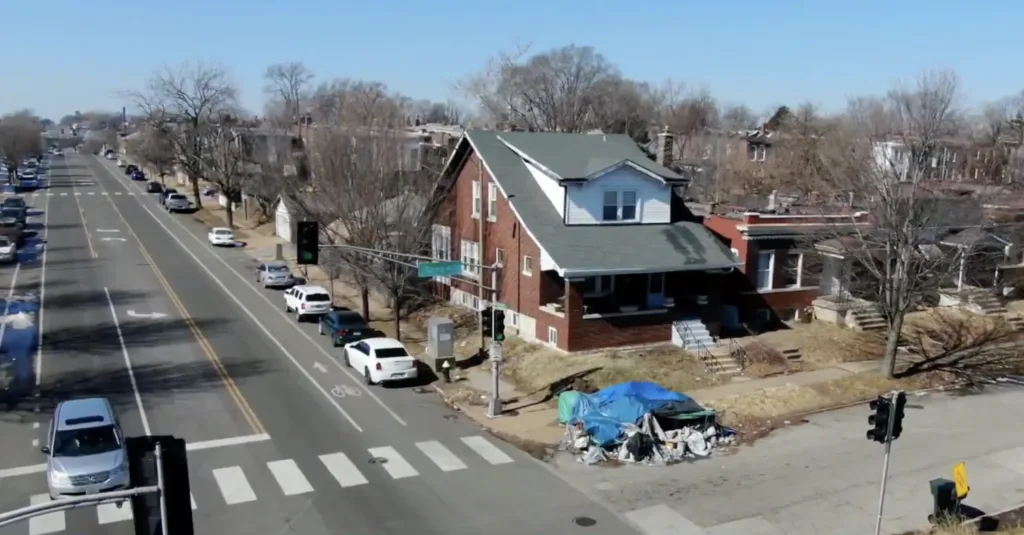
Monday saw opening arguments in the lawsuit brought by two Tower Grove South homeowners who for 44 months had Eisa Ali Agbar Nimir and Zerigha Osman Boia Agbar living on the sidewalk in front of their home. The pair had long been denizens of the general area when they showed up in front of Steven McClanahan and Richard Baumhoff’s home on South Spring in August 2020.
Get a fresh take on the day’s top news
Subscribe to the St. Louis Daily newsletter for a smart, succinct guide to local news from award-winning journalists Sarah Fenske and Ryan Krull.
McClanahan says he remembers it was hot and he thought the couple was just cooling off under the shade of a tree. McClanahan, who works in information technology for a beverage company, thought there was a language barrier but did his best to communicate. “I said, ‘Keep moving eventually, but stay here until sundown,’” McClanahan testified. Yet the next morning the couple was still there, yelling at passersby on the sidewalk.
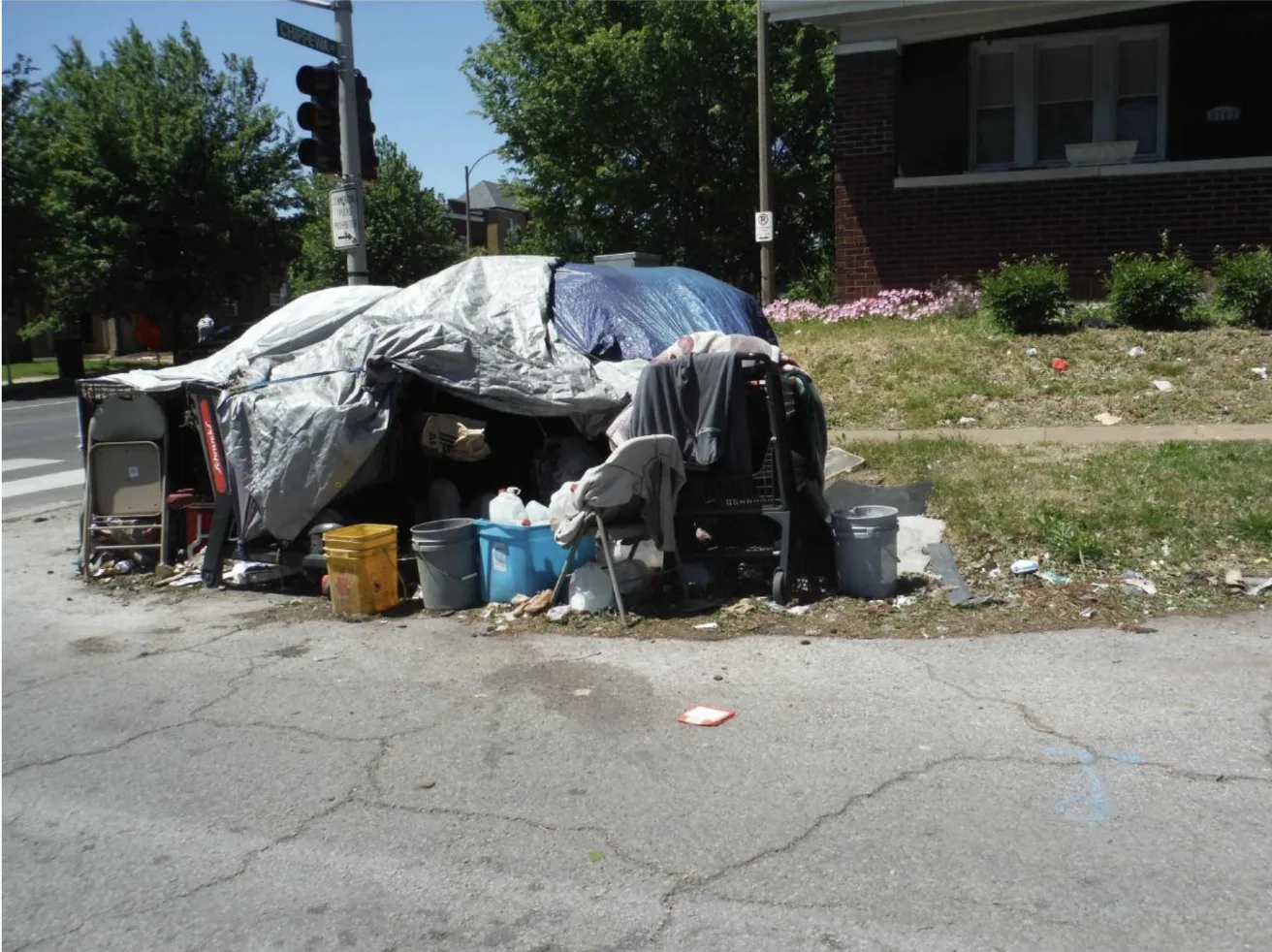
Then the Sudanese couple started putting down roots on the sidewalk. They constructed an enclosure out of Aldi’s shopping carts and tarps dropped off by others, as well as blankets they fished out of dumpsters. They had a hibachi grill and kerosene tanks in the structure, cooking food that in turn attracted rats. The couple took bucket showers and used a bucket toilet—all in full view of neighbors. The corner grew to smell badly. “It was not pleasant,” said McClanahan. The Sudanese couple refused offers of more substantial housing. McClanahan testified that he heard the male, Nimir, speaking English to others even while pretending not to speak it to McClanahan.
It took almost four years for the city to tear down the structure.
But McClanahan and Baumhoff’s lawsuit argues the city didn’t do enough, quickly enough. Their suit is called an inverse condemnation, arguing that the city’s inaction for the 44 months harmed them and their property. They are asking for $66,000, the amount that the property could have been rented out for, had the homeless couple not been a nuisance to it. (This pencils out to $1,500 a month.)
The men’s attorney is Bevis Schock. He said in his opening arguments that for almost four years the city surveilled, inspected, and documented the encampment—but didn’t dismantle it. “[The city] had a playbook, a protocol, but it didn’t happen,” Schock said.
McClanahan’s testimony featured his reading messages he sent over the years to the Citizen Services Bureau, messages that ran over 27 pages long. He said that at one point, the police showed up, but officers told him that then-Mayor Tishaura Jones had tied their hands.
Assistant City Counselor Erin McGowan, representing the city, said in her opening arguments that the city did a lot to deal with a “highly unusual” and incredibly difficult situation. She said the jury may well determine the city’s response wasn’t perfect, but “this is not a situation where the city did nothing.”
She continued, “The city did not cause this nuisance, on the contrary was pouring resources to get them off the streets.”
She added that many meetings were held among city agencies to determine how to get the couple into housing and that it was a long process of city workers building a rapport with the couple to earn their trust and get them to agree to go into housing. A city task force was formed in 2023 to deal with the problem on South Spring. McClanahan himself testified that he saw workers from the city and from the International Institute out on his street with the police trying to reason with the couple—to no avail.
During cross examination, McGowan disputed McClanahan’s assertion of when the Sudanese couple actually began building their structure. She also asked if McClanahan’s home was physically damaged by the couple in any way. He said it wasn’t. McClanahan also confirmed that the couple never got physically aggressive toward him and that at one point, one December, he declined a police officer’s offer to remove the encampment. He didn’t think it would be appropriate to do so given the cold.
McClanahan also said during testimony that he and Baumhoff hadn’t actually attempted to rent out their home in the last five years.
Court filings suggest part of Schock’s argument will be that had the Sudanese couple built a “properly permitted cottage” rather than a makeshift encampment, the city would have moved more quickly to tear it down.
In the coming days, the jury is expected to hear testimony from Nancy Cross, the city’s director of operations under Mayor Jones, and Anthony Elliott, a city health inspector. A deposition given by Matt Moak, the current executive director of the Community Development Administration, will also be read for the jury. The trial is expected to last three days.
The city tore down the Sudanese couple’s encampment in April 2024, about two months after McClanahan and Baumhoff filed their lawsuit. According to media coverage, a few days later, the couple was back on the street and living just a few blocks away, at South Spring and Gravois.