
Our goal for the month was to find some nice autumnal walks, in locations we hadn’t yet had the chance to enjoy. Despite a lifetime of regional excursions, there was still a good list to work from, so check our archives for past installments.
Cairo, Illinois, isn’t so far, really, about three-hours by car. A little more if you decide to stop at some of the roadside attractions, like the colorful Popeye displays in Chester. The landscape for the trip changes frequently, especially if you go through southwestern Illinois, where deep woods alternate with flood-formed bottomlands. In the fall, as one member of our party mentioned poetically, “every tone of brown is represented” in the fields that you pass.
Get a fresh take on the day’s top news
Subscribe to the St. Louis Daily newsletter for a smart, succinct guide to local news from award-winning journalists Sarah Fenske and Ryan Krull.
If you’re going to travel to Cairo, you might want to pack more than some appropriate snacks (though those are a must). Pack up good people, too. For example, in our party of six, one person was a published blues researcher and artist, and another was a widely read architectural historian. When you’re heading down the highway to the “gateway to the south,” those are especially good folks to have along.
We won’t be able to give you an exhaustive history of Cairo here, but some broad brushstrokes follow. At varying times, the town’s deep, troubled racial history has bubbled to the surface. Despite this, Cairo enjoyed a commercial heyday a century ago, thanks to its proximity to the broad confluence of the Ohio and Mississippi rivers, where three states (Missouri, Illinois, and Kentucky) mix-and-mingle along the banks. The town’s been inextricably tied to those waters; in 2011, Cairo was in the national news when nearby levees were exploded, costing thousands of acres of Missouri farmland, but preventing the full flooding of the historic city.
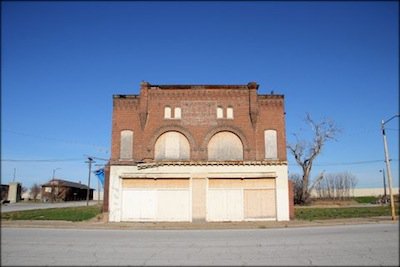
The argument surely was made that the town’s more past than present or future, that “saving” the town now is just putting off an inevitable fate. To walk the streets of Cairo today is to observe a very unusual place, indeed. The town, now numbering only a few thousand residents, has been shaped by every manner of wider, American storyline. Transportation’s changed, lessening the impact of Cairo’s port. Small commercial districts have withered throughout our country, usually impacted by big box stores arriving on the edge of town. As services and amenities dwindle, so can population. Cairo is no exception.
For example, an abandoned hospital in the center of town suggests that the population cannot support a medical facility of even modest size. And its downtown, running along the old Commercial Street and tucked just behind the flood walls, is all but gone. A couple of bars and a handful of light-industrial and service companies are all that remain; the groceries and department stores and theaters are shuttered, half-demolished, or feature faded, worn exteriors.
The residential areas are a mixed bag. Some stately homes endure, with at least one historic house open for Sunday afternoon tours. Brick-lined streets feature buildings that one traveler said “wouldn’t look out place on Taylor in Kirkwood.” And, true enough, the best homes in Cairo had that Southern charm thing down pat, with expansive, wrap-around porches and the occasional, funky element like a small onion dome on a corner bedroom. The flipside to this is the buildings that sit vacant (and there are a lot of them), lovely places but shuttered. Most interesting to the eye were those that approximated the look of the Munsters’ house at 1313 Mockingbird Lane, with peeling clapboard walls and every manner of junk displayed on the front lawn. Yeah, it’s a mix, that Cairo housing market.
With daylight hours at a premium these days, you sometimes have to hustle, quickly gathering visual information before sliding to the next stop. We tried to squeeze in as much as possible, even in a town of such small size.
Arguably, the best stop came first. After zipping through the neighboring, itty-bitty Future City, we pulled through the Cairo flood walls and found ourselves a lunch spot, the Nu Diner. It only serves till 1:30 p.m. on Sundays, and we pulled in with about 50 minutes to spare. Every table was full except the six-top in back, and as we decompressed, it was obvious that everyone around us had just attended church. As astutely pointed out, we’d found “the white diner” in town, not designated that way by law, but by custom. Had we pulled up elsewhere, we’d have had a different Cairo experience.
This one was cool enough, though a little diversity wouldn’t have hurt. Four of us ordered catfish and four had sweet tea; this was a Southern diner, after all. We talked and enjoyed the running commentary of our server. At times, we tried to stick to a made-up, improvisational travel narrative. That we were there for research on a new movie. Or that we were in town to collect driftwood for a museum. Nothing really stuck, and we wound up copping to the truth, for the most part.
We were there to walk around. To take in the ghostly downtown. To enjoy some diner food. To walk along a confluence’s banks. To get away from the city, but not too far. Cairo’s just three hours and a bit of a world away. It’s a place well worth an afternoon of your life.