LeeAnn Tapscott’s been up all night with a baby possum. Bleary-eyed, she wraps both hands around her coffee mug. “If I start hallucinating,” she says dryly, “just move to another table.”
Tapscott also rescues abandoned baby bunnies, and she helps a rural friend with fawns whose white spots, big eyes, and tentative grace could soften the heart of a serial killer. But mainly she focuses on possums, skunks, raccoons, starlings—the lower-caste critters that the rest of us try so hard to get rid of.
Get a fresh take on the day’s top news
Subscribe to the St. Louis Daily newsletter for a smart, succinct guide to local news from award-winning journalists Sarah Fenske and Ryan Krull.
The Missouri Department of Conservation permits her to do wildlife rehab, a midlife vocation she shares with a cohort of empathetic, resolute middle-aged women whose clothes are often torn and poop-stained. The common denominator? She shrugs. “We’re all crazy enough to do this.”
Fierce, too, willing to pack a gun and venture into rough areas to rescue something wide-eyed and trembling that weighs about a pound. “We make the Orange County housewives look tame,” she says. “One of these days, I’m gonna write a sitcom.”
“Raccoons can pick locks,” she remarks. “They can wrap presents.”
First episode: A fellow rehabber, a vet tech, shows up to rescue a snake. “Don’t you have a cage?” nervous firefighters ask the young woman, 5-foot-2 and clad in shorts and flip-flops. “Nope,” she says, eyeing the shovel one of the guys is holding. “Now, what are you gonna do with that shovel?” She gently picks up the snake with a white towel, making sure to cover its head first, and walks away.
Tapscott grins. “People think we have catch poles and big traps. We use a soft voice, a towel, and blond Oreos.”
There are rehabbers like her all over the world, she adds, with lots of “secret underground networks” for mutual aid and consultation. Why secret? “Well, there are some persnickety laws in some areas that make it hard to help wild animals…and then there are the laws of Mother Nature…and they don’t always mesh.”
A 12-year-old boy from New York is calling from his parents’ hotel room at The Chase Park Plaza. It’s a stormy holiday weekend, and thunder’s rumbling again. Over in Forest Park, the boy found a baby raccoon on the MetroLink track, cuddled tight against her dead mother, trying to nurse.
When Tapscott shows up, the boy warns her that they’ll have to walk to the spot. “Oh, we’re not walking,” she says. “We’re running.” They scramble down a ravine, and she wraps the baby raccoon in a sweater and nestles it against her chest. (“If we have to act really fast,” she tells me later, “we stick them down our bra.”)
The baby raccoon’s new name, courtesy of her young rescuer, is Molly Forest. Tapscott goes back that night to try to find Molly’s siblings—not only to rescue them but also because a baby raccoon needs siblings. She did manage to raise a singleton once, “and it was a success, and I wipe my brow on that one. I had to teach him to be a raccoon: how to climb trees, how to play in the water…”
“Do you know possums are the most important animal on the planet?” she asks.
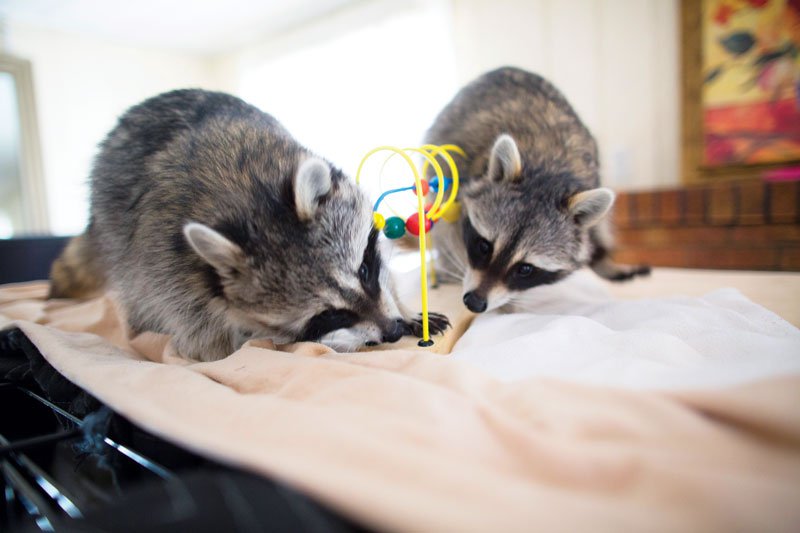
As she tells the story, she mixes up some raccoon formula, adding probiotics. Her current raccoon rescues are wild in both senses of the word: “They growl, but they desperately need their mother,” she remarks. “People need to understand that when these animals growl, they’re out of their mind scared.” She trills at a baby raccoon nestled on her lap. “Yeah, grrrr.” Supporting his head, she lowers the bottle, and he holds it with splayed, clawed fingers.
“Raccoons can pick locks,” she remarks. “They can wrap presents.”
This one’s head tilts back in bliss, and his striped tail twitches. Her hands ring the sides of his mouth: “It’s like creating suction for them.” After a bit, she sets him in a soft blanket, propped against a pillow. He mews, puts down the bottle, and climbs off, so she swoops him up again and briskly burps him. Then she wipes his tiny mouth. “They can get milk burn,” she says, “a rash from the residue.”
The next time we meet, Tapscott announces, by way of greeting, “Possum poo defies all gravity.” I’m here to see the passel of baby possums she just rescued. One sits upright on a suspended platform in a cage, looking at me inquisitively. A dark streak runs down its forehead, and it has a mouse’s long nose, rounded button eyes, ears like dark mushrooms.
Tapscott takes a call from a fellow rehabber, tucking the cell against her cheek while she cleans a possum hammock. “It’s for St. Louis Magazine. All the hoity-toities read it,” I hear her say, “and here she is all clean and perfumey, comin’ to get a whiff of possum crap.”
She ends the call. “It smells worse because their digestive system is so fast,” she informs me. “What they’re passing isn’t all waste; there’s food in there.” A wicked grin. “I could create a real Fear Factor, have people drink this shit!”
Three little heads pop up like periscopes, sticking out of the pouch that she’s fashioned for them. One by one, they climb out onto the platform.
“Do you know possums are the most important animal on the planet?” she asks.
This I did not know. But I am enjoying watching them crawl around, the crisscross of long pink tails making an asterisk in the center of the cage floor.
“First of all, they don’t carry diseases,” she says. “Their body temperature is too low. They can’t catch diseases, either, so they get rid of Lyme disease for us by eating the ticks, and they also get rid of rats and snakes. Possums are nocturnal gardeners. When you’re in bed at night, they’re cleaning up the earth. So if people would let them do their job instead of killing and trapping and removing them… Instead of thinking ‘nuisance,’ try to find out why the animal’s here in the first place. Possums are 65 million years old. And they’re intelligent. When I’m around other humans, I’m thinking, ‘The human race has got to be the dumbest. They have no idea of the magic this earth has.’”
Her cell rings again: Someone’s rushing over day-old robins that need fostering. She fetches glove warmers, a hand-crocheted nest, an incubator.
A rehabber calls looking for a bird expert. “Tattoo that number on your ass,” Tapscott advises, “’cause you’re gonna need her. She’s the No. 1 songbird person, and she’s ethical.”
After a succession of text beeps, the cell rings again. She listens a minute. “Can you take his temp? You can use a regular thermometer—just don’t use it again for you! OK, do you have any baby aspirin? Crush it up, get it in a syringe, and get it down his throat.” She suggests a little more than a quarter of a low-dose aspirin. The caller asks nervous questions. Finally Tapscott says, “It’s not a science; just break the f—ker in half!”
She uses up all her patience on the animals. With the woman who refused to pick up a wounded possum until Tapscott could get there, she bit her tongue so hard, her mouth was bloody. “A predator could have gotten it!”
Then there was the guy who’d trapped a mother skunk in a nice new cage he wanted to keep for future use. With a few judicious snips of a wire cutter, Tapscott let the mother go back to her babies.
“Hey, I’m a volunteer,” she says with a grin. “I told him, ‘You know what? The skunk has babies. Let’s evict her humanely.’ He was Italian, and I used to live on The Hill; we know the same people. I said, ‘Let’s see if I can make you honorable. You let baby skunks die, you’re gonna have to move. Their scent is the worst. But they don’t want to spray you or bother you. She just wants to have her babies’—her den was under the front porch—‘and then she’ll be gone.’”
Tapscott glares at me, needing a proxy. “Animals shouldn’t be trapped. They get stress myopathy, and they can die.”
Much of her time is spent in educating people. Some are clueless but try too hard, “sitting outside in a lawn chair waiting to see if a mother will come back for her baby bunnies. The mother only shows up at dusk and dawn, and you can only see her for a few seconds—it’s this magical Twilight Zone thing—so they sit there all day and miss her.”
Others tell Tapscott, “I felt so helpless, but I didn’t know what to do!”
“A 12-year-old kid found me!” she exclaims. “The grownups make excuses for being dumb. They’re relieved just to hand the animal over. But when kids call, they are so excited: They will do anything to help this animal.”
The baby robins turn out to be starlings, oft maligned. “Good thing you came here,” Tapscott says, “because some rehabbers euthanize them. How long were they without their mom?”
The woman who brought them counts back. “Twelve hours.”
Tapscott shows her how to put water on a paintbrush and rub it on their beaks. Once they’re warm, they can be fed—and you have to feed them every 20 minutes. They’ll let you know!” She hands over the nest. “This is your new handbag. You carry it with you at all times.” She meets the woman’s eyes, focuses in for a second. “Something good will happen to you for doing this. The laws of nature are very powerful.”
The woman smiles, but she’s preoccupied, still sure the hatchlings are baby robins: “There were blue eggshells in the dryer vent!”
“Cowbirds do that,” Tapscott tells her. “They lay birds in other birds’ nests so the other birds will raise them. You make the baby, but you don’t raise it. I’m tellin’ you, they’re more like us than we know.”
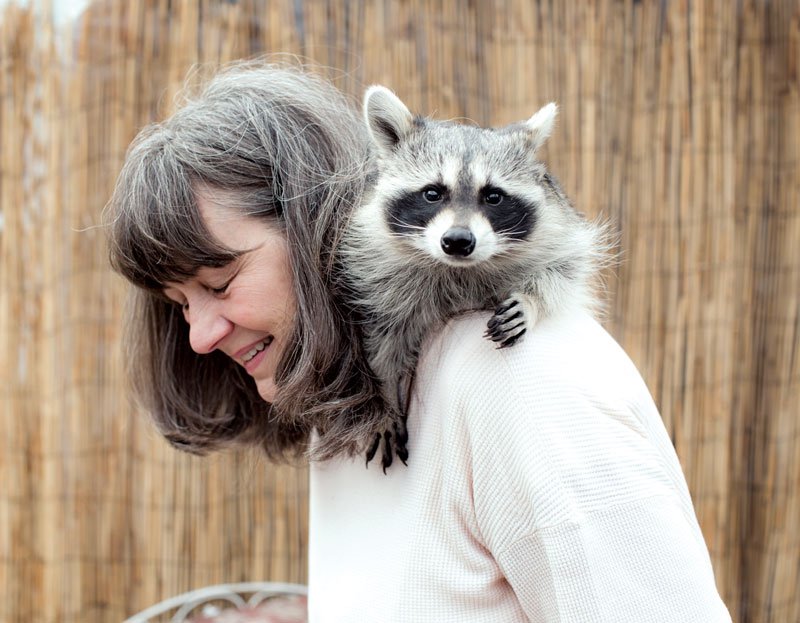
Tapscott grew up “in a Harry Potter world,” saturated with wonder. Her grandmother used to tend animals, and her dad and brother had a talent for wildlife, too. “I was more into getting manicures and going to parties,” she says, ruefully examining nails that are nowhere near party ready.
This time we’re talking at her home. We go outside. “Kathleen, is that you?” Tapscott asks a squirrel watching from a branch. “She’ll come up to me and get her hickory nuts or paper pecans. Someone in a bad area of the city rescued her; she’d lost her mom.”
The picnic table’s centerpiece is a bleached tangle of tree roots. Bird feeders hang from it; squirrels climb on it. “She’s been coming home,” Tapscott says, nodding toward an open-door enclosure with an old lounge chair, a soft floor of leaves and batting, and a quilt fashioned into a sling. “The other squirrels found out, and they came and ransacked her room. She just stood there looking, as though she had her hands on her hips.
“You can teach them how to crack the nuts,” Tapscott continues, “but no one can replace a wild mother. That’s why my biggest prayer is to keep the mothers with the babies. Kathleen will never be 100 percent right.”
Right now, she’s tame and eager, using Tapscott’s yard as her safe space. “She might wild up with sexual maturity. I did have a talk with a hawk; I told him I’d shoot him with a .38, and he’s not been back since.” Still, she adds, “he’s federally protected, and he knows it.”
She was standing outside in this yard—which she calls her “congregation,” because she’d rather meet God by placing a hickory nut in the tiny hands of a squirrel—several years ago, thinking about how humans “take and take and take” from the earth and seldom give anything back. An impulse to help overwhelmed her.
Now, after years of paying attention, asking questions, and staying up all night giving bottles to growling baby raccoons, she’s tapped into a world both subtler and livelier than the one in which most of us dwell. For her, the air’s alive with the thoughts, feelings, and sensations of wild animals. “Most people just see a bird flying around,” she says. “I see their personalities, their interactions with their parents…
“If I were doing hospice or rocking crack babies, people would say, ‘Oh, you are wonderful,’” she remarks, “but for those beings that don’t have a voice—it makes people nervous.”
Grateful, too. Those who bring her foundlings often offer her money.
“What I really want,” she confides, “is sleep.” She shakes her head.
“You’ve got to be a special sort of crazy to do wildlife rescue—but once you start, you can’t stop.”