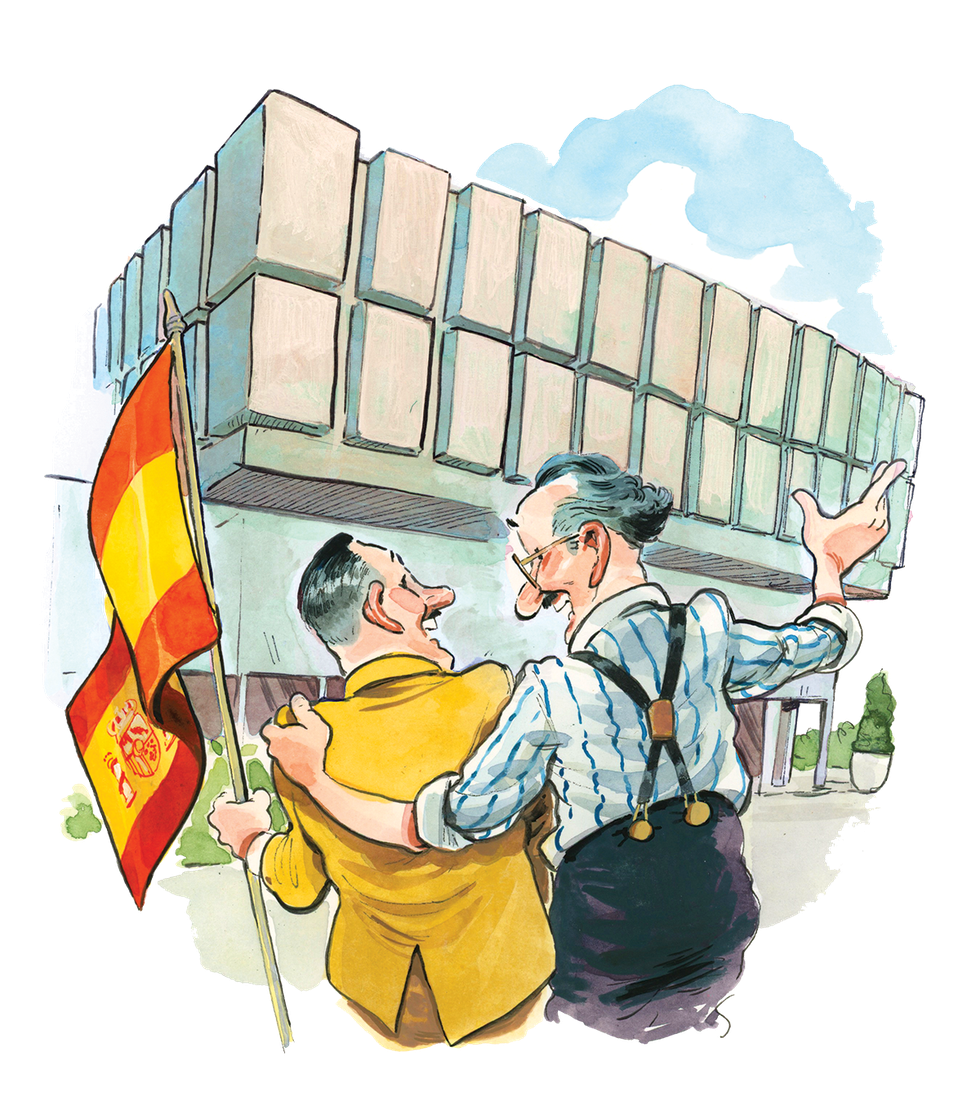
Life Magazine lauded the Spanish Pavilion as the “jewel” of the 1964 New York World’s Fair. Its 27-foot-long iron gate, stucco walls, decorative halls of murals, and geranium-filled courtyards served as an inspired ode to the nation that it represented. But once the fair closed, officials in New York deemed the building too expensive to maintain or move elsewhere in the city. Just as plans were being made to demolish the pavilion, it was moved to St. Louis instead.
That’s because St. Louis Mayor Alfonso J. Cervantes recognized an opportunity. A man proud of his city and his own Spanish heritage, Cervantes asked Spain’s government for permission to relocate the pavilion here. Spanish officials agreed to gift the structure to the city, so long as Cervantes picked up the bill for dismantling, shipping, and rebuilding it at its new location. The mayor organized a fundraising campaign, and the pavilion officially opened in May 1969 as part of a 10-day celebration. By building it on a parking lot at Broadway and Market, Cervantes saw the Spanish Pavilion as the perfect companion to recently constructed downtown attractions, including the Gateway Arch and Busch Stadium. While two of the three corners of St. Louis’ tourist triangle were clear winners, the Spanish Pavilion was a dud.
Although a study projected that the pavilion would attract 2.5 million visitors annually, it reportedly only drew 450,000 during the second half of 1969. Its restaurants lost money, its cultural exhibits fell flat, and within a year of its opening, the Spanish Pavilion sat shuttered. The New York Times dubbed it a “St. Louis fiasco.” Indeed, what was once considered the Big Apple’s jewel had quickly become the Gateway City’s white elephant.
But hotel developer Donald Breckenridge rescued the pavilion with a resourceful idea. He renovated the structure by erecting a 25-story, 352-room hotel atop the courtyard, turning what used to be the Spanish Pavilion into the lobby of his new Breckenridge Pavilion Hotel, which opened in 1976. Over the ensuing decades, the resort changed ownership. Breckenridge sold the hotel to Marriott, which later replaced the pavilion’s original Moorish-style ceiling, which featured more than 350,000 blocks of Flemish pine sourced from the Pyrenees mountains. And while the pavilion’s ceiling was beautiful, it was contaminated with asbestos, the St. Louis Post-Dispatch reported in 1996.
The site is now occupied by the Hilton St. Louis at the Ballpark, where guests can stay just a few floors above what was meant to be a monument to Spanish culture but instead is best remembered—when it is remembered at all—as a well-intentioned boondoggle.