One of the greatest legacies that Bob Cassilly left behind to St. Louis is Architecture Hall, often overlooked by the viscerally enjoyable parts of the City Museum. Between the Building Arts Foundation in Sauget and the collection assembled by Cassilly and the City Museum, St. Louis arguably possesses one of the most extensive records of preserved architectural fragments in the United States. Architecture Hall has on display a wide range of examples from the now-lost architectural heritage of St. Louis, Chicago, and other nearby cities. On a recent weekday, after the crowds had died down slightly, Max gave the author a tour of the collection, where he is planning on hosting a Halloween party next Thursday.
“This is probably your favorite part of the City Museum, isn’t it?” Max grinned as we walked through the third floor. In all honesty, this author has to admit that he had never really examined the collection very closely in the past, and was pleasantly surprised at the important architectural fragments hiding in plain view in this corner of the building. No other institution in St. Louis contains so many pieces of Louis Sullivan ornamentation on public display.
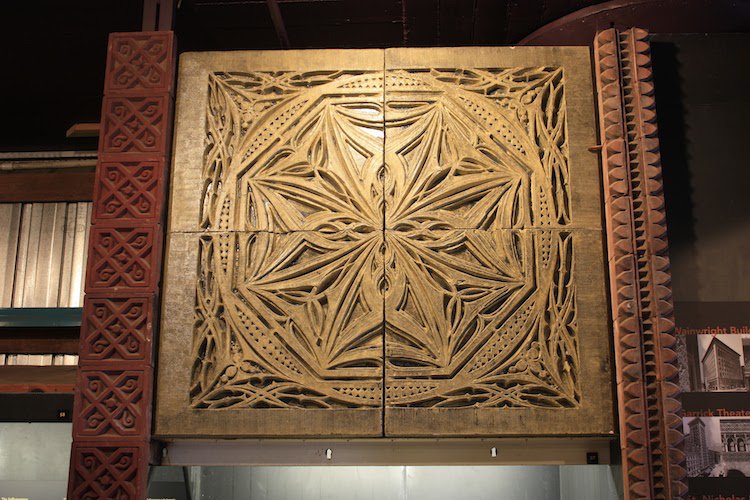
First off, the City Museum has on exhibit two replicas of the terra cotta “snowflake” spandrels from the now-demolished St. Nicholas Hotel, the revolutionary building designed by Dankmar Adler and Louis Sullivan in 1893. These spandrels exist in collections around St. Louis, but upon closer inspection of many of these fragments, one realizes that the four pieces of terra cotta that make up the spandrels often appear to be from different parts of the building. If there is only one benefit of the dirty coal burned in St. Louis, it would its patina of soot left on buildings. Most snowflakes around St. Louis have mismatched soot patterns, lending one to believe the pieces are pastiches. The lack of mismatched soot on the City Museum’s replicas allow one to enjoy the actual designs on their own terms.
Likewise, across the third floor, the City Museum displays some truly sublime, authentic pieces of Adler and Sullivan terracotta from the Chicago Stock Exchange, that icon of the Chicago School demolished decades ago. Its pieces are scattered around the United States, with its central entrance portal on display outside of the Art Institute of Chicago. Embedded in the wall, large pieces of terra cotta in the iconic, Sullivanesque design motifs appear to be pieces of the cornice. In some ways, having the pieces actually incorporated into the walls makes them look better; this author has always been slightly wary of architectural fragments displayed in isolation on mounts against white walls, seemingly floating like ghosts in the air.
The cornice of Chicago’s Broadway Strand Theater (which was built in 1917, and once stood on Roosevelt Road), also appears in the collection. While not originally intended to be viewed at eye level, it nonetheless is interesting to view the detailing closely.
Back to St. Louis architecture: the City Museum also houses numerous fragments from the now-demolished Title Guaranty Building, built in 1898 according to plans by Eames and Young, and later foolishly demolished in 1983. Scattered around St. Louis, the terra cotta caryatids that once graced the cornice of the historic office building show just what the city lost. The City Museum has two of the full-sized caryatids in its collection, as well as a smaller version, which seems to have also been part of the decorative scheme of the building.
In order to highlight this amazing collection of architecture, Max has planned his Halloween party around Sculpture Hall, Thursday, October 29 at 7 p.m., which will feature a whole host of recognizable acts performing over the course of the evening. Also, the architecture will be converted into a haunted house of sorts, with colored lighting that will show off the pieces in a new perspective. This will be one of the last events held in the old Architecture Hall before the pieces are moved one floor up. So this is the perfect chance to reacquaint oneself with the stunning architectural heritage on display at the City Museum.
For more information on “Falling Awake: A City Museum Halloween Spectaculaire” at City Museum, visit the Facebook event page.
Chris Naffziger writes about architecture at St. Louis Patina. Contact him via e-mail at [email protected].
UPDATE (October 23, 12:30 p.m.): City Museum Director Rick Erwin contacted us to make the following clarifications: 1. Only about 2400 square feet of the Architectural Museum will be moving to the fourth floor; also, the Architectural Museum is distinct from Architectural Hall, and is located in another part of the building. Architectural Hall will stay put. 2. Erwin was not contacted by HOK via phone, but rather by email. The sender was John Loyd, Stadium Expert for the Task Force. This email arrived a few days before the story on Rootwad Park ran on SLM‘s website. Erwin says the plans were altered for many reasons, but that Chris Naffziger’s story did bring to light the fact that HOK had overlooked Rootwad Park’s presence within the footprint.