Those portraits. In the final years of his life, in the 1950s, Edwin Lemp, the last son of William Sr. and the youngest of the once-proud brewing clan, began to put his family’s affairs in order. Corresponding via mail with a Missouri History Museum employee, Edwin donated his grandfather Adam’s original copper brew kettle, a small steam engine, and a bottle-corking work bench to the museum in 1953. The employee thanked Edwin for the donation, mentioned the beautiful view over the still-untouched Meramec Valley from the Lemp heir’s estate at Cragwold, and then casually mentioned the family portraits, no doubt hoping to plant a seed in the donor’s mind for a future gift. [1]
When Edwin died, in 1970, he made that gift, donating four family portraits to the Missouri History Museum. According to the 1971 accession records, based on Edwin’s identifications, the paintings came in with the following names for the sitters or subjects of the portraits: Adam Lemp, Justine Clermont Lemp, Louise Bauer Lemp, and William Lemp Sr. All four are painted by or attributed to Charles (or Carl, Karl) Ferdinand Wimar, a German-American painter who lived in St. Louis for much of his career and is famous for his depictions of Native Americans and bison. Wimar is both a fascinating and tragic figure, having been born in Siegburg, in what is now Germany, in 1828. In 1843, his family moved to St. Louis, where he worked with local painter Leon de Pomerade for his initial artistic training. [2]
See More: Unveiling the real Johann Adam Lemp
I was recently given the opportunity to examine early examples of Wimar’s portraiture in what could be called his “Pre-Academic Period” in St. Louis, which lasted until 1852, when he left to study at the art academy in Düsseldorf. [3] Wimar clearly had innate talent before his intensive study in Europe, but when he returned in the winter of 1856-57, his portraiture showed the maturity and influence of academic training. Viewing his portraits of the Lemps and other St. Louisans in the Missouri History Museum’s collection, you can see a distinctive style emerging in his1852–1862 “Academic Period.” Wimar demonstrates much greater understanding of the layering of oil paint and glazing, as well as observation of facial details, the depiction of human hands, and the placement of his sitters in believable backgrounds and interiors. (It’s worth noting that at the time, Wimar was completely inconsistent in his signing and dating of paintings; his works on display at the Saint Louis Art Museum also follow this trend; some are signed and dated, some are only signed, and many are not signed or dated at all.)
But back to the four Lemp paintings. Wimar must have been a very efficient painter, if we are to believe the dates on two of the paintings: the Justine Clermont Lemp and Louise Bauer Lemp portraits. He completed them while in St. Louis between two extensive trips out west.
The Portrait of Louise Bauer Lemp (picuted above) is signed and dated by Charles Wimar in 1857, just after he presumably returned to St. Louis and before his departure up the Missouri River. The sitter is depicted as a young woman, which would be consistent with what we know about the age of Adam Lemp’s third wife. The painting is in an excellent state of conservation and shows Wimar at the height of his portraiture abilities, with his typical depiction of luminescent skin, clothing, fabric, and drapery. A large stone column rises behind her as she holds what looks to be a small white carnation.
See More: Who was Louise Bauer Lemp, Adam Lemp’s mysterious third wife?
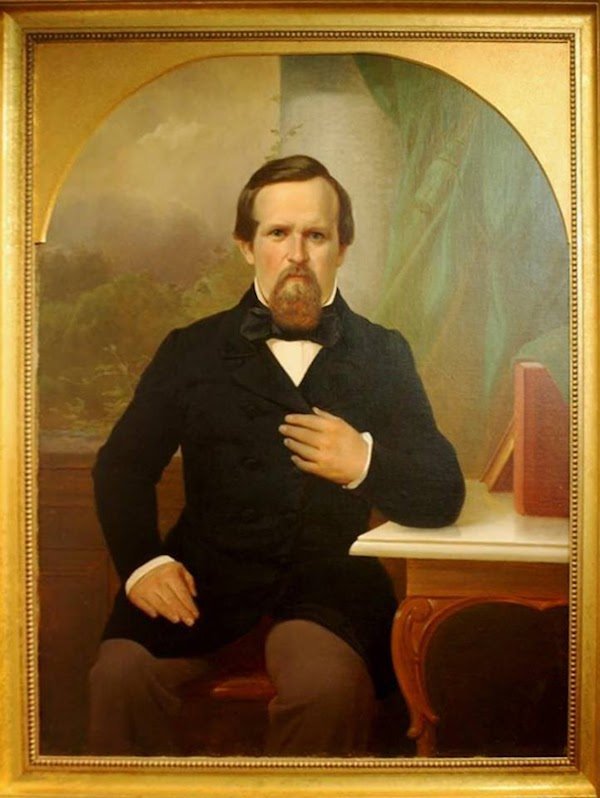
The Portrait of Adam Lemp is not signed or dated, but the handling of paint is consistent with the portrait of Louise. When hung side by side, the painting’s backgrounds form a window, leading you to believe that the portraits functioned as pendants, in which the two paintings were composed for the purpose of being displayed together. Husband and wife portraits are common subjects of pendant paintings. Perhaps this could account for the lack of a signature and date; Wimar could have simply felt that a signature and date on the other portrait was sufficient for both. Adam’s composition is direct and forward, while his wife’s pose is demure and turned toward her husband, consistent with gender roles of the 1850s in St. Louis.
The stories of Adam and Louise’s two portraits are nice and simple—a logical commission for a successful brewer and his wife. But the remaining two portraits given by Edwin Lemp are cloaked in mystery.
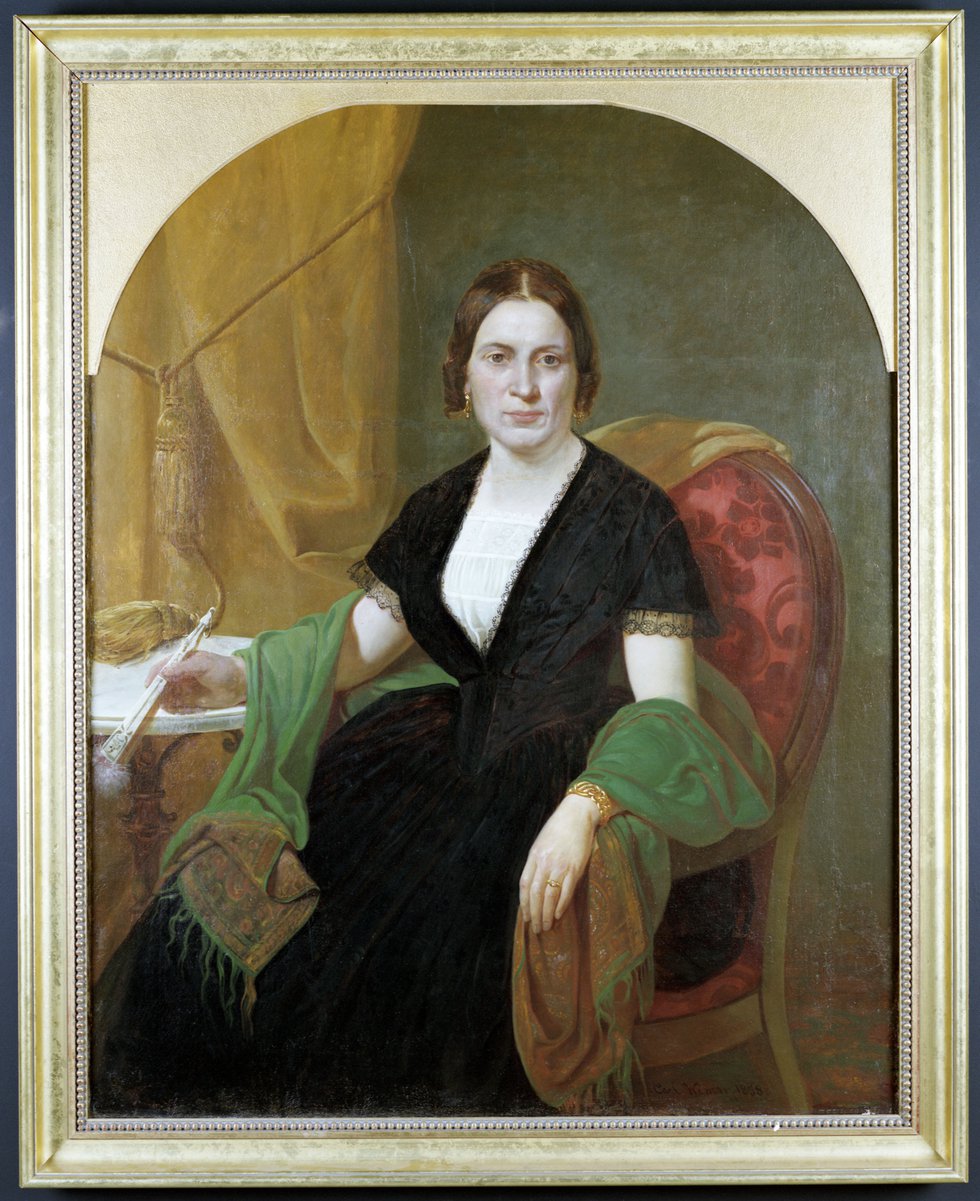
First, the Portrait of “Justine Clermont” Lemp presents us with a quandary. Edwin Lemp’s name for the sitter simply does not exist: It is a combination of the names of the first two wives of Adam Lemp, Anna Clermont and Justina Baum. It seems improbable that the sitter is Anna Clermont, his first wife, as she died in 1832, long before the invention of photography. [4] It also seems unlikely that a highly skilled artist would have been available in such a provincial town as Eschwege, where Adam lived at the time, to sketch her likeness. And it’s even less likely that said drawing would survive until 1858, in order for Wimar to create such a naturalistic depiction of her.
It’s most likely that the older woman in the 1858 portrait is Justina Baum Lemp, mother of William Lemp Sr. and the former second wife of Adam. Though I’m loath to engage in pop psychology, it seems highly improbable that Adam’s third wife, Louise Bauer Lemp, would have been comfortable with her predecessor’s portrait hanging around the couple’s apartment on South Second Street or decorating their Italianate villa on Second Carondelet Avenue. Given the portrait’s date, it easily could have been commissioned independent of the pendant portraits discussed above. Consequently, the patron most likely to have commissioned this portrait is William Lemp Sr., who would have just returned from touring various German states and cities, including Berlin, Leipzig and Eschwege.
From the stamps on his passport, preserved in the collection of the Missouri History Museum, we can develop a timeline in which William could have returned on the famous USS Vanderbilt into New York City after visiting his mother in Eschwege, a photograph of his mother in hand, ready for Wimar to reference for an oil painting. [5] Perhaps the smiling, confident expression of Justina Baum in Wimar’s portrait reflects a mother’s feelings of redemption at seeing how her son had successfully transitioned to his new home in St. Louis. The portrait of Justina Baum also has suffered from a conservation standpoint (in particular, there are some heavy abrasions as well as paint loss on her proper right hand), suggesting that it was displayed or kept in different environmental conditions for a substantial portion of its existence. That would indicate that it was stored apart from the Adam and Louise pendant portraits.
But things become very complicated when we turn to the final, fourth portrait in the Missouri History Museum collection. First of all, this painting is not easily examined or publishable due to conservation issues, though I was able to view it briefly. Neither signed nor dated, it depicts a young man of indeterminate age with brown hair and possibly greenish blue eyes. While the painting is competent, it comes nowhere near the quality of the other three Lemp portraits, or the other Academic Period portraits by Wimar. In fact, the fourth painting even entered the museum’s collection with the lower status of “Attributed to Charles Wimar.” [6] The varnish has darkened considerably. Unlike the other three portraits, this one has no discernable background. In other words, it’s the odd man out. Edwin Lemp identified the sitter as William Lemp Sr., his father, and certainly we must consider that attribution seriously, as it is an immediate family member.
However, there are some major problems. First of all, the probate records of Adam Lemp don’t mention any family portraits in the inventory of his property, which is notable for its incredible attention to detail, even down to the number of glass tumblers in the Lemp saloon on South Second Street. [7] Second, when Louise Bauer Lemp finally died, the inventory of the villa turns up five family portraits. [8] Louise died intestate and in financial difficulty, and the Lemp Brewery bought the villa where William “Billy” Lemp, Jr. lived with his wife Lillian Handlan. [9] It is very possible that the brewery bought the entire contents of the house, including the five portraits listed in the inventory. Certainly the William Sr./Justina Baum branch of the Lemp family reveled at finally seizing control of that last bit of real estate on the corner, right across from their rapidly expanding business across Cherokee Street.
But five family portraits? Who’s the sitter in the fifth portrait? And again, assuming that Louise would not want her husband’s second wife staring at her for decades, who is the fourth sitter? There’s one other detail from William Lemp Sr.’s passport worth mentioning: In that official government document, the young brewer is described as being blond. The man in the portrait clearly has dark brown hair. Could the sitter in the “William Lemp Sr.” portrait actually be Otto Pfaff, the step-grandson of Adam Lemp via his marriage to Louise Bauer? It seems strange that Adam, who describes Otto in his will as a beloved member of his family (Otto even took the Lemp name to show his appreciation of their love), would skip his live-in step-grandson when commissioning portraits of his family. The sitter in the portrait also seems too young to be William—more like a boy—which would better match a youth such as Otto, whose parents, Mathilda and Gottfried Pfaff, had died by the time the Wimar commissions had begun. [10] The inventory also mentioned a landscape, which might well be the view of the cave house built over the lagering cellar on Cherokee Street, now in the collection of the Saint Louis Art Museum. Unfortunately, the men enlisted to conduct the inventory of estates were chosen specifically because they were disinterested parties who were unacquainted with the people involved, and thus the identities of the sitters in the portraits are left a mystery.
See More: What was “Lemp’s Cave” really like?
The men who conducted the inventory of Louise Bauer Lemp’s estate did state that there were five family portraits in that now-demolished Italianate villa across Cherokee Street from the family’s brewery. Somewhere in St. Louis, there might very well be one or two incredibly valuable Lemp family portraits by Charles Ferdinand Wimar waiting to be discovered.
The author wishes to thank Shannon Meyer, Jeff Meyer, Molly Kodner and Jaime Bourassa at the Missouri History Museum and Archives for their assistance. The Portrait of Adam Lemp is on display at the Museum on Lindell.
Chris Naffziger writes about architecture at St. Louis Patina. Contact him via email at [email protected].
[1] Unsigned letter from anonymous Missouri History Museum to Edwin Lemp from 1953 in curatorial files of Lemp portraits.
[2] Hodges, William Romaine. Carl Wimar. Galveston, Texas: Charles Reymershoffer, 1908. p. 12.
[3] Ibid, 14.
[4] Bond, Christy Hawes. Gateway Families: Ancestors and Descendants of Richard Simrall Hawes III and Marie Christy Johnson. 1994, p. 107.
[5] William Lemp Passport, Collection of Missouri History Museum.
[6] Curatorial Record for Portrait of William Lemp.
[7] Inventory of property, August 29, 1862, Adam Lemp Probate File 6229.
[8] Inventory of property, April 3, 1893, Louise Lemp Probate File 19640.
[9] “Mrs. Lemp and Her Son Must Leave Mansion,” St. Louis Post-Dispatch, Vo. 60, no. 276 (May 23, 1908), p. 2.
[10] Burial records for Adam Lemp Plot 800 of Bellefontaine Cemetery.