This year is a flash, a switchover, a bright scintillation on the sharp side of a needle. At Christmas, Queen Victoria travels to the Isle of Wight and begins to die; her son, Edward, is on the throne by January. Paul Poiret seethes through his mandatory French military service, but will soon join the House of Worth. Two years later, he’ll found his own Paris fashion atelier and dispense with the squab-chested, S-silhouette of late Victoriana. The white shirtwaists go; the big, dark circle skirts go. Most important, corsets go, replaced by bras worn under draped dresses inspired by Greco-Roman tunics dyed ecru, turquoise, vivid burnt orange.
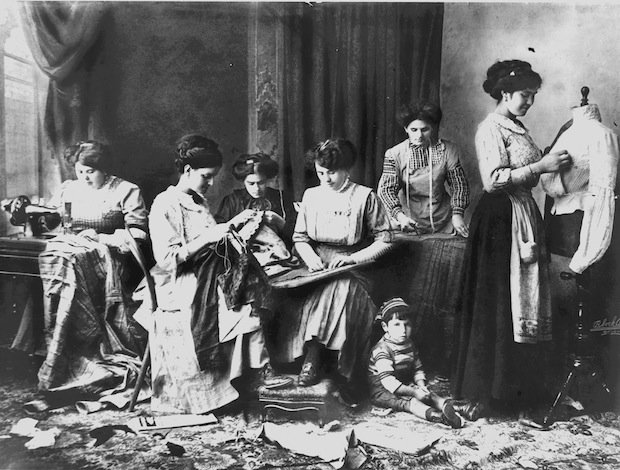
In 1901, St. Louis women copied Paris fashions by handing off a magazine page to a dressmaker or pinning it to their own sewing-room walls. (They could also mail-order anything, from European silks to hooks and eyes in an astonishing array of styles: Camel Brand, Short Bill, Prym’s Continuous, Eagle Talon Improved, Appleton’s Patent Invisible…) Poiret is a sign of things to come, though. His dresses are actor’s clothes, made to look “beautiful from a distance,” without complicated architecture. One jacket sported only a single seam. His dresses sparkle the eyes with silver lamé, cellulose beads, and folksy trims, but don’t require complex tailoring.
By the midteens, the honed skills of dressmakers are less in demand, as the “sweated industry” of seamstressing takes hold. Girls in garment factories spend 12-hour shifts, stitching the same sleeve or collar; they join the ranks of paper-flower makers and coffin-tassel twisters. Though no one remembered Poiret in 1925—Chanel displaced him—his influence lives on in mass-manufactured clothing, particularly fast fashion’s minimally stitched frocks dressed up with grommets and plastic gems.