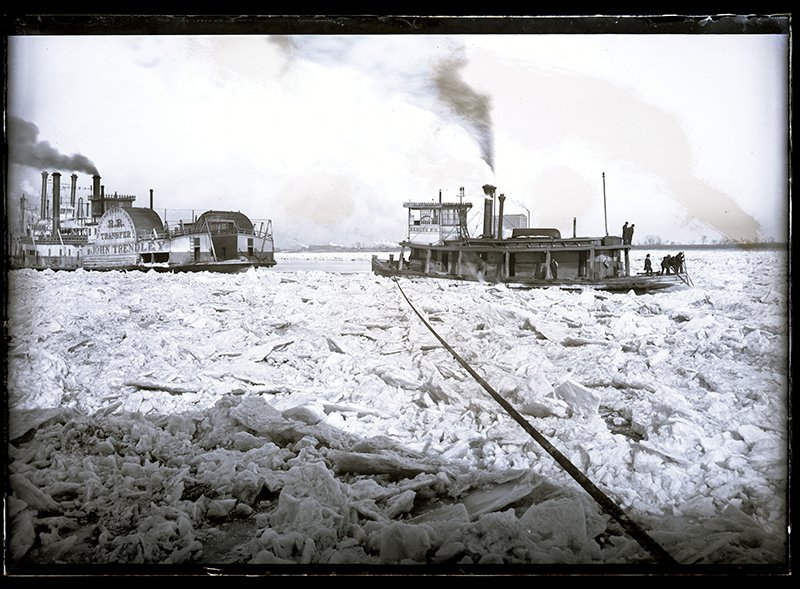
The Mississippi still ices up, but it doesn’t gorge. A gorge, at least as explained in an 1888 article in the St. Louis Post-Dispatch, is “a mass of ice blocks heaped upon one another and rivaling a church steeple in height.” A century or more ago, you could pick up any paper to learn where the ice had stubbornly jammed. Dynamite cartridges, like the ones tossed out by harbor tugs such as this one, Rescue No. 2, had mixed effects. B.W. Denton of Gray’s Iron Line swore that the ice varied from shore to shore. Missouri River ice, he explained, “is light and porous, much mixed with clay and sand, and seldom comes in large fields. But the ice from the upper river is different… It is formed on deep water and is clear and free from impurities, comes in great floes and is solid as iron.” This made it so sharp, he said, that it cut through a hull “like a knife through cheese.” He claimed that it was also “what river men call ‘colder.’ Two lumps the same size and shape may be laid in the sun together and the Missouri River produce will disappear far sooner than that from the upper river.” Ice may have its terroir, but the sun eventually renders every floe—dense, edgy, silty, or buoyant—back into flow.


Kingside Diner opens fifth restaurant in former Rosé by Peno space
The growing local restaurant group aims to fill a neighborhood need with seven-day-a-week breakfast, lunch, takeout, and delivery before eventually expanding into evening service.