With Heart
A COVID-19 diagnosis was just the beginning for one St. Louisan.
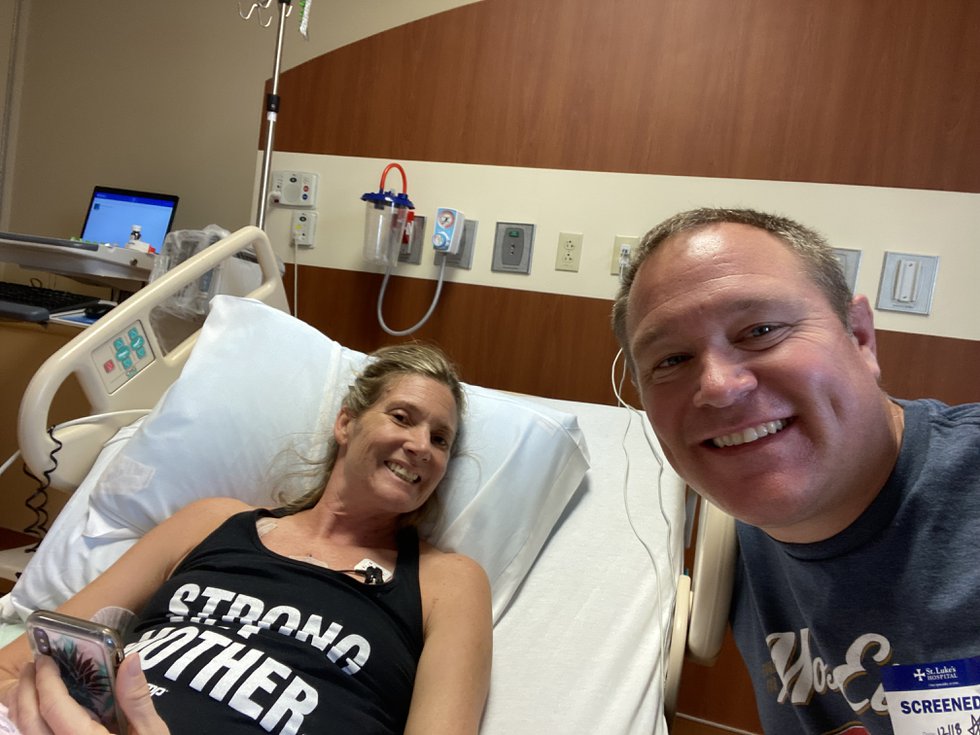
It started with a cough. But within hours of returning home from work on a Friday night in December 2020, Kerri Bryles realized something much more sinister than a cold was ravaging her body. The initial concern was COVID-19. After four negative tests, Bryles received a positive result. And yet, soon after arriving at a local healthcare facility, Bryles and her family learned that the virus was just one of her worries.
Due to a shortage of available beds, Bryles was transferred to St. Luke’s Hospital in Chesterfield, where doctors treating her for respiratory failure found that she also had a malfunctioning heart valve. “They said, ‘Wait a minute. This is a heart event,’” recalls Bryles’s husband, Tim. Indeed, Bryles was suffering from an underlying condition known as torrential mitral regurgitation, which causes a large percentage of blood flow to leak backward, rather than pumping through the rest of the body.
Your guide to a healthier, happier you
Sign up for the St. Louis Wellness newsletter and get practical tips for a balanced, healthy life in St. Louis.
First, a team led by cardiothoracic surgeon Dr. Jeremy Leidenfrost implanted the Impella 5.0, the world’s smallest heart pump, to support Bryles’ heart and allow her body to rest. Then, after nearly a week’s worth of incremental improvement, Leidenfrost was able to perform a successful mitral valve replacement surgery. Best of all, Bryles was able to leave the hospital in time to join her family at home for Christmas.
A year and a half later, she feels as strong as she ever has. “My cardiologist says there’s nothing I can’t do,” Bryles says.
For that, Bryles’ family feels grateful for the care of Leidenfrost and the team at St. Luke’s. “I have a special place in my heart for Dr. Leidenfrost,” Tim says. “Every so often, when I think of a great memory or we have a great Christmas event, I text him something small, like, ‘Hey, thanks again for all that you do.’”
A Dramatic Turnaround
How a life-altering surgery allowed one St. Louisan to continue living independently
Hal Oliver could barely walk. The 78-year-old’s bladder was causing him problems, his appetite was fading, his memory was failing, and he was experiencing wild mood swings. It seemed like he might even need to move into a nursing home. “Everything that could go wrong did,” Oliver says. Something was clearly malfunctioning inside his body, but what could explain all of these different problems?
After routine blood work revealed high calcium levels, Oliver’s primary care physician referred him to Dr. Peter DiPasco, a surgical oncologist with Mercy Clinic Surgical Specialists. DiPasco verified that Oliver was suffering from hyperparathyroidism, a condition caused when at least one of a person’s four parathyroid glands malfunctions and fails to control the amount of calcium in the bloodstream. When that happens, the entire body can pay for the consequences. “He had been suffering for years, and it had gotten worse and worse and worse,” DiPasco says. “It was really dire straits.”
Oliver’s condition made him irritable, and he had trouble processing the diagnosis. So he was initially incredulous when DiPasco said he could perform a surgical procedure that could make all the disparate problems vanish. But Oliver was willing to try just about anything that would allow him to continue living independently at home, so he agreed to the procedure. DiPasco and his team removed an infected parathyroid gland. Within hours of surgery, Oliver says, his problems disappeared.
“It was literally within about an hour and a half in the operating room that we turned his whole life around,” DiPasco says. “He came out of it as a new person. He was a totally different human being and incredibly thankful. I have not seen a transformation that drastic. I’ve seen others that have been memorable, but this was the most dramatic I’ve ever seen.”
A Race Against Time
One transplant team’s harrowing journey to save a patient
The trip to Chicago and back was supposed to be quick and easy for members of the Barnes-Jewish Hospital transplant team. They’d made countless expeditions like this one before. In late January, the team received word that a set of lungs was available there. So the group—a surgical attending physician, a surgical resident, and a transplant coordinator—boarded a private plane bound for Chicago late that night. Although snow was in the forecast for the Chicagoland area, the group was told there would be enough time to get in and out before the worst of the weather rolled in. “But that was not to be the case,” recalls Dr. Katharine Caldwell.
The retrieval process is always a race against time because circulation needs to be reestablished to an organ within six to eight hours. So when the team returned to the plane with a cooler containing the freshly procured lungs, only to find that the storm had blown in sooner than expected, there was concern. Just as she learned that the group’s private plane would not be able to take off, Caldwell looked across the airfield to the commercial jets at neighboring Chicago Midway International Airport and wondered if they could catch a different plane back. A departure list showed an outbound Southwest flight leaving for St. Louis in less than an hour, so the group hurried to the ticket counter.
“I kept explaining to people that I’m a doctor, this is a set of human lungs, and I’m trying to get on the plane,” Caldwell says. “Everyone was outrageously accommodating.” In the cabin, Southwest’s flight crew helped strap the precious cargo into its own seat, and the team was able to make it back to St. Louis in time to complete the transplant. “Without the actions of every single person, from the gate agents to the security people to the flight attendants to the teams in the operating room, this wouldn’t have happened,” Caldwell says.
Back in the Game
How a St. Louis man bounced back after a one-two punch of cancer and COVID
Ken Tohill needed to fix his truck. While working under the hood one day last October, he bumped his chest against the open engine compartment and thought he might have injured a rib. Days later, not only was his chest still throbbing, but Tohill had also come down with a fever. It was just the beginning of his health problems.
After running Tohill through several rounds of scans and X-rays, doctors found what they thought might have been a tumorous mass in his chest. While examining the mass, doctors discovered that Tohill was actually suffering from lymphoma. “It was scary,” he says. There’s never a good time to have cancer, but during a pandemic is especially bad.
A few weeks after his diagnosis, Tohill was admitted to SSM Health St. Joseph Hospital for COVID pneumonia. He endured an eight-day hospital stay, during which he couldn’t walk, struggled to eat, and needed oxygen support. The one-two punch of cancer and COVID made him feel extremely weak all winter and into the spring.
Tohill eventually shook off the effects of COVID and, thanks to the help of the oncology team at the SSM Health Outpatient Center in St. Charles, regular intravenous chemotherapy treatments have helped him get back on his feet and to the softball field this summer. Although he overestimated his leg strength and fell the first time he took to the field, he’s running better now and playing at least two days per week.
All the while, he’s thankful for the care he received—and for that throbbing rib that brought him to the doctor in the first place. “I didn’t know I was sick before, and you couldn’t even tell I’m sick right now,” Tohill says. “I feel like I’m the same person I was before all this stuff started.”
Dear Diary
An ICU diary can help St. Louisans piece together gaps in memory.
Karen Gilbert’s only memories from her three-week stay in the SSM Health St. Joseph Hospital intensive care unit in 2018 aren’t her own. They are words scribbled by her family in a journal that she keeps tucked away in the top drawer of her bedroom dresser.
Not long after Gilbert was admitted to the hospital with Type A influenza that February, her family was tasked with capturing the details of her stay in an ICU diary developed by Dr. Michael Johnson. Because it’s so common for ICU patients to have little or no recollection of their time under the hospital’s care, ICU diaries are places where they can chronicle their recovery, log concerns, provide updates, and piece together gaps in memory caused by ICU psychosis. “It’s kind of like an extended get-well card, in some ways,” Johnson says.
In Gilbert’s diary, there are notes from hospital staff on her progression and how she responded to treatment. Most notable, however, are the deeply personal entries penned by her husband and children, who detailed life updates from outside the hospital walls. “If I didn’t have the journal, I wouldn’t have any of that to look back on or even know about,” Gilbert says. “It’s such a gift because three weeks that otherwise would have been gone are documented.”
Four years after leaving the ICU, Gilbert still occasionally flips through the diary. At this point, it’s not so much to retrieve lost memories but to remember how far she has come and how much she is loved. Recently, she wrote a letter to Johnson. “It was probably one of the most impactful thank-yous I’ve ever received as a physician,” Johnson says. “It triggered the hope that other diary recipients felt the same way.”