This story first appeared in the Outdoors newsletter. Click here to learn more and sign up.
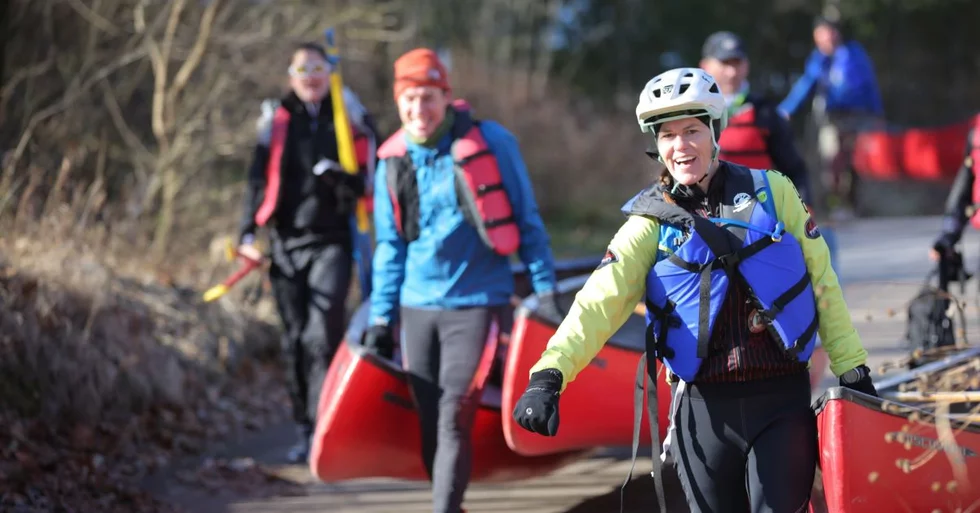
Rain or shine or snow, the 20th edition of the sweaty and mud-caked Castlewood 8-Hour Adventure Race is set for Saturday. That event name is sometimes a misnomer: The contest may or may not pass through its eponymous state park in West County. The precise location is kept secret until the night before. That’s part of the madness.
Discover your next outdoor adventure
Subscribe to the St. Louis Outdoors newsletter to get smarter about hiking, biking, paddling, climbing, and camping within the St. Louis region and beyond.
Here’s how it works, for anyone who missed our recent guide to the sport and is still unaware. The race organizers select a cluster of parks, roads, and waterways somewhere in the region and string together several race “sections,” each requiring a specific mode of travel: paddling, trekking, or mountain biking. When the teams (of two or four racers, moving as a pack) enter a section, they must look at a topo map and clue sheet—again, typically revealed on the eve of the race—to decide the fastest way of finding the various “checkpoints” hidden in that section. One checkpoint equals one point for the team. But each minute they arrive at the finish line past the eight-hour cutoff will effectively erase one of their points. So racers must think before they move—and often, while they’re moving. (All you visual learners can check out our infographic here.)
The Castlewood 8’s organizers, Carrie and Jeff Sona, cap the race at 300 participants, and this year, like previous years, is sold out. If you didn’t register this year but plan to try next year, read on to get a feel for what awaits you.
If you did register, and it’s your first time, there a number of things you’ve probably done already, such as gone to an orienteering meet to learn the basics of navigation; found a teammate (or teammates); gathered your gear (whether it was rented, bought, or borrowed); practiced the three disciplines; and settled on a team goal for the race. But now that we’re less than 48 hours out, here are some quick and final tips from Jeff Sona on how to approach your first Castlewood 8. Says Sona: “This year is going to be hard.”
Meet up with your teammates the night before
Packet pick-up is 4–7 p.m. Friday at Alpine Shop in Kirkwood—the entity that’s putting on the race. Sona recommends meeting with your teammates afterward to go over your maps. “Don’t be afraid to write on your maps,” he says. “You want to highlight your route so that it helps you as you’re going along.”
Be a team player
To Sona, this is the single most important piece of advice he can give. “I just can’t say enough how important it is to be good to your teammates” Sona says. “You get out there and maybe things are going right; it’s easy to get frustrated, bark at a teammate. But be nice—and help one another out. There’s a saving in adventure racing I really like: There’s no better gift you can give your teammates than to let them help you.”
Remind one another to eat and drink
It’s easy to forget to eat because you’re watching your map so intently, Sona says. “Then, all of a sudden, you’re bonking.” He suggests regularly asking your teammates whether they’ve consumed enough and feel ok. Easily digestible carbohydrates are key, although the precise amount, frequency, and kind of snacks and liquids will vary by a racer’s needs and preferences. Here’s a video, posted by Alpine Shop, that goes over the basics.
Stay found
It’s quite common, Sona says, that newbies can run, bike, and paddle way faster than they can read a map. “They’re not watching their map,” he says, “and pretty soon, they have no idea where they are. I’ve done it. Make yourself stay in touch with your map.” In addition, he says, it’s helpful to identify “catching features”—that is, If we see X, we’ll know we’ve gone too far.
Finish with zero checkpoints if you need to
In a marathon, the only way to finish is to run all 26.2 miles. Adventure racing isn’t like that; you don’t need to collect every checkpoint to finish. In fact, Sona says, this year’s Castlewood 8 will have no mandatory checkpoints, so in theory, you could leave the starting line and cross the finish line with zero points and still finish—a bad score, but if finishing is your goal, you’ve accomplished it. Remembering that fact may take some unneeded stress out of your first race, Sona says.
Stay for the post-race party
Sona says that folks come in from Indiana, Iowa, Nebraska, and Arkansas just to do the Castlewood 8—and then after the race, everybody hangs out at the finish line to crack open beers and “geek out” over strategy and tactics. “It’s truly one of the funnest things to talk about,” he says. “How did you guys do this? What was your plan for that? The party atmosphere that occurs afterward is often just as much fun as the race.” So where will the finish-line party be this year? At press time, that was still a secret. But he did say that the after-after party will be at JP’s in Eureka.
The race’s official website is here, and you can find more of Alpine Shop’s informational videos here.