This story first appeared in the Outdoors newsletter. Click here to learn more and sign up.
Sometimes, Jon Richard says, he’ll be up in the canopy of a large Missouri tree, doing work of some kind, and will stop for a moment to sit still on a perch. “It’s just calming,” says Richard. “I look around and think, ‘This isn’t a bad office.’”
Discover your next outdoor adventure
Subscribe to the St. Louis Outdoors newsletter to get smarter about hiking, biking, paddling, climbing, and camping within the St. Louis region and beyond.
Richard is the founder of the St. Louis–based adventure company, Vertical Voyages. He’s a 54-year-old Kirkwood resident and has been at it full-time since 2009. Trees were not on his radar in the beginning, when he premised his business model on the emergence of St. Louis’ four climbing gyms: He expected those to create a bumper crop of folks trying to migrate outside to rock climb, and because the skills of that sport are traditionally passed on from veterans to newbies in-person, he predicted a “mentorship gap”—one that Richard, who is certified with the American Mountain Guides Association, could fill. Plus, he reasoned, the Midwest offers some underrated crags that are not only fun in themselves but also a venue where local climbers could build experience so solid that when they travel to Europe or the American West, they’d be prepared for epic ascents there.
But in the intervening decade and a half, Richard discovered tree climbing. He became a certified arborist, incorporated the activity into Vertical Voyages—and it took off. “It’s the bread and butter of my business,” he says. “In terms of days out, it’s probably fifty-fifty [rock and tree climbing], but in terms of people served, it’s a lot more tree climbers.” One reason: He regularly does programming for schools such as John Burroughs, Rossman, North Kirkwood, and Nipher.
Another reason is that Richard teaches the general public how to get up into the canopy. Here are the two main avenues.
Canopy Climbs at Missouri Botanical Garden and Shaw Nature Reserve
On multiple weekend dates in September and October, Vertical Voyages does “canopy climbs” at Missouri Botanical Garden and Shaw Nature Reserve. These events are for first-timers age 8 and up. The cost is $54 per person for non-members.
At MoBOT, climbers typically ascend a 100-foot pin oak in the Japanese Garden, whereas at Shaw, they work with white oaks. The former location has a taller tree and “more manicured, urban setting,” Richard says; the latter location has less intimidating trees and a more forested environment.
In both locations, Richard says, participants are taught to ascend via a rope system, primarily by using their legs so that it’s less strenuous. There’s no weight limit, Richard says, but if for whatever reason a person can’t fit into the extra large saddle, they can’t climb.
Private Courses and Experiences
Vertical Voyages also offers private tree climbs of two main varieties.
One is private courses. These are for people with a serious interest in eventually using their own gear to climb trees on their own, whether for recreational purposes (such as hunting) or professional purposes (such as tree trimming). The courses tend to take place at the Wyman Center in Eureka.
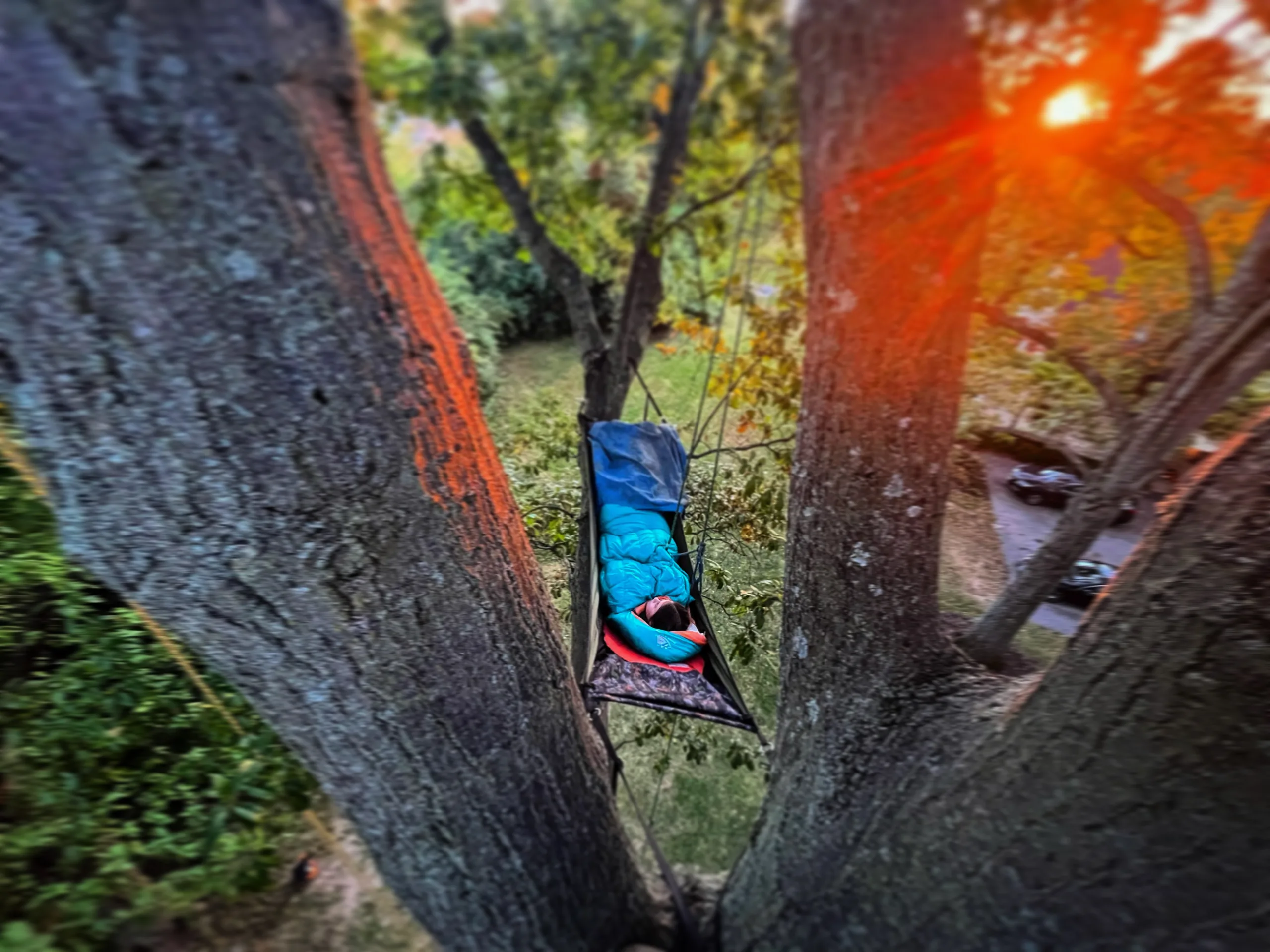
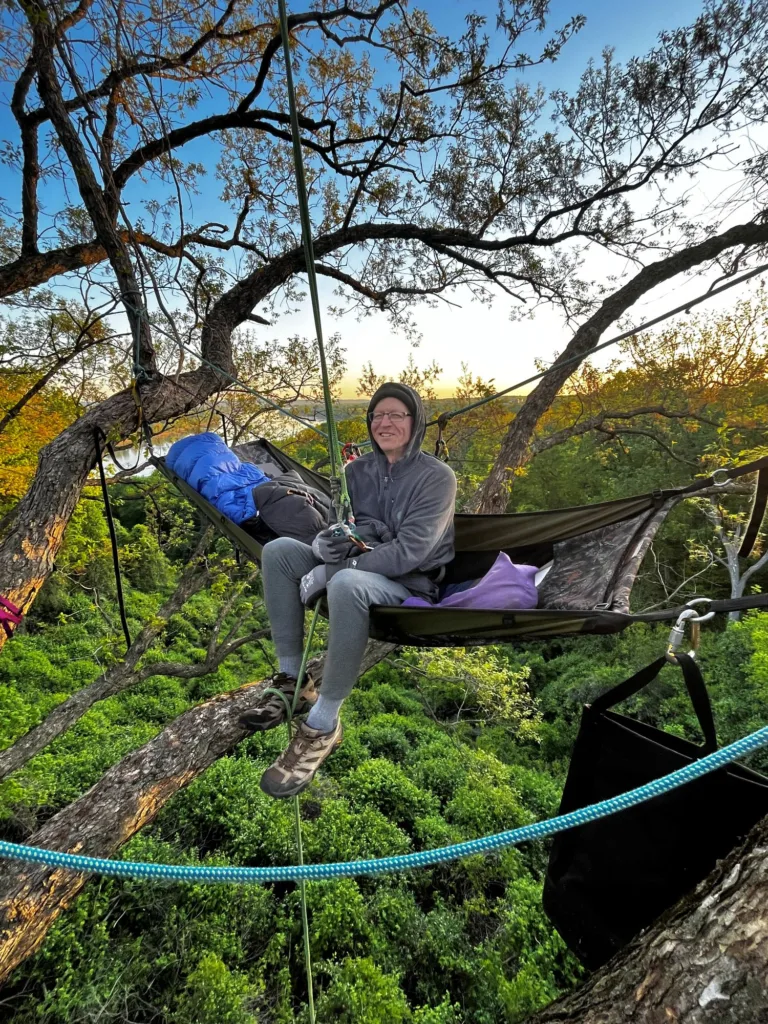
The other is private experiences. The majority of clients just want to try out tree climbing for a day, Richard says, but there’s also the option to camp up in the canopy. Such campouts are on the pricier side—$474 per camper in a party of two, for example—and “not for everybody,” Richard says. “For that, we would recommend [clients] be pretty physically fit and not mind heights.” Campouts generally take place on private land with views of the Missouri River and work best during the favorable weather of the shoulder seasons. Richard says sleeping bags are arranged on platforms similar to the ones rock climbers use to bivy on cliffsides. Campers might spot deer down on the ground below at dusk, or owls on nearby branches, and ideally, will fall asleep under the moon and stars.
Whether camping or not, all tree climbers are connected to the rope system at all times. Richard, who has a sideline as a tree-risk consultant, says that a common question he gets is: How do you know that branch won’t break? “You can’t ever be sure,” he says. “There’s definitely an inherent, intrinsic risk we can’t foresee or manage. Especially with the school programs, we like to teach kids about healthy risk-taking. One of the worst injuries I’ve had was while hiking. I tripped on a root. So things can happen at any time. But our trees are healthy. We’ve checked them.”
In addition, Richard says that he and his staff take steps to avoid damaging the trees themselves. They don’t use spikes that dig into the trunk. Rather, they take a rope tied to a weight and, sometimes using a slingshot, launch the weight over a branch to start setting up a rope system. Once up in the canopy, they install special sleeves to avoid damaging the tree’s bark.
Asked to explain why he finds the canopy “calming,” Richard says: “I think partially the reason is that it’s distancing yourself from the technologies that we create—buildings and phones. But to immerse yourself in the trees and the breeze and the smells, yeah: I find that to be very therapeutic. And it’s just kinda fun to be up in a tree.”