For two and a half months after her cancer diagnosis, writer and illustrator Virginia Elizabeth Hayes stopped thinking, drawing, hoping. She’d “dropped into free-fall,” she says, her body shocked by high-dose radiation. She couldn’t imagine bothering to be creative.
What got you back to writing and drawing? People were sending me things, and I hadn’t responded. Usually I’d draw a little picture, but my brain was giving me nothing. So I woke up in a flop sweat, thinking my mother would know I hadn’t written any thank-you notes. I just did them one at a time. People could probably do better with their feet!—and I want them to. Pick up a pencil. Don’t sit there waiting to die.
Your guide to a healthier, happier you
Sign up for the St. Louis Wellness newsletter and get practical tips for a balanced, healthy life in St. Louis.
What responses did you get? One woman said I had“a serious funny bone.” I thought people might respond to warm and fuzzy, but some really like the defiant ones. I was taught not to be defiant, but sometimes it’s very useful.
Had you always liked the comic book form? I’d never drawn one before! I have a generally sane husband who, in August, decided he wanted these two kittens. At that point, I thought that was the worst thing that could ever happen to me. In December, I got my diagnosis. And then I realized that the worst tumor nights were always the best kitten nights—they’d do all the most adorable things—so the cats had to be part of it.
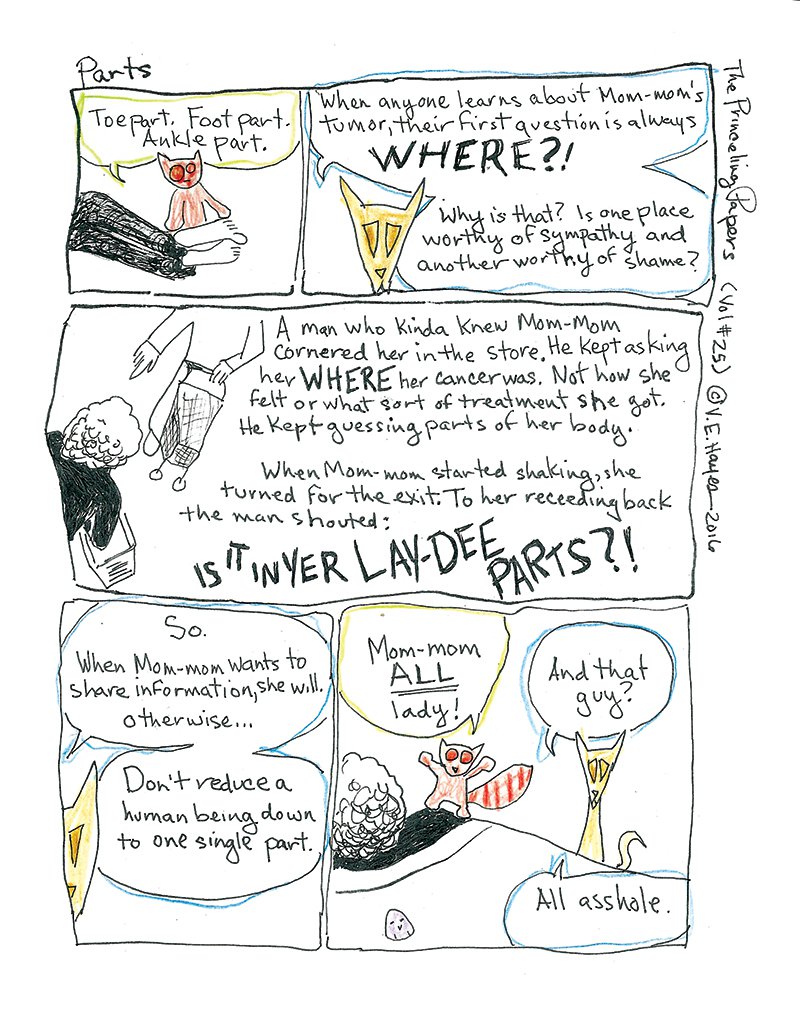
Hence the subtitle to your book The Princeling Papers: Or, how to fight cancer with colored pencils and kittens. I knew if I drew myself talking, it would be nothing but bitterness and anger. The cats were a good filter: They are very excited and happy about things, and I’m not. Also, you have to have someone explain the situation. It’s the only reason there were blonde women in ’50s sci-fi movies: so they could say, “What’s that?” and someone could explain.
The cats were a device but also a comfort? At 2 a.m., you can tell your cat anything. If I hadn’t had the cats and the colored pencils—if I hadn’t decided not to wait until my hands stopped shaking—I don’t think I could have made it.
You started turning awful stuff into humor. Like the man who cornered me at the grocery store: “Oh, Gini, oh my God, you look terrible.” I said I’d just had chemo, and he kept asking me where my cancer was. Not how I felt, just where it was, naming off body parts. I said, “You know what? I’m not sure that’s important.” And in the middle of the grocery store, he yelled, “Is it in your lady parts?”
Good God. There were some things I didn’t make cartoons of; I couldn’t get the bitterness out. My grandma used to say, “When it’s funny, I’ll tell you the story.”