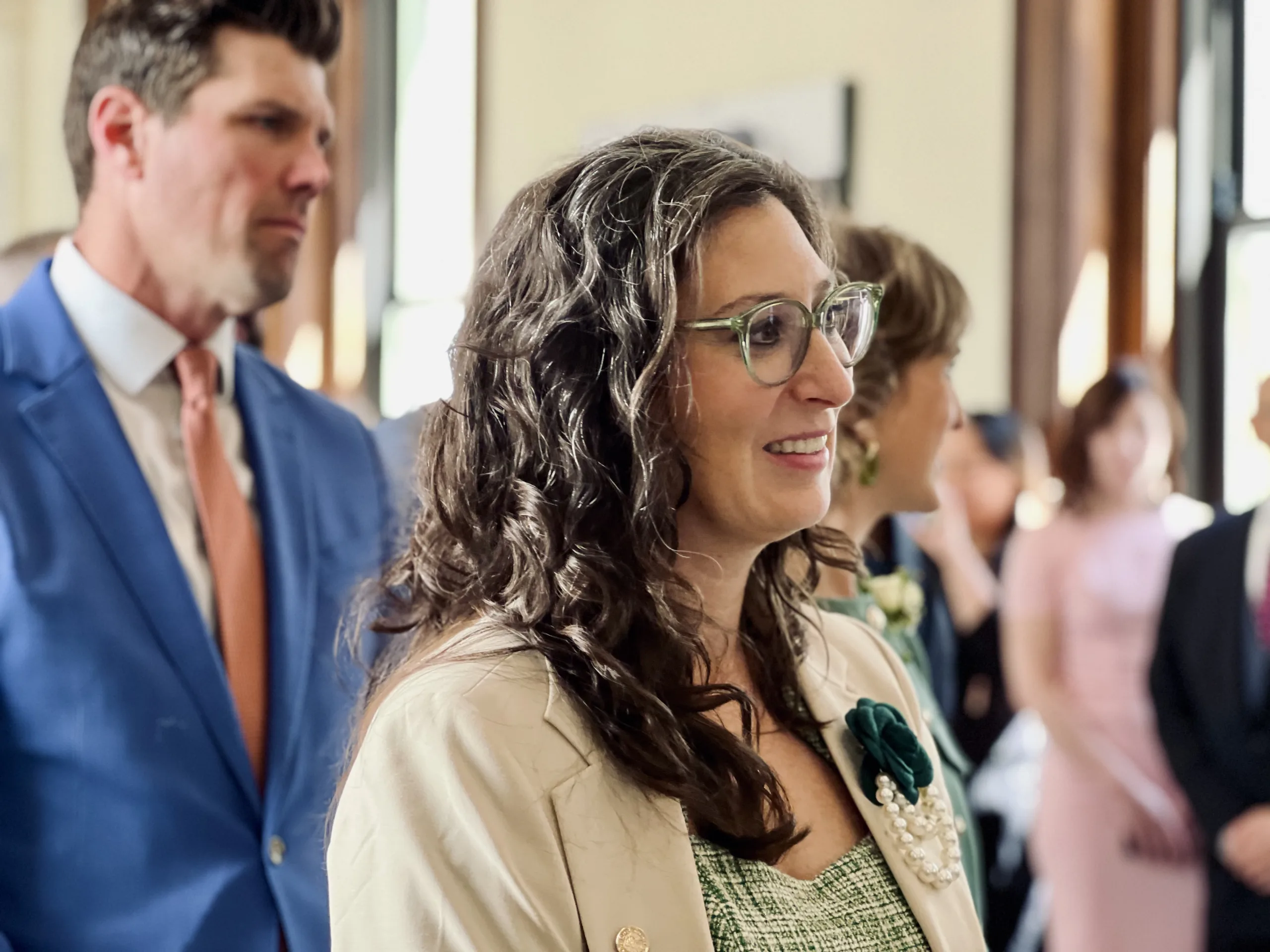
When Megan Ellyia Green was elected president of the St. Louis Board of Aldermen in 2022, she made history. Now, she’s about to do it again—this time as the first person to hold the office while becoming a mother.
As she prepares to welcome her first child after a years-long IVF journey, Green is bringing that experience into sharper focus and using it to highlight issues facing St. Louis families, from childcare costs to parental leave. During her tenure, those priorities have translated into policy: expanded fertility coverage for city employees, legislation to allow bigger families more housing options, and housing stability efforts aimed at keeping kids in consistent learning environments.
Discover fun things to do with the family
Subscribe to the St. Louis Family newsletter for family-friendly things to do and news for local parents, sent every Monday.
Redefining Leadership
From the start, Green saw her election as more than symbolic.
“I think from the beginning, we knew that my election was going to mean a lot of firsts,” she says—pointing not just to being the first woman in the role, but to launching a youth council, unionizing staff, and making board proceedings more accessible.
That approach has also shaped how she prioritizes family-focused policy—and her decision to speak publicly about her fertility journey, something many still navigate quietly.
“There’s still so much stigma around infertility,” she says. “When I started talking about it, I began hearing from so many people, even friends, who had gone through it but had never shared their experiences.”
For Green, the path to motherhood began during an unexpectedly difficult stretch. In 2021, after a severe case of COVID-19 led to long-term symptoms, she found herself slowing down and taking stock. “I spent months not able to do much beyond moving from the couch to my computer chair,” she says. “It gave me time to think about the things I had and hadn’t done.”
One of those things was becoming a parent. She began exploring that path in 2021, initially planning to pursue motherhood on her own.
“I started my journey in 2021 thinking I would be a single mother by choice, but in the fall of 2022, I met the person who would become my husband,” she says. “Fortunately, he was supportive of the process from the very beginning, and we got married in December 2024. It seemed serendipitous in some ways; I was determined to go down this path whether or not I had a significant other, but meeting him gave me even more confidence that I’d be able to move forward.”
As she moved ahead, Green decided to pursue fertility testing—expecting, like many people, that time was still on her side. Instead, she was met with a diagnosis that would reshape and accelerate her path forward: diminished ovarian reserve.
What followed was a years-long process marked by physical strain, financial pressure, and repeated uncertainty.

The Cost of Building a Family
Like many families navigating infertility, Green quickly learned the process was as financial as it was emotional. A single round of IVF in the U.S. can cost $25,000 to $30,000 or more, often without insurance coverage. Searching for more affordable options, she traveled to Barbados for her first round of IVF. The attempt was unsuccessful; an early ovulation meant she never made it to egg retrieval. Doctors pivoted to intrauterine insemination (IUI), which also failed.
Back in St. Louis, multiple rounds of IUI followed, each bringing the same cycle of hope and disappointment. “Every month, you think, ‘This is going to be the time,’” she says. “And then it isn’t.”
As the physical toll intensified, so did her awareness of a broader issue: access. Conversations with her doctor revealed how few employers offer fertility coverage—and how prohibitive the costs can be.
So when the city reviewed its employee health plan, Green pushed to include it. “We asked if we could add fertility benefits,” she says. “And what was amazing is that we were able to do it without increasing costs.”
The change added tens of thousands of dollars in coverage for medications and procedures—an uncommon benefit that broadened access for employees experiencing infertility, as well as LGBTQ+ families building a path to parenthood.
Green would come to rely on the plan, and understand its limits, firsthand. In one round alone, she exhausted the entire medication benefit allocated by the city’s plan.
After multiple egg retrievals, she reached nine viable eggs. That was fewer than recommended, but enough to move forward. “We decided to take the chance,” she says.
At age 42, the first transfer worked.
A Community Effort
By the time the pregnancy took hold, it hardly felt like a victory Green had reached alone. “I’m lucky that I have a very supportive staff,” she says. “I could say, ‘I’m going through another round—if I seem a little off, it’s because of the hormones.’ And everyone understood.”
Through the highs and lows, her team followed along, celebrating small milestones and weathering setbacks. When the transfer finally worked, the moment felt collective. “It really did feel like the whole office was rooting for this,” she says.
Now, with a baby boy due in May, she’s weeks away from meeting her son—something that once felt uncertain after nearly four years. “I’m definitely at the point where I’m ready for this part to be over,” she says with a laugh.

From Conception to City Hall
For Green, the overlap between personal experience and public policy isn’t abstract. “People often think of City Hall as roads and budgets,” she says. “But the decisions we make every day affect what it looks like to raise a family here.”
Childcare is one of the clearest examples. Like many parents, Green encountered long waitlists and costs for many daycare centers that rival a mortgage. “It’s about a year wait everywhere,” she says. “And then it’s $1,400 or $1,500 a month.” The impact extends beyond individual households, with high costs pushing some parents out of the workforce, or out of the city altogether.
In response, the city has tried testing new approaches: a guaranteed basic income pilot for families with public school students (later moved to private funding after a legal challenge), temporary housing partnerships for unhoused families, and funding to help tenants avoid sudden displacement. Those policies are rooted in the idea that stability at home shapes outcomes for children, Green says.
At times, the city staff has struggled to deliver on the various big ideas dreamed up by the Board of Aldermen. But Green still defends the legislative’s body ambitions.
“There are always financial constraints when it comes to writing and implementing big policy ideas, but at the end of the day it comes down to what our priorities are,” she adds. “And if our priority is, for instance, that everybody in our city should be housed, then we have to pursue programs like the Impacted Tenants Fund. You only get places by thinking big and working hard to achieve those goals. It’s much easier and more cost effective to tackle issues like housing by working proactively rather than reactively.”
Inside her office, Green has worked to model a more flexible approach, allowing staff to adjust schedules, work remotely, or bring children to work when needed. “It’s about recognizing that people are whole people,” she says. “You can’t separate work from family life.”
She sees room to go further—through expanded childcare support, stronger benefits, and policies that make it easier for families to stay. Housing is part of that equation.
“A lot of what we’re building are studios and one-bedrooms,” she says. “But families need space—and if the city wants them to stay, it has to plan for that.” Last year, aldermen approved a plan to relax occupancy codes to allow larger families in some types of residences than were previously permitted.
Green also points to other emerging solutions: a proposed ballot initiative to raise sales taxes to fund early childcare providers and state-level pilot programs aimed at lowering costs. “This is about whether families can afford to live here, work here, and stay here,” she says.
The City She Hopes to Build
As Green prepares to step into motherhood, she’s also thinking about the kind of city her son will grow up in. “I want him to grow up in a place that’s accepting,” she says. “Where he feels safe, where he has opportunity.”
That vision shapes both her policy priorities and her leadership and the message she hopes other women take from her experience. “Don’t be afraid to do it all,” she says. “I think society often tells women you have to choose. And I just don’t believe that’s true.”
For Green, the goal isn’t just to balance work and family. It’s to make that balance more attainable for others.
St. Louis, she believes, already has much of what families need: parks, cultural institutions, neighborhoods filled with young parents. The challenge is making it possible to stay. “We have so many of the things that make a great place to raise kids,” she says. “Now it’s about making sure people can actually build their lives here.”
As Green prepares to welcome her son this spring, these issues are no longer theoretical—they’re personal. And the future of St. Louis is no longer just policy. It’s parenthood.


