Safety in Subtlety
ARCHITECTS AND EDUCATORS ARE TRYING TO DETER SCHOOL SHOOTINGS IN WAYS YOU MIGHT NOT NOTICE.
The thickness of classroom tables is not a trivial detail to the Lindbergh Schools’ superintendent Tony Lake. “You can build a barricade,” says Lake, who on a recent afternoon is crouching inside his district’s newly constructed high school to muscle a long table upward so that it stands on end. “If somebody is shooting through that window,” he says, gesturing forward, “and also this table, it might get through and hit you, but it wouldn’t do as much damage.”
Discover fun things to do with the family
Subscribe to the St. Louis Family newsletter for family-friendly things to do and news for local parents, sent every Monday.
It’s a scenario that a superintendent must contemplate in a country with abundant firearms and a decades-long pattern of school shootings. Education Week counted 144 such incidents from 2018 through 2022. Last October, at Central Visual and Performing Arts High School, an alum killed two and wounded several others after shooting out the window of a side door and letting himself in. That fact, according to interviews with education officials in the region, compelled some area school leaders to take a closer look at their own existing perimeters.
“We’re looking at every single thing that we could look at to try to make sure this kind of thing doesn’t happen again,” said Kelvin Adams, the former superintendent of the city’s school district, “and obviously, the exterior is of consideration.”
Over time, though, the accumulation of similar shootings, from Uvalde and Parkland to Newtown and Columbine, has had an even broader effect: It has informed how schools are designed, built, and furnished in the first place. And many of these details will be subtle, or even invisible, to the casual observer.
That’s certainly the case at Lindbergh, where a $105 million bond issue has enabled, among other things, a well-protected new high school. One reason for subtlety of design, Lake says, is to foster a warm and welcoming atmosphere (instead of a prisonlike one) for students. Another is to obscure sensitive info from bad actors. Lake declines to specify, for example, which panes of glass at Lindbergh are ballistic rated, or bulletproof, or neither. But some features he’s willing to point out.
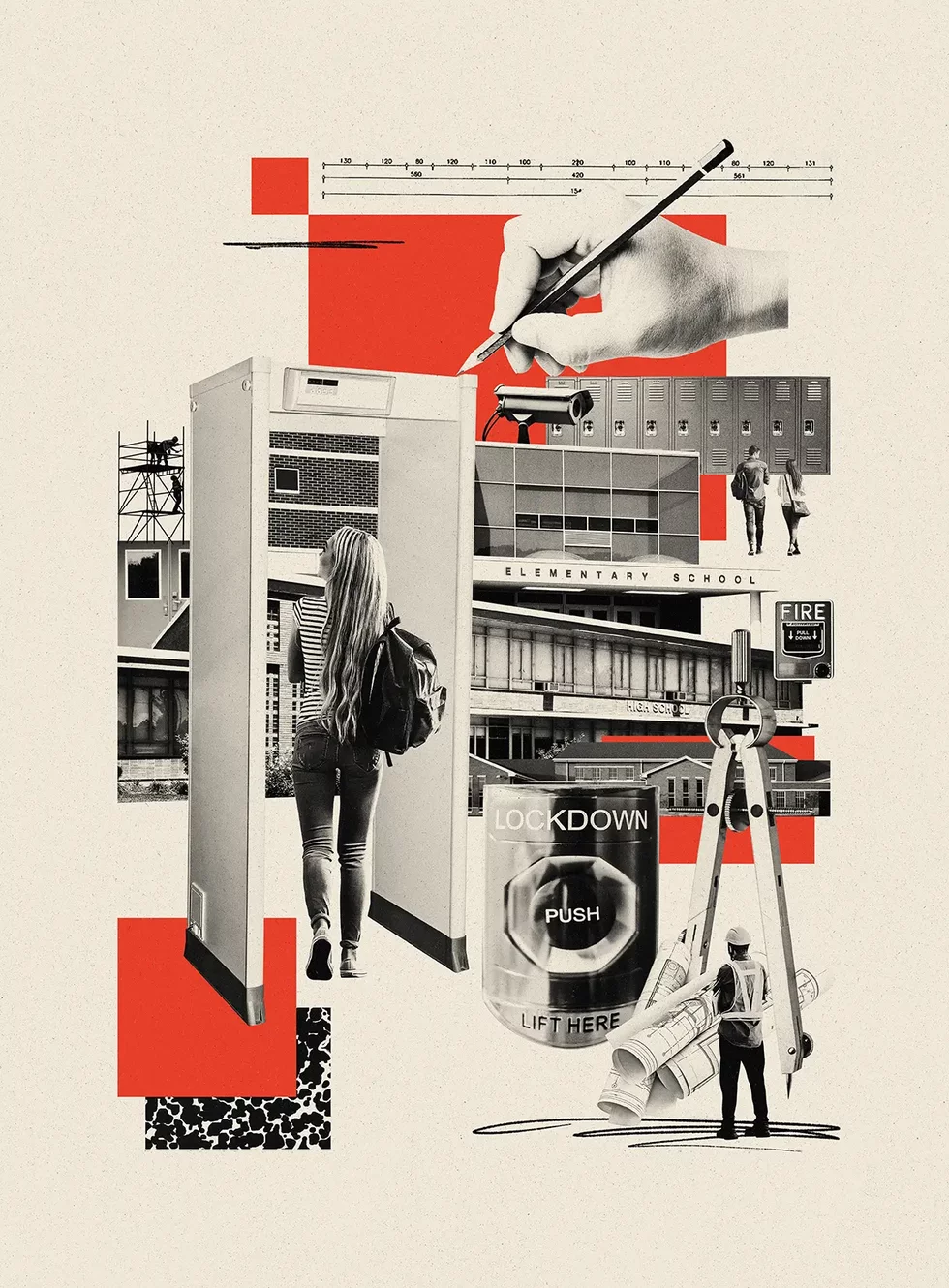
On the second floor, he leads us along a corridor edged with high-impact sheetrock walls, which offer more protection than plaster does. Some classrooms here are fronted with garage doors that can slide up and allow students to spill out into the common space and collaborate. But students also have access to a “hard corner”—that is, a spot where people can gather outside the line of sight of someone who’s standing at a door and looking through its window. And certain classroom doors have thumb-turn locks so a teacher won’t have to search for keys in a moment of panic.
Yet no visual feature calls to mind a nightmare scenario, observes Phil Santore, the managing principal at Ross & Baruzzini who consulted on Lindbergh’s project. It looks like a regular school. “At the end of the day,” says Santore, who also consulted on the rebuilds of Sandy Hook Elementary and the World Trade Center, “we’re not trying to build Fort Knox. We’re trying to buy time for law enforcement to arrive.”
And to buy time, Santore argues, schools should focus first on their perimeters. Lindbergh used to have multiple points of entry; it will soon have only one, through a vestibule where a security officer behind a window must buzz you in.
Lake knows the built environment can’t do it all. Relationships help, he argues. The school’s single extended lunch hour, which allows students a better chance to join extracurriculars and socialize, has measurably reduced stress and increased feelings of connectivity, he says. And many safety features at Lindbergh don’t directly relate to active shooters; the fortified band room, for instance, could withstand a tornado. Restroom stalls are enclosed to prevent acts of bullying. The vice principals’ offices were moved out of the admin area and into the mix with students.
But as superintendent, Lake imagines the worst. He halts our walking tour at a window overlooking Lindbergh’s new entrance. Soon, he says, traffic bollards down below will be in place, in part to stop any vehicle from ramming into the edifice. There’s also a plan before the school board to purchase an alarm system, made by a company called Centegix, wherein any faculty or staff member could rapidly press a button multiple times on a worn badge and lock down the building. “We think it’ll be a game-changer,” he says, “as far as giving people peace of mind and giving people time.”
GREEN SPACE
Area schools are incorporating the great outdoors into building blueprints, lesson plans, field trips, and more. After significant damage from flash flooding last summer, New City School is reimagining its early childhood spaces to emphasize the natural world and outdoor learning opportunities, as well as to provide areas for students to interact in small groups. Last year, the U.S. Department of Education recognized Principia School and the School District of University City as Green Ribbon Schools, an honor that highlights a school’s commitment to sustainability in its educational programs and campus-wide practices. Principia also recently received Missouri Green Schools’ Seedling honor, given to schools that integrate sustainability into their curriculum through place-based learning opportunities. Having conducted solar energy research at Washington University last summer, as part of a National Science Foundation partnership, Whitfield School chemistry teacher Chris Sellers is incorporating the experience into the lesson plans for his Accelerated Chemistry course. And eighth graders at The College School take a nine-day trip each year to the southeastern United States to learn more about field ecology. Students conduct experiments in the ocean, waterfalls, wetlands, and more.
Retention Tension
MISSOURI EDUCATORS AND POLITICIANS ARE TACKLING HOW TO ATTRACT AND RETAIN TEACHERS.
An English teacher who prefers to be quoted only by her first name, Jackie, struggled, during her final year at a public high school in St. Louis, to balance her work and personal life. The number of hours she put in during evenings and weekends was draining her. Worries about particular students seeped into her private life. She asked her boyfriend to change her school email password each Saturday and not tell her what it was so she could restrict her access to the account for the weekend.
But the thing that pushed Jackie over the edge were the parents. “I very rarely felt like I was treated as a professional,” she says. One time Jackie reached out to a student, who was taking her class virtually, with concerns about participation in discussion and turning in homework. Jackie says the student’s parent emailed her back and said teachers like her were the reason children were suicidal during the pandemic.
Jackie took an unpaid leave of absence for the 2021–2022 school year to decide if teaching was something she could continue. The school board asked her in January 2022 whether she was coming back. Her answer was no.
Jackie’s experience isn’t singular. Across the nation, public schools are struggling to attract and retain teachers. In Missouri, about 8 percent of full-time teaching jobs are either vacant or filled by someone who isn’t fully certified. About 40 percent of new teachers here leave the profession within the first three years of their careers. Zoom out to five years, and the number jumps to 50 percent.
The Missouri Department of Elementary and Secondary Education is well-aware of the problem, says Mallory McGowin, its chief communications officer. “We fully believe that we are on the cusp of a crisis here,” she says.
In the meantime, administrators are left to figure out how to attract the next generation of educators—and how to protect the ones who are already there from burning out.
In August, the organization PDK released the results of its annual poll of the Public’s Attitudes Toward the Public Schools. In the findings was a twist: While more respondents than ever gave an A or B grade to their community’s public school, more people than ever also said they would not want their child to become a public school teacher. Among the reasons: poor pay, the demands of the job, and lack of respect for the profession.
The state is trying to address the low wages. Last summer, the Missouri State Board of Education convened a commission to study the teacher shortage and troubles with retention. Missouri’s average starting teacher salary—$32,970—is the lowest in the country, so the commission recommended that the Missouri legislature amend a statute and raise the minimum starting teacher salary to at least $38,000. The Missouri legislature is now weighing increasing teachers’ wages permanently.
But there are other reasons why teachers are unhappy, DESE says, and these are more difficult to change with policy. They’re largely cultural, related to the political climate and poor working conditions.
McGowin says that teachers have said it quite clearly: To stay in the classroom, they’ll need more than a salary increase. Basic things that would make their day-to-day more tolerable must also be changed.
Low pay led another teacher, whose first name is Laura, to leave the small Catholic school where she was teaching English for a spot at a bigger school with more resources. But pay wasn’t the reason that Laura left the profession altogether in 2022. When the pandemic hit and her school pivoted to virtual learning, Laura says, it was terrible—but also temporary. When school resumed in person, in August 2021, she made it to September before resolving that it would be her last year in the classroom.
“Everyone was having serious behavior problems with the students,” she recalls. “The students had lost two years of school, and they didn’t know how to be a student. I was doing 10 times the work just managing students instead of teaching.”
Around that same time, Laura says, “parents and politics got really nasty.” Because of talk surrounding book bans, she felt like there was a lack of trust in her judgment. She was nervous to discuss sensitive topics. “Every week, it was, ‘So-and-so is pushing parents’ freedom of choice for their students’ and, ‘Teachers are grooming your children,’ and who wants to go into a profession where you’re seen as a person who’s abusing children?”
When Laura was mulling an exit, her therapist asked what she would need to stay. Autonomy was a big factor. So was switching to a school week in which educators teach in the classroom for four days with one day set aside for planning.
Jenny, an English Language Arts teacher for a public high school, also says fewer in-person instruction days would make teaching more manageable. Jenny says her students’ incessant use of smartphones has soured her teaching experience. She often wonders whether she should cede her job to someone younger who wouldn’t be so annoyed by it. But beyond how irritating she finds the phones, Jenny wonders: Should students, who are growing up with more technology, more stimulation, than ever before, be expected to sit and do traditional school for seven hours a day, five days a week?
Teachers, Jenny points out, now have to work much harder than in the past to keep students engaged because, for most kids, watching TikTok videos is way more entertaining than talking about imagery in The Great Gatsby. “It’s not as if before cell phones kids were like, ‘I can’t wait to learn about semicolons,’” she says. But now kids have a tiny computer virtually attached to their body, and that computer contains everything they could ever want to look at.
“It seems like it’s a new world, and we need to change some things because I don’t know that we’re meeting the needs of kids,” she continues. “I think that school shouldn’t be totally virtual because so much of school is learning how to function as a person in the world—how to be around different types of people, how to adjust to people who don’t agree with you or who annoy you.”
But if a school week consisted of two days in person and three days of independent work, maybe teachers could be more strict about no phones in the classroom during the in-person days. And maybe teachers like Jenny wouldn’t be considering leaving the profession.
While DESE works on another set of recommendations to address factors unrelated to pay, some superintendents are trying to get ahead of the retention problem by creating their own pool of future teachers.
Last year, Parkway Schools superintendent Dr. Keith Marty had an opening at one of his schools for a principal. Ten years ago, he probably would have received 100 candidates; for this role, there were 7 qualified applicants, he says.
Faced with reality—fewer people are pursuing careers in education—Marty made the decision to recruit within the school district’s student pool. Spark! Teaching & Learning is a sort of Grow Your Own Teacher program, in which juniors and seniors receive dual credit for shadowing a mentor and going to classrooms at elementary, middle, and high schools to work with kids. “We’re also working with local universities to hopefully get scholarships for these students,” Marty says. “The idea is that we’d give them opportunities through college, and then they would come back to Parkway upon graduation.”
The Spark! teaching program is still in its early stages—it hasn’t seen any former Parkway students graduate and come back to teach. In the meantime, Marty says, Parkway is considering how to make the day-to-day reality for teachers more pleasant. Marty says the district continually looks at how it can make salaries more competitive and provides mental health resources through its employee assistance program.
“We made the decision to create, hopefully, a positive environment where people look at the profession for what it is really meant to be: working with young people,” he says. “We have to think about our future because we need good people in our classrooms.”
PAVING A PATH
During a time of teacher shortages and turnover, a local program is striving to help new educators in the city succeed. Working in partnership with University College and the Institute for School Partnership at Washington University, the St. Louis Teacher Residency provides an alternative path for aspiring educators looking to quickly gain real-world experience. The program, launched in 2018 by Wash. U. alum Laura Vilines and Anne Lamb, takes an approach somewhat akin to a medical residency: Rather than complete the traditional steps, participants—many of whom are pursuing a second career—are immediately placed in partner schools for a year-long apprenticeship while taking classes, receiving a stipend, and earning a teaching certificate. During their second year in the program, participants become lead teachers and work toward completing a master’s degree. Residency graduates are then expected to continue teaching at a partner school or district for at least three years. The idea: It carves out a much-needed pathway to support both educators and high-needs students.