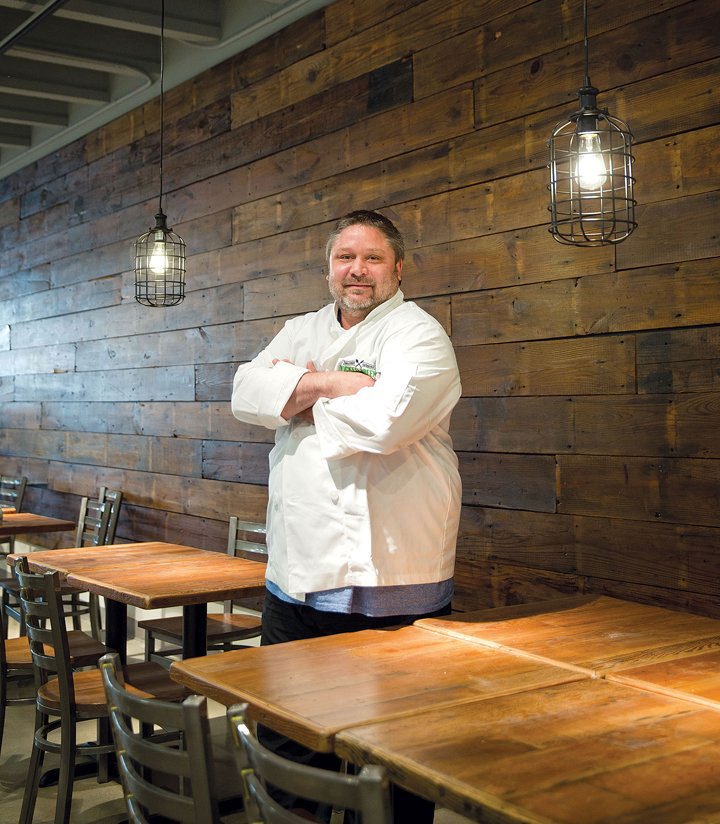
Thirteen salads, each served with its own dressing—only a chef would attempt to design such a menu. At Wicked Greenz, partner Justin Haifley (formerly of The Tavern and Cucina Pazzo) serves only salads, half a dozen homemade soups, and a handful of prepared foods. The enterprising chef even cuts salad vegetables differently.
You spent 11 years working for your mentor, chef Roy Yamaguchi. Do you still keep in touch with him?
Find the best food in St. Louis
Subscribe to the St. Louis Dining In and Dining Out newsletters to stay up-to-date on the local restaurant and culinary scene.
I still talk with Roy and a lot of the ‘ohana (family in Hawaiian). You work a few years in his restaurants and end up with lifetime friends. If I could have bottled any part of that experience, it was the close-knit cultural structure. Like any family, we all watched each other’s backs, which resulted in fewer mistakes.
What was your biggest takeaway from working at The Tavern?
Initially, we agonized over exactly what people in West County wanted to eat, but I knew what I was really good at—cooking fish—and thought, “Why not just do that, especially since there was no seafood places nearby?” The fish entrées led to the introduction of tasting boards, which became the most successful thing we did.
What else was instrumental in you becoming a successful chef?
Notoriety. Once a restaurant wins any local award, you become visible, and national people are at least taking a look. I would never have been nominated by Food & Wine [for People’s Best New Chef: Midwest] had The Tavern not been recognized here first.
What happened to Cucina Pazzo?
The concept was not right for that building at that time. We needed to do a solid lunch business but were too far from the Barnes complex for that to happen—it was too far to walk. Brunch was good but lunch was not. In retrospect, I think Pazzo would have been successful further up Euclid.
How did Wicked Greenz get started?
Healthy-style food was on the rise—and quick service was moving in that direction—thanks to places like Chipotle and Crazy Bowls. My partners and I felt the next wave would be chef-inspired tasty food that was healthier than the alternatives.
What makes the salads different?
They’re served in a bowl or wrapped in a tortilla— “bowled or rolled,” as we call it—using different cooking techniques and methods of seasoning.
You don’t see pepper mills in fast-casual places for some reason.
It’s a nod to chef quality, which even fast-casual customers expect now. Same thing with the herbs. We have a different fresh herb or herb mix in every salad.
Why have a different dressing for every salad? Isn’t that overkill?
No, it creates more interest and it serves as another point of introduction. We intend to sell them at the restaurants, in small containers, because there’s nothing better than a freshly made dressing. Dressings shouldn’t sit around in people’s refrigerators.
Any favorite items?
The Mexicali. The vegetables are cut in a way that maximizes both flavor and mouthfeel: The red onions are cut on a mandoline, then cut in bite-size pieces, with the grain, which reduces the crunch and harshness so the flavor doesn’t overwhelm you.
How much do the salads cost?
They come in two sizes—for $6.50 and $8.50—plus extra for a protein, including three kinds of chicken, shrimp, steak, and bacon.
Talk about your commissary. Was that necessary or merely a convenience?
[Laughs.] We tried to not build it, but we had to. For one store it was not necessary, but to have control and consistency across multiple shops it was. We need to do three places to pay for it. At four, we start to look good.
How do you keep the protein moist if it’s cooked at the commissary?
We brine all the chicken, mark it on the grill, cook it sous-vide, and then Cryovac it before sending to the stores on a daily basis. The chicken is tender, juicy, and flavorful.
Did Wicked Greenz take cues from another restaurant concept?
We thought this kind of concept would be right for St. Louis and then tried every similar place across the country. [Laughs.] We thought we had all these great, revolutionary ideas. Then we discovered that we weren’t the first people to think of this, which was kind of a bummer. But our goal is not to do hundreds of these—just as many as we can do successfully, whatever that number is.
What happens when the weather turns cold and people want heartier food?
Nothing. We all love high-calorie comfort food but also want a break from it every once in a while. We are that alternative. Delivering high-quality food consistently is key to our business and it’s next to impossible when the food is hot. We do offer soups and chowders, which deliver well, but we do that all year long.
But Wicked Greenz does sell prepared meals that can be heated up.
Half a dozen Quick Fix entrées are available for either pick-up or delivery. But the customer is doing the heating at home, not us.
How late will Wicked Greenz stay open?
Right now 8 p.m., but we’ll see. It will partly be a function of how popular the heat-and-eat meals will be.
Will there be a kids menu?
No, but the Quick Fix program might be expanded to accommodate kids. Since so many parents are trying to get their kids to eat better, it makes sense to offer something for everybody.
What percentage of sales will be from delivery?
Since we’re in Clayton, a lot—approximately 60 percent.
How long does delivery take?
We under-promise and over-deliver. We might tell you 30 minutes, but you’ll probably have it in 20. In Clayton, it could be faster because we deliver on bikes. We’re not trying to meet some crazy delivery time, though. That’s not the goal. But compared to pizza delivery, it will be fast.
How important is time spent in line at the counter?
In Clayton, at lunchtime, it’s super important. We can make a salad in 18 seconds, so our goal is to have salad in hand by the time the credit card is processed. That’s one reason we have two production lines: one for dine-in and the other for delivery, call-in, and online orders.
Does an extra minute in a fast-casual line really make a difference?
Maybe not to you and me, but if it makes a difference to one person in that line, then it makes a difference. These days, speed happens to fall under convenience, and people today want things as convenient as possible—a short time in line, drive-thrus, fast delivery, and a quick grab-and-go.
Online ordering is getting as popular as fast-casual dining.
Our app is quick and convenient, so there’s no reason not to go that route. Why not avoid the line and save some time?
Describe the interior.
We designed it to be comfortable enough—high-energy and fast-paced, with subway tile, barn wood, white walls with greenery, and a window wall that opens in front. It’s not a hang-out-and-drink-coffee kind of place.
Why not serve alcohol?
The concept is about speed, convenience, and health. Alcohol can clash with those goals.
Does the informality of this concept cramp the style of a former fine-dining chef?
I can be just as creative putting together a salad or a fine-dining entrée. In some ways, this is more of a challenge, having to accommodate the speed and delivery aspects.
What’s the future of fast-casual versus fine dining?
People are eating out more often but in less formal situations, and those concepts are working. So with more and more chefs coming onto the scene, I see an explosion of casual and fast-casual places.
Are other locations planned?
One, on Highway K [in O’Fallon, Missouri], will open early next year. We’re close to securing locations in West County and Maryland Heights.
And you have plans for another Clayton restaurant?
Next year, we’ll convert the old Jennifer’s Pharmacy into a higher-end but still casual full-service restaurant, serving small portions on shared plates. The concept’s never really been done here, so it’s hard to pigeonhole…which is why we haven’t even been able to name it yet!
There’s a Mexican restaurant in the works, too?
That concept we’re calling chef-Mex—authentic chef-quality Mexican food. The location has yet to be finalized. We also want to do a place with high-end pub food, because that hasn’t been done here either. We need to change all that.
Will other cities be targeted for any of the concepts?
The plan is to open several Wicked Greenz and several different one-offs that make sense to us. That’s all we know for sure.