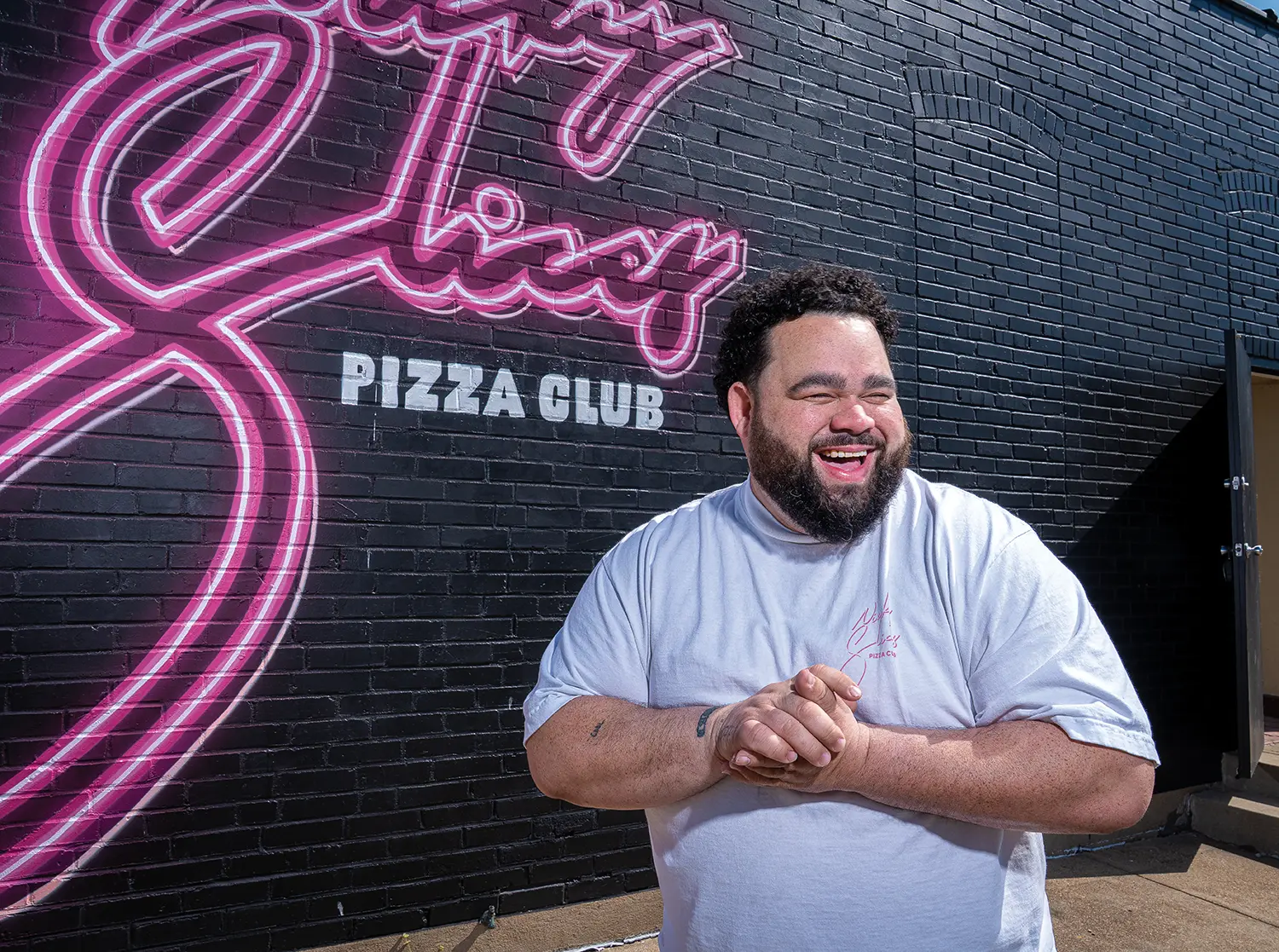
In the dark and uncertain days of mid-2020, Nick Williams created a phenomenon that gave people a little slice of joy when it was in short supply in the form of his Instagram-based take-and-bake pizza business, Nicky Slices. Now, not quite a year after opening the concept as a brick-and-mortar, Williams reflects on his journey to becoming chairman of the “coolest club in town” and what is driving success at his new location on The Hill.
How did you develop such a strong love of cooking—and food in general? My dad was a really good home cook. He got that from his grandma Mabel and his mother, Joyce. All of the [men] on my dad’s side can cook their asses off. As a little kid, I would always be banging on pots and pans while he was in the kitchen; pretty much whatever my dad did, I wanted to do. Later, in my teenage years, my dad would get home on the weekends, and we’d watch Emeril and Iron Chef together. His day off was every other Monday, so we would take that day and pick something we’d seen on Emeril and cook it together.
Find the best food in St. Louis
Subscribe to the St. Louis Dining In and Dining Out newsletters to stay up-to-date on the local restaurant and culinary scene.
Did you always know you’d parlay that love of cooking into a profession? The only thing I knew early on was that I was going to do something creative. My dad opened a pizzeria on South Grand, which was ahead of its time back when opening a restaurant wasn’t the coolest thing to do like it is now. I started helping him with dough; he taught me everything he knew, which was a lot, but as someone who went to journalism school, I dove into researching it. At the same time, I was getting ready to move to New York [for a journalism internship] and worked for the OG Hospitality guys at the Tavern and the Corner Pub in Valley Park doing front-of-house stuff. Once I was in New York, I started working for Complex magazine as a graphic designer. It was an internship, and I needed money, but I told myself I was not going to work in restaurants… But what do you know? It took a little less than a year, and I was working in a restaurant.
You say it started as a way to make money, but it quickly escalated into something more. How did that happen? I went out to eat with my aunt at a spot called Littleneck, where she had to walk past a half-open kitchen to get to the bathroom. When she came back, she had the chef by the hand and said, “This is my nephew. He is from St. Louis, and he needs a job.” The chef asked if I knew how to cook fish, and I said yes, even though, being from St. Louis, I only really knew how to fry catfish. He had me come in on a Monday, which was a really slow day. We ended up having a conversation about hip-hop, and he said, “You have really great taste in music. Cook a medium-rare cheeseburger, and you’ve got the job.” I ended up working there for eight years.
You worked your way up to leading the kitchen there and eventually buying a café from them. How did that happen? Everyone around me just kept falling off, but I kept my head down and paid attention to everything around me, and I’d make a point to get there early so I could learn. Sooner or later, everyone fell off, and I became the chef’s guy. [When he left] I stepped in until the owners could find a replacement. They kept bringing in these other chefs for tastings, and as I was watching these guys, I realized I could do exactly what they were doing. Finally, I asked them to give me a shot to run the kitchen. They let me do it, and eight years later, we’d grown to have two restaurants and two cafés. In late 2019, I’d bought one of the cafés from them and was getting ready to run it myself. Then [the pandemic] happened.
You thought your move back to St. Louis would be temporary. Why did you end up staying? New York was ground zero during [the pandemic]. I would walk from my apartment to the train station, which was by the hospital; it had temperature-controlled semi-trucks outside, which wasn’t good for the psyche, so I decided to come back to St. Louis for a while. My sister had just had my niece, and my dad was diagnosed with cancer, so it was good that I was able to spend time with my family. By October 2020, I gave up on opening the restaurant, bought a one-way ticket, and moved back.
You began Nicky Slices not long after moving back. How did that come about? I needed to make money, so I figured I would do private chef gigs, which is how the pizza thing started: I would leave take-and-bakes or lasagnas as thank-you gifts. The pizzas just stuck, and people started asking for them. I cooked up a logo, figured out the gist of what I wanted to do, and started it out of my sister’s basement. The premise was that I would drop a menu on [Instagram] on Sunday; people would send me a DM with their orders; then pay when they picked it up.
Was it clear right away that you’d turn Nicky Slices into a brick-and-mortar operation? By the end of 2021, I realized I was probably not going back to New York, and I wanted to see what I could do with this. I started looking at places all the way back then, and what’s funny is the place where I ended up was the first place I looked… It took so much longer than I’d wanted, but I’ve come to see the extra time as a good thing because it gave me time to do things the way I wanted.
Tell us about the space and how you translated the Instagram pizza club feeling into real life. Aesthetic-wise, this is exactly the way I envisioned things turning out. It’s as if our Instagram is now real life, because we have carried the themes and the aesthetic into the space. This is a classic slice joint with the sort of things you would traditionally find in one but of really high quality. Think really good pizzeria food, like slices, chicken wings, a really great Philly inspired by Angelo’s in Philadelphia. I think there is a stigma about pizzerias or slice joints in New York, that they only put extras on the menu because they are profitable; we are doing those extras, but with the mindset that what you are getting here should be of the same quality that you would get at a fine-dining restaurant. We have spots for people to eat, but they are bar-height style counter seating for people to just grab a slice and a drink. We also have outdoor seating and will sometimes open the garage door out back, where we make the dough on Saturdays with DJs and fun community vibes done tastefully that respects the neighborhood and gives people a place to hang out.
You call this a casual pizza joint, but you are very focused on hospitality. What is your philosophy on that? Like our aesthetic, this is another thing that I think we have done really well. We have a great team—the guys who have been with me for all four years are still here, and everyone really knows their roles. We greet every single person who comes in with our tagline, “Welcome to Slices.” First impressions are everything, so it’s important for us to get that right and then deliver on everything after.
What have been some of the challenges of the transition to a brick-and-mortar space? It was really hard to suss out how people were going to respond to us, because there were so very few slice shops in St. Louis, and, honestly, it is one of those things where we are still trying to perfect our operations in terms of the slices. We figured out that we are faced with two dilemmas: Get out slices as quickly as we can, or make slices as best as we can. We decided to focus on making them as best as we can, so we get a lot of people who say, “What is ready right now?” and the answer is “nothing.” Slices, which are actually half-pies, take about 10–20 minutes, and if we’re busy, they take longer. We’re constantly trying to improve our operations, because we know we have to get that time down, and we are testing out a couple of things like new pans and a new oven setup, so we can get out slices with the same quality but in a more timely manner. I don’t think we will ever have the spinning, grab-and-go-style slices. But before we open for lunch, we definitely need to figure out a more efficient way to get things out quicker.
Another thing that’s been a big change is that when we were doing the Instagram business, I had time to do all of the social media and videos. Every Sunday was a video shoot day, Saturday was a day off, and Friday was a normal 9-to-5 day. Now, I have all the responsibilities and operational ownership stuff that comes with the brick-and-mortar and, I really don’t have as much time to do the social. That means that when we do the social and videos, they are a lot more thoughtful and intentional. At heart, I am an artist and creative, so the transition from the Instagram business to this has been a big change.
You mentioned that lunch is coming soon. What are your plans? I don’t want lunch to be the same energy as dinner. I want you to be able to walk in, get something to eat, and be out in ten minutes. We want to have something more affordable, too. One of things people got hung up on when we first opened was the price of our slices. They range from $9–$12, but here a slice is half of a pizza. We now call them “half-pies,” but at lunch we want to do more of a true slice to bring prices down and be more efficient, so you can get in and out quickly and affordably.
It sounds like there have been some learning experiences, but you have certainly been well-received. What has the response been like so far? I call the take-and-bake business the “lemonade stand” in the sense that nothing compares to this. Everyone on the team has grown into the roles that they are in, and I have grown as a leader—there’s been growth on all fronts. I am glad that the neighborhood has taken us in and that we are really a part of the community. I’m feeling the love, and we are giving it back.