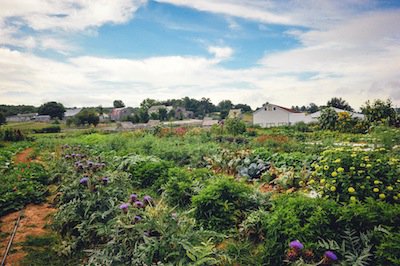
Jere Gettle is excited about a carrot. Truth be told, he’s excited about many carrots. But this one, this Oxheart, seems formed by nature with a Missouri gardener in mind.
Gettle has dedicated his life to finding, growing, and sharing fascinating plants like the Oxheart carrot. His company, Baker Creek Heirloom Seeds, is now the nation’s largest seller of rare heirloom seeds. These legacy plants look strikingly unlike the ones in the Shop ’n Save produce department.
Get a weekly dose of home and style inspiration
Subscribe to the St. Louis Design+Home newsletter to explore the latest stories from the local interior design, fashion, and retail scene.
The New York Times called the Gettle family “The Evangelists for Heirloom Vegetables.” Gettle is a tall man with dark hair under a cabbie hat. As he holds the carrot seed packet, he describes the plant’s usefulness: “Most carrots need soft, loamy soil,” he says. “But this one develops outward.” The carrot grows wide like a beet, which means hope for gardeners struggling with the Ozark Plateau’s clay-dense soil.
Rows of seed packets line the wood-planked general store in the rolling hills 45 miles east of Springfield. Accessed by winding back roads, the closest town is Mansfield, and the nearest landmark is the Laura Ingalls Wilder Historic Home & Museum. Baker Creek’s charming throwback “pioneer village”—with its barns, bakery, and blacksmith shop—could come from a page ripped from Little House on the Prairie. But first impressions deceive. Although most everything about Baker Creek honors the past, Gettle is among the heirloom-seed industry’s greatest innovators.
Deep-Rooted
There’s something about Missouri soil. Those of us who grew up here understand “garden fresh” as much as we can taste it. We sit silently when non-native folks talk about their famous sweet corn or their northern apples. All we have to do is utter two words: Missouri tomato. A slab of the red fruit with a dab of mayonnaise, and you will forget that BLT even came with bacon.
So it’s no surprise that in the midst of a food-and-health-crazed culture, an heirloom seed store would thrive in the Show-Me State. Yes, Baker Creek runs a store in California and another in Connecticut. But the Missouri farm is home. This is where Jere and his wife, Emilee, raise their daughters, Sasha and Malia.
Gettle has long been on the gardening path. He remembers flipping through seed catalogs while growing up in Oregon and Montana. When his family moved to the Ozarks, his love of plants only grew.
Dave Kaiser, a friend of Gettle’s with a bushy white beard, says he’s watched Gettle grow like a weed. “I remember him going to swap meets with seeds as a boy. He put together his own catalog at a copy shop and stapled it himself,” Kaiser says. “I never knew what I wanted to do with my life. Most of us don’t. But Jere, he always knew.”
In 1998, Gettle sent out his first mail-order catalog. He was 17. Now, Baker Creek sells nearly 2,000 varieties of plants gathered from some 75 countries, sometimes receiving 1,000 orders for seeds in a day. And demand is where tradition meets technology.
A Day’s Work
It’s funny to think about advanced technology when you see where we’re standing—in an Amish-built barn storing crates of green-bean and pumpkin seeds. But worlds collide here as a matter of practicality—Gettle needed to send seeds faster so the business could run more smoothly. Before Gettle invested in a customized mailing system, employees packed orders one at a time.
The seeds themselves are still hand-spooned into paper packages printed with art and folded into rectangles. What happens next is what’s special. Programmed projectors flash a number on organized seed bins. Workers walk down a long aisle, grabbing the number of items illuminated.
They drop packets onto a conveyer belt as scanners keep track of supply. The belts lead to open boxes organized by shipment. Ten mailings are filled this way in a matter of minutes. Then it’s time for another round before the 3 p.m. shipping deadline. The entire system involves 28 projectors but runs on less energy than a space heater.
“Even our 7-year-old, Sasha, will come down to track orders and help out,” Gettle says. “She chases the lights as they pop up and picks out the seeds.” Although the system is still working out kinks, Gettle has already seen fewer errors, faster packing, and more satisfied customers.
Break Time
A plate of angel-hair pasta arrives heaped with heirloom orange tomatoes. Gettle sits on a bench at the on-site restaurant where he takes lunch with his family. The Asian-influenced saloon is adorned with Chinese lanterns and swinging doors. Your bill is the amount you feel like donating, and the menu changes based on what is in the garden.
The chef checks to make sure we have enough chamomile-mint lemongrass tea in our Mason jar glasses. It turns out he’s earned his stripes; chef Quintin Eason trained at Le Cordon Bleu College of Culinary Arts in Scottsdale, Arizona.
Quiet during the winter, the restaurant bustles come spring—especially when planting season arrives and with it the company’s Spring Planting Festival in May. Ten thousand visitors arrive to meet the family, to see farmers Jere and Dave in person, and, of course, to plant rows of vegetables, beds of flowers, and pots of herbs so the farm can produce all summer. If Gettle has anything to say about it, Baker Creek will thrive for many summers to come.
Baker Creek hosts the Spring Planting Festival May 3 and 4. Admission is $5 for adults. During the rest of the year, Baker Creek is free and open 8 a.m. to 4 p.m. Sunday through Friday (closed on Saturdays).