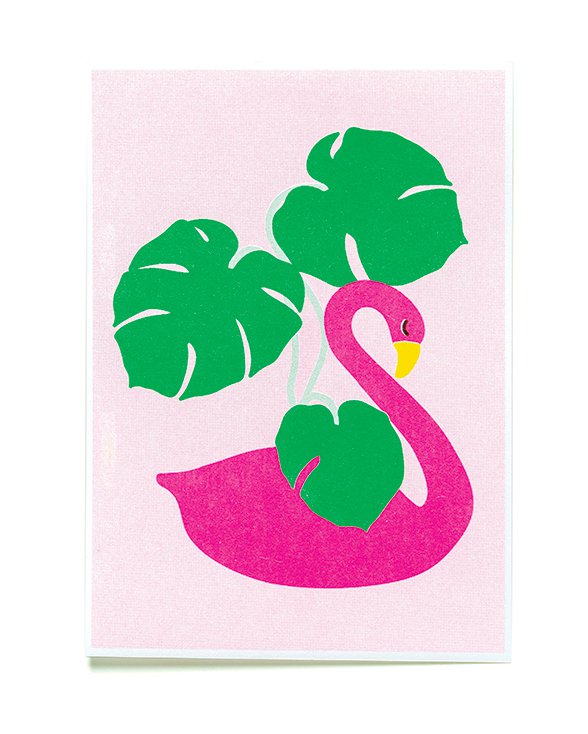
Who’d have thought a retro Japanese office copier would be cranking out some of the cleanest, brightest contemporary design? The artists at Riso Hell crave pure color, so they’ve refined this quirky Instagram-famous technique, using the copier to burn stencils and make multiple meticulous passes of color. It’s harder than you’d think; everything must be arranged just so, designed with a refined simplicity that will look effortless. The result? Flat, polished images inspired by the best of pop culture. Or by joyful shards of memory. Or by the concrete swans carefully placed and planted in a grandmother’s yard, their effect unexpectedly charming.
If Risographs are just glorified office machines, how did they climb into the art world?
Get a weekly dose of home and style inspiration
Subscribe to the St. Louis Design+Home newsletter to explore the latest stories from the local interior design, fashion, and retail scene.
Bandy: They were made in Japan in the ’80s, and production peaked in the early ’00s. Around 2010, artists started finding them on Craigslist. People would find out what they could do and post on Instagram, and it grew by word of mouth.
And what can they do?
Bandy: Risograph printing’s like silkscreening but more affordable, more approachable. Instead of printing with process color—cyan, magenta, yellow, black—we’re able to print in pure spot colors, so it’s more vibrant. There are cartridges of pure orange, red, purple, green, yellow, blue…
What was the impetus to do this?
Bandy: We noticed Riso printing taking off, but it wasn’t picking up traction in St. Louis, and we wanted to bring it here—first to do our own work, but now it feels like a responsibility to make people aware of it.
When you can squeeze in time for your own work, what’s the best part of it?
Bandy: Coming up with the perfect imagery and colors.
Carey: We both work with a lot of pop culture references, especially pop culture that was prevalent in our childhoods.
Bandy: We’re in a time where we’re able to take certain themes and aesthetics from other time periods and meld them into this overbearing, bright, fun, colorful—
Carey: —experience. It’s a lot of cherry-picking, then putting it all together. Printmaking is so hand in hand with pop culture, has been since the ’60s.
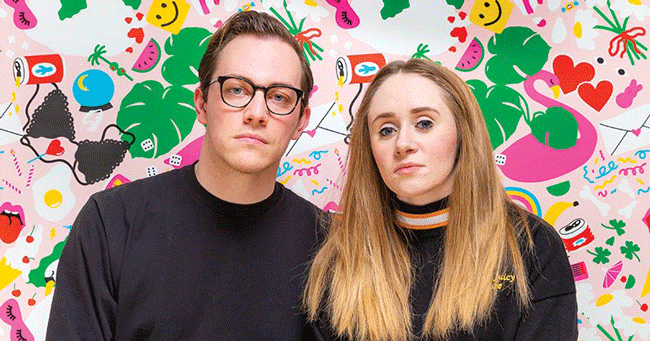
Bridget’s wallpaper design is so…happy.
Carey: It’s things my friends had, like Magic 8-Balls [we’d use to] ask about our crushes, and the swan planters at my grandma’s house. Valentines from elementary school.
And Monstera leaves and watermelons and crystal balls…
Bandy: We’ve developed a fascination with objects you see in pop culture but you don’t see a lot in real life, like crystal balls. They’re kind of mystical and banal at the same time. Bunny Bread. Icons you see on billboards. The zebra who plays sports on the temporary-tattoo wrappers of Fruit Stripe gum. And we both had this fascination with Salem the talking cat on Sabrina, the Teenage Witch. A lot of this is about nostalgia: I think our generation is particularly susceptible to it. We’ve seen so much happen with technology that to cope with it, we go back to these things that are comforting.
What’s the hallmark of your work?
Carey: The dependence on bright colors and this aura of an experience.
Bandy: I think mine’s also been a reaction to—not to get political, but how—
Carey: —really bad things have been.
Bandy: Or just divisive, especially in St. Louis in the last few years. People are reacting by making work that’s really serious, and I can only take so much that’s that heavy, so I’m counteracting some of the negativity.
Carey: Give the viewer a break.