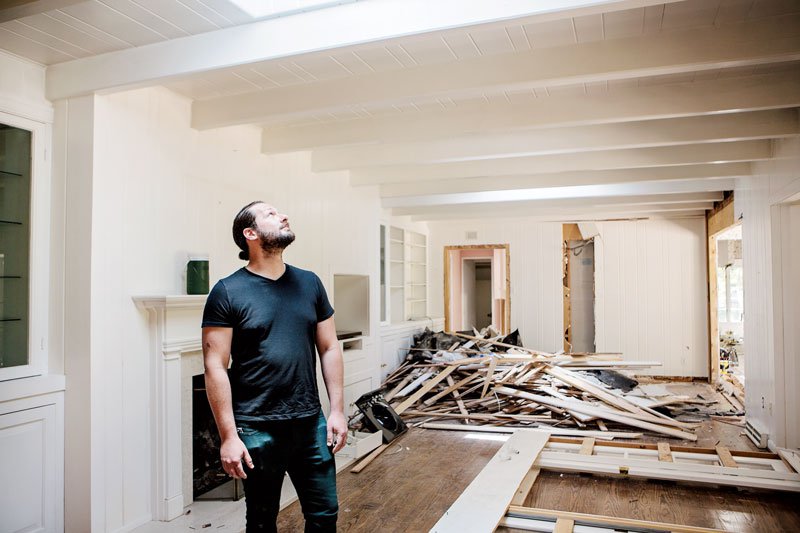
A dark beard, hair coiled into a tight bun, and a black T-shirt give Eric Schwarz the look of an artist, but the broad shoulders and easy informality hint at something more straightforward. The company he started, Refab, deconstructs properties, pre-demo, for owners who’d rather donate the architectural salvage than see it crushed in a landfill. The work’s done sustainably, training and employing people who are homeless. And what’s saved is sold for reuse.
I find Schwarz in a Midcentury house in Ladue, puzzling over a staircase to see whether it can be plucked in one piece or will need to be taken apart and coded like a kit for reassembly.
Get a weekly dose of home and style inspiration
Subscribe to the St. Louis Design+Home newsletter to explore the latest stories from the local interior design, fashion, and retail scene.
“A scientist from the Manhattan Project lived here,” he says. “I don’t know his name, but we do know something about his interests.” The basement held a three-spigot soda fountain, a pool table, a vintage Southwestern Bell telephone booth. There was a gorgeous oak bar with a brass foot rail, a triple sink, and a well for ice. On the bathroom wall, someone has painted a Doberman sitting at a window.
“His dog?” I ask.
“Could be. There was a dog gate at the top of the stairs,” says Schwarz.
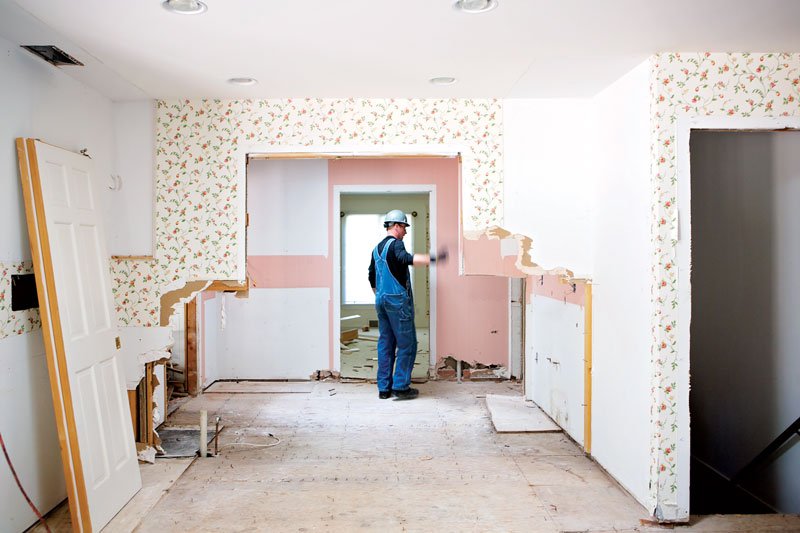
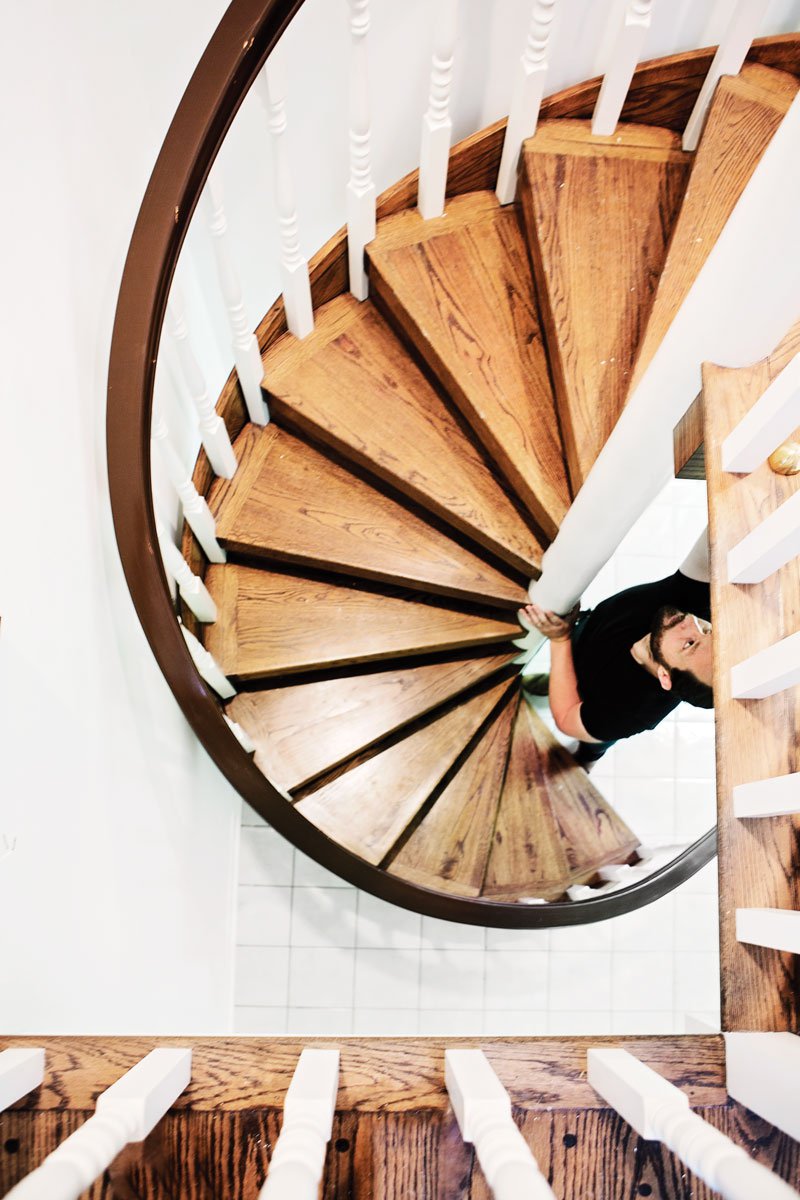




As he deconstructs a place, he pieces together its life. “You can tell so much about people from what they leave behind,” he says.
In the kitchen, Schwarz points heavenward. “We’ll be here on demo day for those. Solid wood beams, 3-by-6 fir.” In the master bath, his team will remove the cast-iron jet tub. Tile’s hard to save—though when it’s antique subway tile, he adds, it’s worth the effort. So are the wrought-iron garden gates, though it’ll mean breaking the brick in which they’re anchored.
We walk back inside, stepping around a pile of crisscrossed 2-by-4s. The house is all raw edges now, like a garment turned inside out.
“I went to architecture school for a minute,” Schwarz confides. “My professor said, ‘Eric, you’re 18 years old. You do not need to be in a building for the next four years. Go see the world, learn about people because you’re going to be designing buildings for people.’”
He took the advice, spent time in Thailand, Colombia, Germany, South Korea. “I left the month Lehmann Brothers collapsed, and I lost my savings because the exchange rate tanked,” he says wryly, “so I came home.”
By then he’d realized that he didn’t want to build houses. “I saw how people lived in other countries. They were not throwing stuff away.”
He worked for Habitat for Humanity Saint Louis, became its first sustainability coordinator. Ran a small deconstruction unit, urged his bosses to reclaim more of the building materials, heard it wasn’t the direction they wanted to take. And his career path took a third turn. Refab started with Schwarz living out of his car; five years later, it’s a million-dollar nonprofit.
“People are amazed that I remember where everything came from,” he says, “but the story’s part of it.”
Next week, he’s deconstructing a farmhouse that was owned by sexologist William Masters, “and apparently Vincent Price was a guest. The barn has hand-hewn beams, and the guy who bought the place wants us to salvage it for a vaulted ceiling with exposed beams.”
This makes Schwarz happy.