It’s no surprise that Genny Cortinovis takes an eclectic approach to design. Her job as an assistant curator at the Saint Louis Art Museum (e.g., Reigning Men: Fashion in Menswear, 1715–2015; St. Louis Modern; and Blow-Up: Graphic Abstraction in 1960s Design) calls for a sweeping vision. Her style, at home and in fashion, follows suit.
“I love antiques. I buy mostly old things, but I also like Midcentury Modern,” says the 34-year-old. “My style doesn’t pertain to a certain era. Even though my house is Victorian, it’s not designed in a Victorian way.”
Get a weekly dose of home and style inspiration
Subscribe to the St. Louis Design+Home newsletter to explore the latest stories from the local interior design, fashion, and retail scene.
Instead, Cortinovis fills her living space with objects that tell a story, such as the 18th-century French walnut armoire that was a gift from her parents, or the dining room table that she and her husband salvaged from his former restaurant.
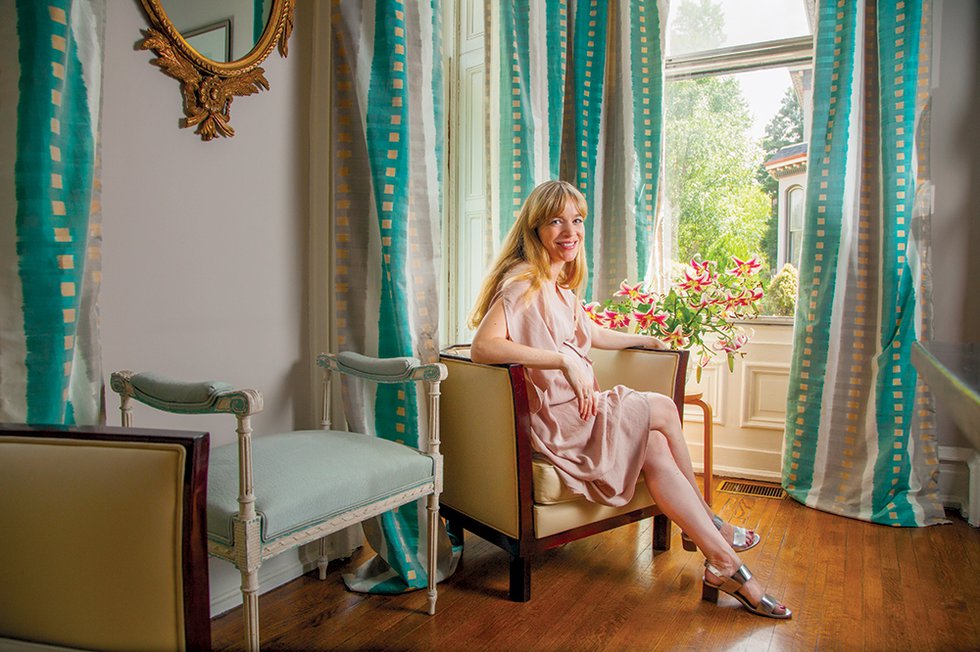
Then there are the silk ikat curtains in the dining room that frame the 13-foot-high arch-top windows that are typical of the home’s Second Empire architecture. Their provenance shows the lengths to which Cortinovis will go to infuse meaning into her surroundings. The fabric took weavers from the Takéo province of Cambodia, south of Phnom Penh—where Cortinovis lived for close to two years—nearly three months to create with the use of traditional tied-and-dyed methods.
“I take a special interest in fabrics and wallpapers, an artisanal, handmade approach,” Cortinovis says. When a room calls for paint, she’s as meticulous about selecting the colors as she is in getting the fabrics she wants. Farrow & Ball’s Arsenic, a teal hue favored by Napoleon, and Pavilion Blue, a mint ice cream color used in 18th-century Sweden, are seen throughout the home.
That desire for connection drives her wardrobe choices, too. Cortinovis has a soft spot for loose-fitting silhouettes—“basics with a twist,” she calls them—and she’s partial to those from designer, 7115 by Szeki, that reflect her minimalist style. Because the line skews monochromatic, Cortinovis pairs the pieces with bold jewelry for flair. For a typical workday, she turns to the brand’s reversible maxidress for its practical edge. A personal connection to the designer, whose low-key attitude Cortinovis appreciates, makes buying all the more satisfying.
“That’s what I love about heirlooms, too…the objects have a good story,” she says. “When there isn’t a story, there’s no meaning for me, and the object loses its aesthetic beauty.”
Cortinovis’ instinct, in shopping for clothes or for the home, is to allow an organic process to play out. A recent trip to Paris reminded her why she loves to let the experience unfold at its own pace.
“It’s the process of talking with the shopkeeper, sorting through the clothes, the personal touch that you can’t find elsewhere,” she says. In other words, the story.