
The relationship between politics and the decorative arts has always been a passion of author and curator James Archer Abbott. The nexus of the two form the foundation of his book, Designing Camelot: The Kennedy White House Restoration, a culmination of more than 35 years of research and interviews. “I was born the day after JFK was killed, and I’m the youngest of eight kids, so I don’t remember having Dr. Seuss, and I don’t remember having a lot of children’s books, but I do remember having books that memorialize JFK…and that has always stuck with me.”
Born in California and raised in St. Louis, Abbott, the current executive director and chief curator of Wright’s Ferry Mansion in Pennsylvania, will be at the Missouri History Museum this Saturday, November 25, to discuss his book, an in-depth, illustrated analysis of the White House restoration and its most illustrious contributors, people such as American antiques expert Henry du Pont, French decorator Stéphane Boudin, and the American art collector, Jayne Wrighstman, who helped underwrite the years-long project, among others. First Lady Jacqueline Kennedy is credited with recognizing the power of the decorative arts to help tell the story of the United States. “The idea that we see the White House collection of fine art, and the White House collection of furniture, as one of the premier collections of American fine and decorative arts is due to Jacqueline Kennedy,” says Abbott. “She initiated it. She had legislation passed. She gave a permanence to what she was doing that still carries over to this day.”
Get a weekly dose of home and style inspiration
Subscribe to the St. Louis Design+Home newsletter to explore the latest stories from the local interior design, fashion, and retail scene.
SLM’s Veronica Theodoro recently interviewed Abbott about his book.
Why should we be interested in a restoration project from 60 years ago?
Our current presidential stage was defined by John and Jacqueline Kennedy. Their legacy is all over the backdrop that we see, be it the Rose Garden, the idea of the Oval Office being identified as a permanent or full-time office for the President, the idea of state dinners with round tables, and then the State Rooms having a collection of artwork and decorative objects that represents the entire span of American history. All of that was born of John F. Kennedy and Jacqueline Kennedy.
How do you describe the Kennedy aesthetic in the White House?
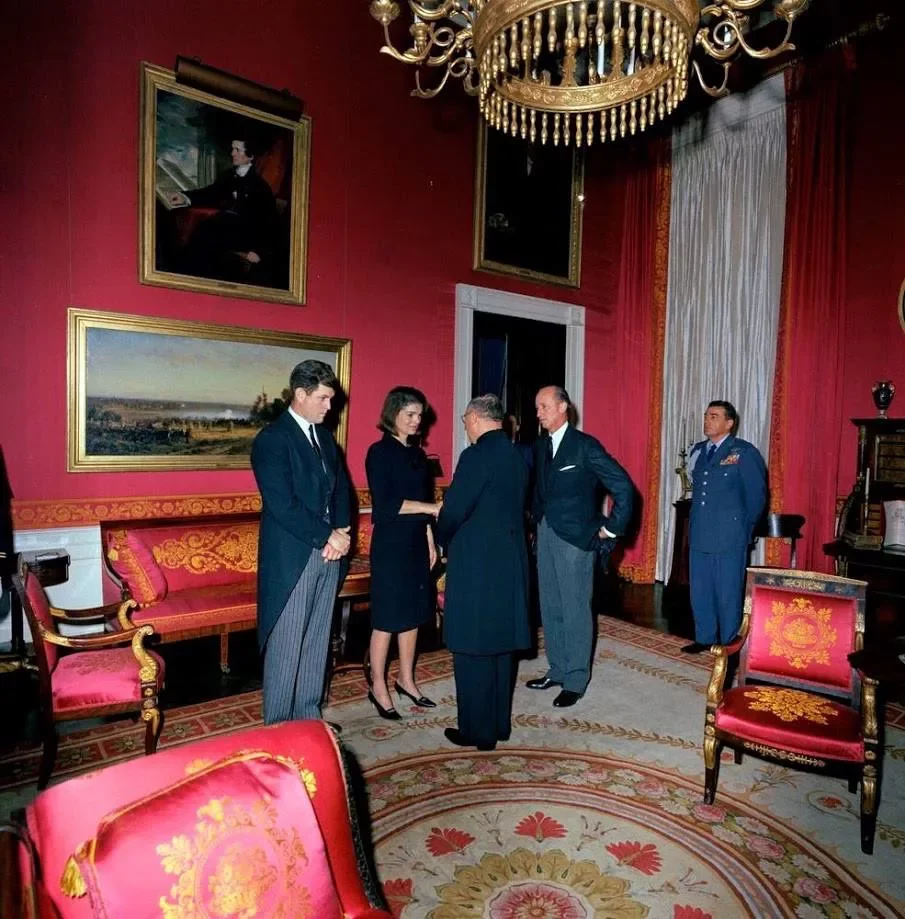
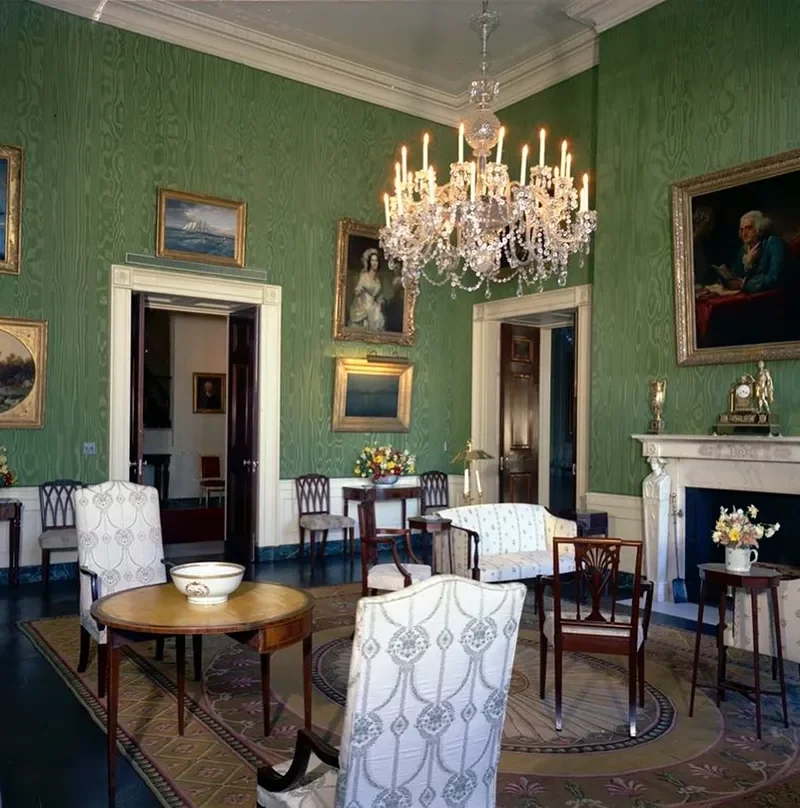
The decor was directed to play up John F. Kennedy’s youth, vigor, and it’s not just with the White House. Think about Air Force One and the blue-and-white color scheme that Raymond Loewy devised for the Kennedys. It wasn’t a blue from the American flag–it wasn’t a dark blue–it was a light blue–young, vibrant, youthful color. And the same could be applied to the Kennedy restoration of the State Rooms: the Red Room, the Blue Room, the Green Room. They went from a Renaissance red in the Red Room and dark blue in the Blue Room, and then what would be like a blue-green in the Green Room. Suddenly you had a youthful cerise and you had what was deemed an Empire blue, a light, light blue in the Blue Room with white walls, and then even the Green Room…suddenly moss green became like a chartreuse green. Very young, very energetic.
When you go to the White House today, are the rooms similar to how they were during the Kennedy era?
If you’re going to the White House and you walk into the state parlors and you’re thinking, What speaks of John and Jacqueline Kennedy? Well, there is the thematic. The idea that these rooms represent, for the most part architecturally, and by their furnishings, the first quarter of the 19th century when America was coming to the table as a power to be addressed. In the Red Room, all of the patterns, the textiles, the silk lampas, classically inspired scroll tapes, and all of the upholstery, most of the furnishings, most of the paintings, the carpet, the chandelier: Jacqueline Kennedy’s efforts. The Blue Room. All of that gilded furniture that has been brought back, that had been purchased by James Monroe for the rebuilt White House after the War of 1812, Mrs. Kennedy initiated the return of so many pieces of furniture by finding them in a White House warehouse. The idea of the green moiré on the walls, American landscape paintings, Federal furniture, all tied to Jacqueline Kennedy’s efforts. And to that… Stéphane Boudin, of Maison Jansen, is very much a part of what you see.
What can a homeowner or a designer learn from this book to use in their own home or in a project?
Although the Kennedys lived in the largest house built in America pre-Civil War, those rooms were intended to be used. I think one of the lessons you get from the Kennedy restoration is, although there’s a lot of politics involved and although we’re talking about 18-foot-high ceilings, the fact of the matter is the Kennedys were insistent that the house be inviting and comfortable and that the homeowner not be put off by anything that surrounded them. One of the curators for Mrs. Kennedy had said it was never [the] intent that you would walk into a room and it would only be 1810, 1820, because our nation is not tied to just one decade or one year. And so the curator said it was Mrs. Kennedy’s hope that objects of recent presidents would be eventually recognized as important to be integrated…There’s a lesson here: to not just be locked into what you see in a magazine per se, but the fact is, our interiors reflect the residents and they can be as eclectic and rich and inspiring as possible.
What is the oldest possession to survive in the White House?
The famous portrait of George Washington by Gilbert Stuart was brought to the White House in 1800. Dolly Madison actually had it cut from its frame and rolled up and taken away by allies during the War of 1812. It was one of the few objects that survived the burning of the White House during the War of 1812.
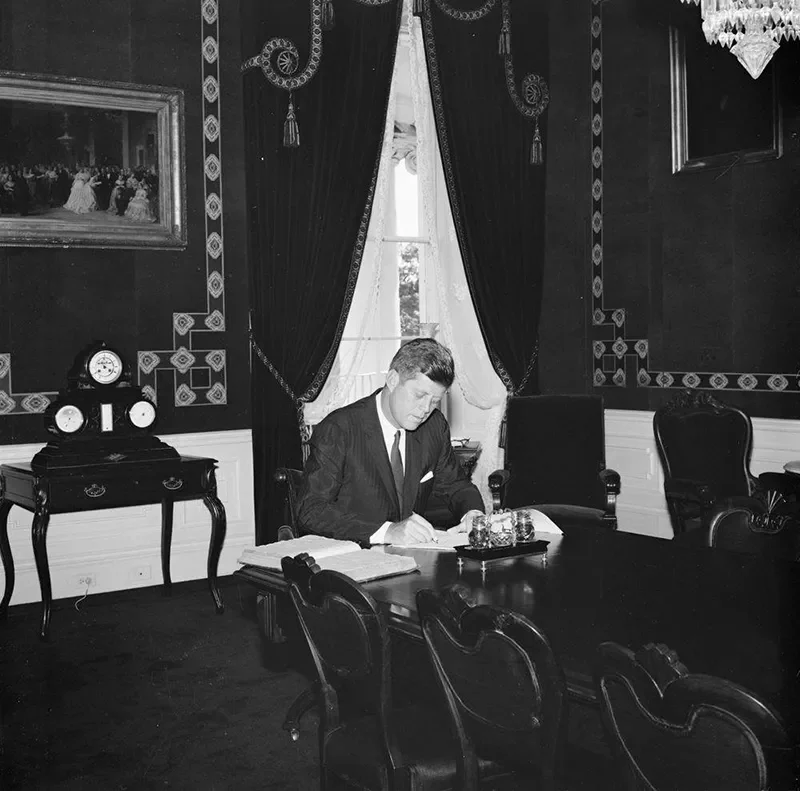
Do you define the work as a restoration and a decoration or is it one or the other?
Mrs. Kennedy, President Kennedy, a legal adviser, Mrs. Wrightsman really thought about how do you market this to the public. The White House, although it had been gutted during the Truman years, during a full physical rebuilding, the Kennedys had to think about how, if we change anything, it has to be seen as an improvement or an enhancement of what exists. And so that’s part of the reason why Henry du Pont, someone who was seen as the great authority on American decorative arts, was asked to serve as chairman of the committee. He provided a face that Americans could see as the knowledgeable authority, and therefore any changes would be approved. So restoration became the term but, you know, you really can’t restore a room because in 1800 Abigail Adams was hanging laundry in the East Wing and the other side of the house was incomplete. There’s no set period because which administration would you choose? And this is where politics does come in.
I was interested to read about the role of Scalamandré and Zuber. Are there other manufacturers or textile designers that you can point to that are still part of today’s conversation?
Brunschwig and Schumacher and Scalamandré were all generous to Mrs. Kennedy’s projects and those firms exist in one facet or another. There’s also the French firm Tassinari & Chatel, which still exists to this day. It was absorbed by another firm but it supplied a number of textiles to the State Rooms. In 1961, Mrs. Kennedy was obligated to go with American manufacturers. By 1962, if you’ve ever watched her televised tour of the White House, she makes a statement where she says whether it’s American or made elsewhere, as long as this is the best, then that’s what I want for the president’s house. That’s telling you that from 1961 to the beginning of 1962, she has won enough political [support] of this program to be a little daring enough to accept the gift of French linens for the State Dining Table and to accept French textiles for the State Room projects. And by 1963 it becomes public that there are French manufacturers as well as the American manufacturers involved.
There are many older homes in St. Louis. Why is it important to maintain the integrity of historic houses?
Because it’s who we are and the older we get, the greater we fear being forgotten. And to that I think we’re served in our youth when we understand a bit about the past, when we can identify with some aspect of the generations that have come before.
Signed copies of Abbott’s book will be for sale after the event at the Missouri History Museum.