A couple of years ago, Anders Carlsson and his wife, Christiane, found themselves facing the dilemma many empty-nesters do, but with a twist. With their two kids away at college, the Carlssons had outgrown their 21/2–story, turn-of-the-century gem in University City—but they hadn’t outgrown the neighborhood. Anders could walk to Washington University, where he’s a physics professor; they were close to MetroLink; and they liked the general diversity that comes with living near a major university. Still, living in a 3,000-square-foot house—just the two of them—didn’t make sense, both economically and, from the couple’s eco-conscious point of view, environmentally.
“We wanted to build a green house,” Anders says. But where? It’s a question that bedevils many who are interested in building eco-friendly homes, a demographic that typically also wants to live in a more urban environment with access to things like public transit, says project manager Jay Swoboda of EcoUrban, which specializes in environmentally sustainable residential architecture. As it has with all developers, the real-estate market collapse has taken its toll on EcoUrban, but beyond that, Swoboda says, the city also lacks vacant lots that are both suitable and desirable. “I can only think of eight lots right now that are in the sorts of neighborhoods where people want to live,” he says.
Get a weekly dose of home and style inspiration
Subscribe to the St. Louis Design+Home newsletter to explore the latest stories from the local interior design, fashion, and retail scene.
The Carlssons got lucky. They found an empty lot northeast of the university, a mere 10-minute walk from their old house, on a street of century-old apartment buildings and single-family homes. Several months later, their green dream house began to arrive—on the backs of four flatbed trucks. Working with EcoUrban, the Carlssons customized a prefab house made by Homeway Homes in Peoria, Ill. “There were some constraints on the layout,” Anders says, including the fact that each piece couldn’t be significantly larger than a tractor trailer, “but none that we felt limited by.”
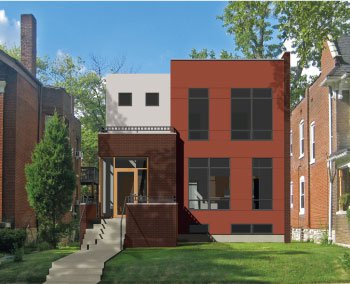
The result? Far from the sort of cookie-cutter eyesore one might envision when imagining a factory-built home plunked down in a historic neighborhood, the Carlssons’ new two-story, 2,000-square-foot house nestles unobtrusively among its neighbors. Bright and airy inside, with a distinct Scandinavian air (Anders is originally from Sweden, Christiane from Germany), the home is full of amenities that make hip, eco-smart urbanites swoon: a state-of-the-art geothermal HVAC system, locally harvested white-oak floors, recessed LED lighting, and a 3.6-kilowatt array of flat solar panels on the roof that can provide more than 50 percent of the home’s energy.
A home may be quintessentially local, but for the Carlssons, the decision to build green was fundamentally global. “It’s a matter of wanting to live sustainably,” Anders says. “And to us, that meant if everyone lived in a house that used this amount of energy, the world would be in better shape.”
EcoUrban Construction, 906 Olive, Ste. 1212, 314-231-0400 x4, ecourbanhomes.com.