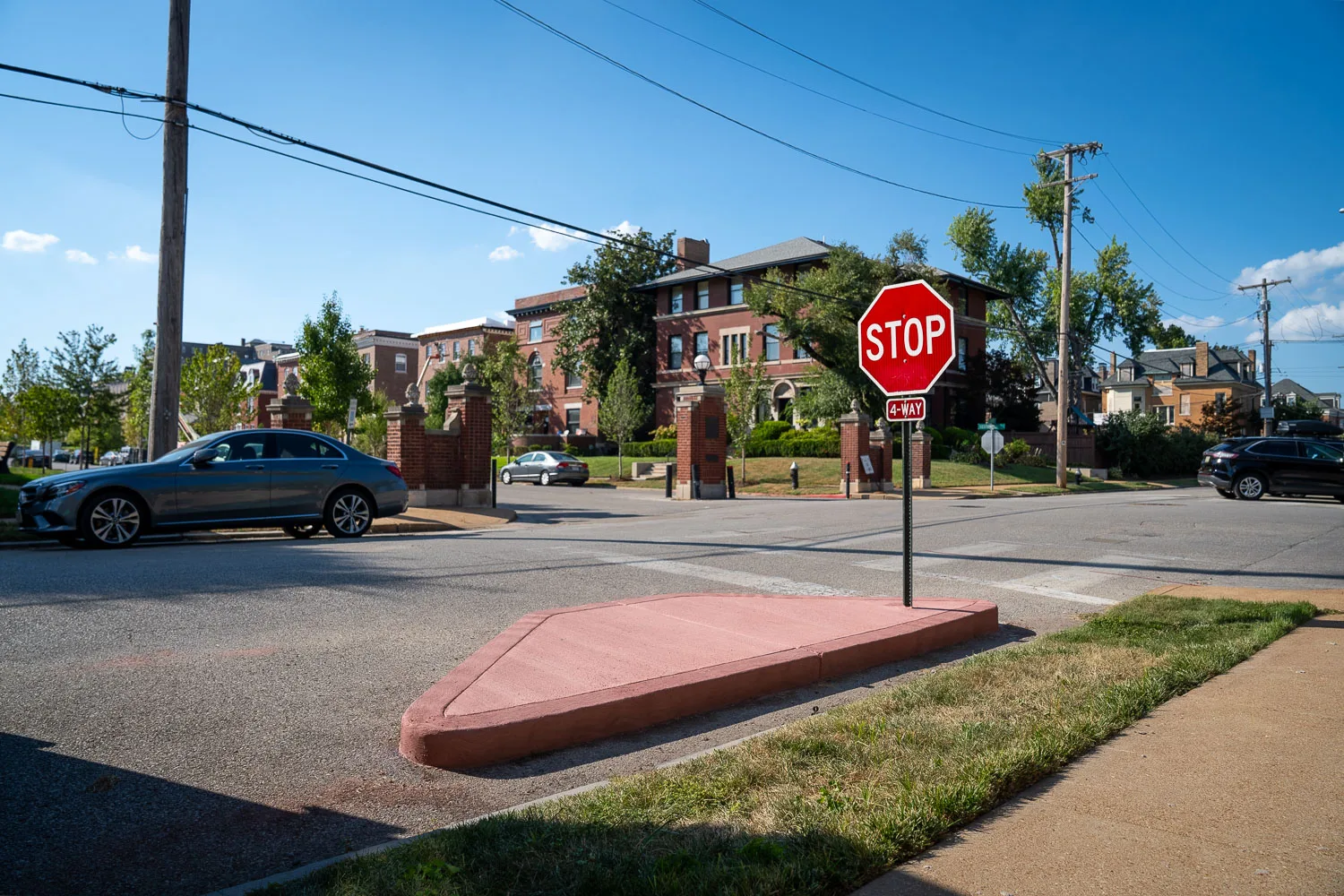
If you live in the city of St. Louis or have recently visited one of its neighborhoods, you may have noticed the presence of concrete bumpouts on residential streets.
For some residents, bumpouts are a welcome addition, helping to make their streets safer for pedestrians. Others view them as taking up valuable parking spaces or bringing an unwelcome aesthetic to the streetscape.
Get a weekly dose of home and style inspiration
Subscribe to the St. Louis Design+Home newsletter to explore the latest stories from the local interior design, fashion, and retail scene.
Not to be confused with larger islands seen along Kingshighway, for example, a comprehensive project funded by the American Rescue Plan Act, bumpouts are smaller in scale and supported by a local alderperson who is responding to a request by a constituent.
“Bumpouts are traffic calming infrastructure designed to improve pedestrian safety,” says Michael Browning, an alderman of the 9th Ward. “They do that by keeping cars from parking too close to intersections.”
Known as daylighting, this type of infrastructure makes pedestrians more visible. By not having a parked car blocking a stop sign or obscuring a pedestrian as they’re about to enter the roadway, city living becomes safer–and more walkable–for all.
Some residents may object to one less place to park, but bumpouts are typically installed next to an intersection where cars shouldn’t be parked in the first place. “It’s actually illegal to park your car that close to a stop sign,” says Browning, “but that’s often not enforced.”
Currently, the city follows an alderperson-led process for approving bumpouts using ward capital funds. In 2029, the process will shift into the newly formed Department of Transportation, which will help standardize a lot of these types of requests. “It’s hard to understand what’s happening in your city right now when decisions are made on a ward by ward basis,” says Browning. “People deserve safety, no matter who their alderperson is.”
Browning has plans for several dozen bumpouts in this ward, including along Lindell and Chouteau. Each bumpout costs approximately three to $4,000, in comparison to speed humps, which run between five and $6,000. “This is a pretty affordable treatment to make roads safer, and it’s easily applied,” he says. “It can be put down on any type of pavement, installed very quickly, and has a really good return on investment in that it improves safety vastly.”
“Part of the reason people love living in the Central West End and other places in the city is that you can walk around and get to where you’re going without necessarily having to take a trip in your car,” says Browning. “But, ultimately, bumpouts make it safer for everybody, no matter how they’re traveling.”