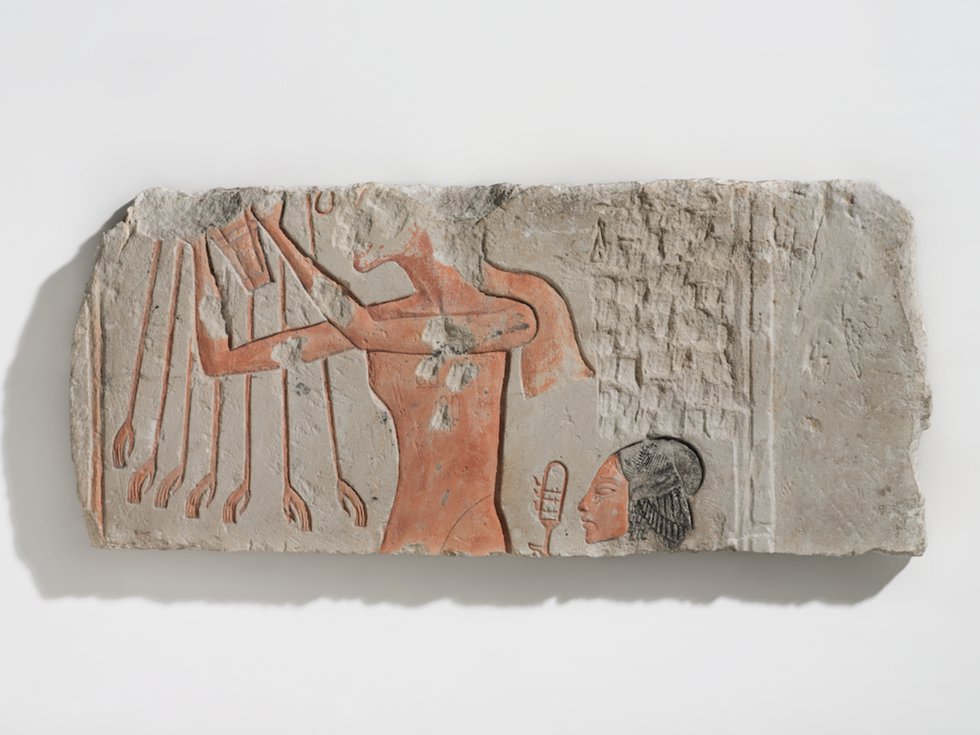
It’s tempting to think of ancient Egypt as a static, monolithic entity. A new exhibition, Striking Power: Iconoclasm in Ancient Egypt at the Pulitzer Arts Foundation, however, challenges the viewer to think about changing attitudes regarding politics and religion during this time. The exhibition, which opens Friday, is presented in collaboration with the Brooklyn Museum and includes artifacts from the Pharaonic Period (3000-30BCE), Late Antiquity (200-642 CE), and the Islamic period (642 CE-present) that have suffered intentional harm, and explores the reasons behind the destruction.
Striking Power, which runs through August 11, is curated by Edward Bleiberg, senior curator of Egyptian, Classical, and Ancient Near Eastern Art for the Brooklyn Museum, and Stephanie Weissberg, associate curator at the Pulitzer. The exhibit was born of a simple query.
Stay up-to-date with the local arts scene
Subscribe to the weekly St. Louis Arts+Culture newsletter to discover must-attend art exhibits, performances, festivals, and more.
“The most common question I am asked about the Brooklyn Museum’s collection of Egyptian art is ‘Why are the noses broken?’” Bleiberg says. “This exhibition grew out of my search for the answer to that question. By observing the patterns of damage on many sculptures and reconstructing what was once there, we gain insight into the original contexts in which these objects existed.” Taken together, Striking Power shows the viewer how artworks were used as instruments of political and cultural power.
The debasement of these objects tell stories of both transition and tension. In the case of Hatshepsut, perhaps the most famous female Pharaoh of ancient Egypt, the desecration of her likeness shows strained family ties and a contentious line of succession. The harming of Pharaoh Akhenaten’s images speaks to his radical program to change religion in Egypt from polytheism to the sole worship of the god Aten. After his death, the worship of many gods was reinstated, and images depicting Akhenaten were damaged by his successors in an effort to erase this memory.
Christians in the Late Antique period systematically dismantled the temples and artifacts of ancient Egypt, fearing that malevolent spiritual forces resided in these objects, and in the Islamic period, some artifacts were dissembled for the value of the raw material.
Whatever the reason for destruction, each motive tells us something about the contemporaneous society of that time and how representation influences legacy. Striking Power: Iconoclasm in Ancient Egypt promises to be a thought-provoking exhibition, with many parallels to our current world. It’s on view from March 22–August 11 at the Pulitzer Arts Foundation. The opening reception is Friday from 9–6 p.m.