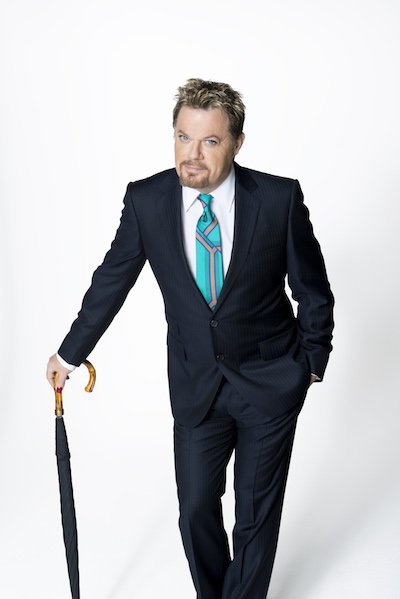
Most people don’t think of world history as something to sit and laugh about, but throw in unexpected references to current events, a few impressions, and a little bit of chaos, and you’ve stumbled into one of Eddie Izzard’s side-splitting bits. In his own words, Izzard describes his style of comedy as smart, surreal, and perhaps even borrowing from the tradition of Monty Python. On Thursday, June 19, Izzard will be returning to St. Louis and the Fabulous Fox Theater as a part of his “Force Majeure” tour. The aptly named tour began in March of 2013, has spanned 25 countries, and according to Izzard, it’s the “most extensive would tour of comedy that’s ever happened.”
Recently, on the 70th anniversary of D-Day, Izzard put on three back-to-back shows in Normandy, France. Each show was in a different language— English, German, and French—and the entire event lasted only a few hours. Last week, Izzard took time to talk with us about the current tour, as well as some of his other projects.
Stay up-to-date with the local arts scene
Subscribe to the weekly St. Louis Arts+Culture newsletter to discover must-attend art exhibits, performances, festivals, and more.
Tell me about your shows in Normandy on June 6. This was an important even for you, wasn’t it?
Three languages, three hours, three shows. Yes, indeed. It was great to do it—it was great to see the veterans again. I was there on the 60th anniversary, the 65th, and I said, “I’m going to take two days out of the tour to go and do this.” I thought I may as well do initially, French and English, and then I thought, “actually, German, French and English.” [They were] the three languages that were spoken on that day of D-Day, day of all days, and now to have people be able to sit down and be entertained, give their money to charity, and have a beer afterwards—that seemed very positive.
How did you keep things straight between the three languages, and still make the jokes work syntax-wise?
It’s actually easier than you think; references are the problem. Anyone could tour around the world. Actually, it’s easier for more alternative, progressive comedians than the more mainstream comedians. I’m talking about human sacrifice, and ancient medieval kings, and gods—whether they exist, and dinosaurs, and squirrels with guns, and moles digging for gold. It’s kind of surreal stuff; very Monty Python as stand-up, but if you go to Moscow, they understand that. You go to Istanbul, they understand that, and you go to St. Louis, and they understand it as well, so that’s how it works.
For the French, German, and English shows, what I do is exactly the same show. So I never get lost in the show, because I always know what’s coming next. The German show, I’ve done for two months back in Berlin at the beginning of the year. The tricky thing was the French show; I hadn’t done “Force Majeure” in French ever before. I had done the previous show, “Stripped,” in French, so my French is pretty good, but I’d only done five rehearsals, and then I had to do 45 minutes and 15 minutes, all in French. Sometimes I was swearing in German or getting some German words into the French one, so that’s the thing I was doing occasionally. That gets a little tricky, you just jump and reach and ad lib, and you hit the other language.
Do you ever run into a problem with jokes that don’t translate?
Nope, they’re all fine. You know, human sacrifice—in German, “Menshenopfer,” in French, “sacrifice humain.” If you go around France, or you go around Germany, and talk about human sacrifice, you say, “Yeah, why did we do that? What on Earth was that about? 1000 years ago and beyond that, we were doing it, and it doesn’t make any sense. Why would gods want us to kill people?” If you go to any intelligent city or town of the world, they understand that in whatever language. You don’t have to change it; you just have to translate the world.
You use a lot of history in your routines. How did you discover that history could be used as a comedic goldmine?
Well, I actually think it’s a subject goldmine, to be honest. The more you get into it, the more you can point out. Comedy is good at pointing out the complete idiocy of people and things, and some systems that have been set up, and extremist ways of thinking, from the Nazis to extreme religious ideas. Once you get in there, you’ve got all these things, and you look for the most extreme points of history and then you can talk about that. I don’t suppose history is very good for comedy if you’re just talking about the day-to-day life of a serf living in Russia or in Europe at the time of the Great Plague. The Great Plague—that’s a tragic thing, but you can use that as a counterpoint. I started using it because I thought no one else was doing it, and that would make me, as a white male standup, stand out from the crowd. So, that was my initial thing. I hadn’t told everyone that I was a transvestite at that point [laughs], so I was looking to seem a little bit different.
In some of your earlier tours you talk quite a bit about being a transvestite; is this still a larger point in your standup?
I have one story in this show I talk about. People thought it was fused with the comedy; the comedy was all about being transgender or something, and it isn’t. The comedy is about anything, and the thing is, it happens to be a sexuality thing I can talk about. I talk about the fact that when I was a teenager I was trying to be in the army, I was trying to go out with girls, I was trying to learn French, and I was trying to be a transvestite. So, four things at the same time, which I call the “Four Horsemen of the Apocalypse.” Then I can just go into seeing how those all bumped into each other on the way to the forum. It’s just something that, yeah, I will dip into, but then I dip out of it and talk about other things.
Aside from your comedic work, you also do some more serious acting. You recently finished working on the film Boy Choir with Dustin Hoffman, right?
Yes, indeed. Dustin Hoffman, Kathy Bates, Josh Lucas, Debra Winger—great to do that. I came out of doing two months of standup in German in Berlin, and then straight into doing Boy Choir.
It’s a film about a kid from the wrong side of the tracks who ends up singing in the American Boychoir School, which is a real school, actually. He has this voice, even though he doesn’t know that he has one, so he is put into this school. It’s the fight for what he’s going to do, whether he’s going to use this to further his life. Dustin Hoffman plays the head of the school, and I’m trying to be Dustin Hoffman’s nemesis.
Do you prefer acting or standup, one more than the other, or does each have it’s own reward?
I think it’s a different reward, but I prefer both of them. There’s my cheeky answer. [Laughs] It is different. I wanted to be an actor first. I didn’t think of it as being a dramatic actor, I just said I wanted to be an actor first when I was seven. I liked comedy. I didn’t know I could do comedy; I made someone laugh when I was 12 first in a public setting. I remember the feeling of that, thinking, “Oh, wow, that was quite a reaction,” and then from about 15, 16, I was thinking, “I’ve got to do comedy, and not drama.” Then it took ages for the comedy to take off. That started taking off when I was about 30, and so I started pushing on the drama at the same time, so now I have both going in tandem. They don’t necessarily support each other. I don’t know if necessarily people who’ve seen me in “The Riches” or a drama like Valkyrie or anything, say, “Hey, I’ve got to see that guy doing surreal comedy,” or vice versa, but I like doing both of them.
It’s good to know that you’re versatile, and able to be rewarded by both aspects of your career.
Definitely for me, I’m happy, but I’m not just adding on things. Sometimes in my life people will say, “Oh, you’re just collecting all of the things you want to do.” It is actually that these are the things I wanted to do in the first place. I am just following through on that, where most people would not follow all the way through.
What should someone who’s never seen your comedy work be prepared for?
Well my comedy comes from the pace of Monty Python, Richard Pryor, Steve Martin standup, and Billy Connolly Scottish comedian standup, so it’s intelligent, and it’s surreal. So, if you’re open-minded, positive, and like your comedy a little bit smart and a little bit crazy, that’s what it is. If your taste is very mainstream, it’s probably not for you, so stay home and have a big sandwich.
Eddie Izzard performs at the Fox Theatre (527 N. Grand) at 8 p.m. on Thursday, June 19. For more information visit eddieizzard.com or fabulousfox.com.