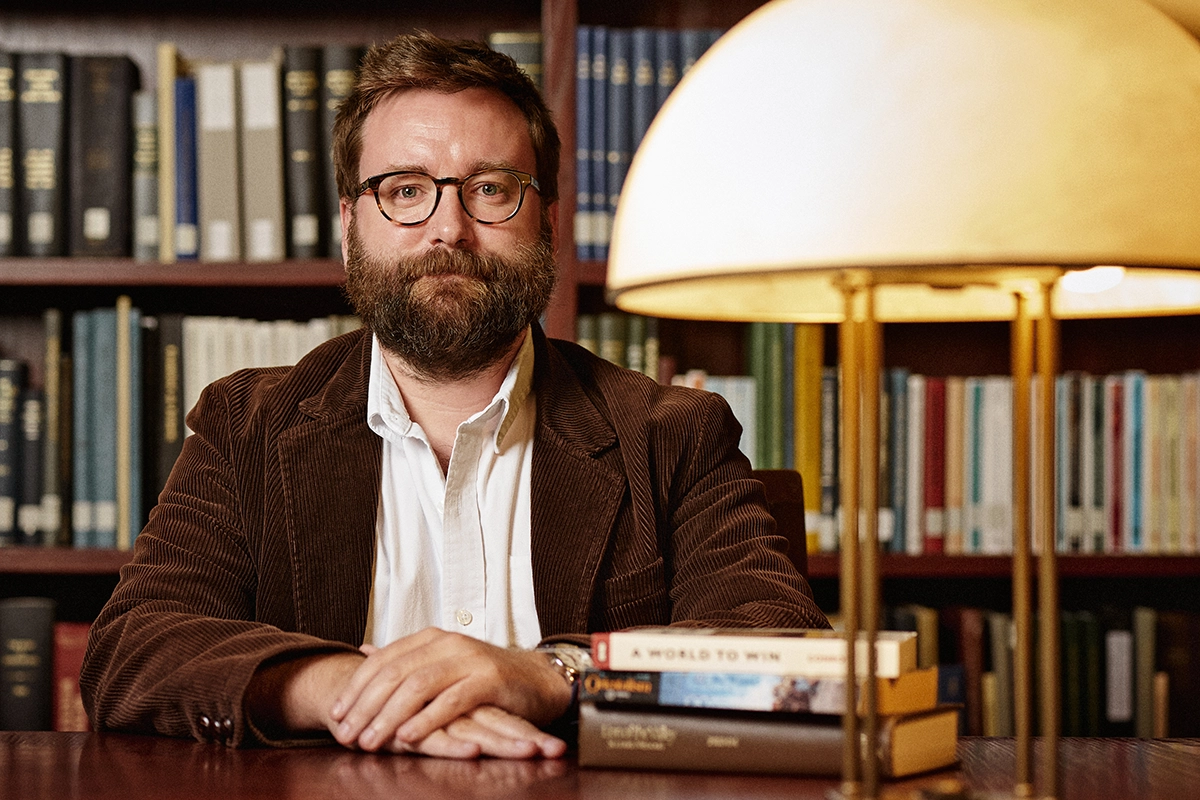
If you went downtown on New Year’s Eve and saw Nikki Glaser do standup for a sold-out, 3,100-seat Stifel Theatre, be apprised: She didn’t see you. She blurs her vision while onstage. Avoiding eye contact with the audience, she says, ensures she won’t see anyone who’s not laughing. That makes her sound insecure. She certainly can be. You wouldn’t have guessed it that evening from her swagger in knee-high stiletto boots and a dark, strapless getup; nor from her relentless nasal patter about ejaculation, suicide, and her vulva, which for a while during the pandemic had only a partial electrolysis treatment and so looked “patchy [and] steadfast… like a South American soccer field,” she joked at one point, to big laughs; nor would you have guessed it from her belting out of spoof songs, or her obvious mastery of her craft. But put aside for a moment the financial perks of performing, which are considerable—she now plays to theaters in the U.S. and Europe, has her second HBO comedy special in the works, and is producing/hosting two reality shows this summer for The CW Network. A central reason that Glaser, a 39-year-old Des Peres native, has been going on stage and screen for two decades is precisely that she has an oceanic need for attention and validation yet sometimes doubts that she deserves either. Performing is a chance to prove those doubts wrong. At least, such is the game that, until recently, she thought she was playing.
Hours before the Stifel show, Glaser steps into the theater’s side entrance with her dad, E.J. Glaser, and a pink welt on her forehead—the result of a mishap while helping him lift bags into their car. (Her dad is a retired Charter marketing exec who still lives in Des Peres and whose band, Glaze and the Moonkings, plays around town. He would later join her onstage with his guitar to play a duet, set to the tune of Lady Gaga’s “Shallow,” about the fact that Nikki had briefly moved back in with her parents early in the pandemic, hence her line, “This song’s off the deep end / Where did we go wrong / I want us to get along,” and his response, “It’s too late for that now / I’m kicking you out now / and I’m gonna bang your mom.”) As father and daughter find their way to dressing rooms, a Stifel staffer finds a Band-Aid and brings it to Nikki. “Thank you so much!” she gushes. “Is it cute? I mean my wound.”
Stay up-to-date with the local arts scene
Subscribe to the weekly St. Louis Arts+Culture newsletter to discover must-attend art exhibits, performances, festivals, and more.
Glaser has nearly collapsed her public and private personalities into one, according to those who know her best. Kerstin Robertson, who’s been tight with Glaser since fourth grade, says that listening to The Nikki Glaser Podcast, for example, is “like hearing a long voice memo from a friend. It’s crazy how open and normal she is with all these people.” She has made a career, in fact, out of graphic yarns about her body and her sex life—all of them basically true, Glaser says, and many involving her boyfriend, Chris Convy, who co-hosts The Courtney Show on 106.5 The Arch. (Their on-again-off-again romance was the main theme of her 2021 reality show Welcome Home Nikki Glaser? on E!) But on New Year’s Eve, with a hometown crowd converging on the Stifel, she resolves to self-censor a bit.
“I don’t want to embarrass Chris with any material,” she mutters, seated in her dressing room, using a Sharpie to scribble joke cues on index cards. (This is pure ritual—she never ends up consulting the cards, she says, nor does she write out her jokes anymore; her act floats in her head.) “Even though [Chris] has never cared. He’s always cool.” Still, many loved ones plan to attend. She doesn’t want to disappoint anyone.

“I just have to embrace that people are excited to see me, even though I’m not excited to see me,” she says. “I don’t even know how to put this hair in.” She means hair extensions. They’re but one piece of an elaborate regimen. Other pieces: fake eyelashes, spray tan, Botox, filler, laser facials, microneedling. Glaser both resents having to do all this and seems to revel in the outcome: Her Instagram account pops with shots of her looking like the hot influencer that, with more than a million followers, she is. She makes money off the anti-aging industry, too. One of her Insta reels is basically an ad for the anti-wrinkle injection Xeomin.
But whether she’s propping up a harmful standard or taking an empowered cut of the action, one thing is certain: By the time she hits the Stifel stage, she’s a spectacle—and immediately subverts it. Likening her physical appearance to “Owen Wilson after a suicide attempt,” she shares: “People say to me, ‘Nikki, you look so good, what are you talking about?’ And I say”—she gestures to herself—“‘This is all a lie.’” She’s only hot, she explains, because she has money to spend on her regimen.
To be famous, she tells her fans in the crowd (the most devoted of whom she likes to refer to as “besties”), you can lack beauty or you can lack talent, but you can’t lack both. Would anyone know Adele’s name, Glaser asks the crowd, if Adele had the talents of Gigi Hadid, whose talents consists of “having rich parents” and “looking like a shiny, wet sphinx?” Of course not, said Glaser: “I’d like to be fat someday and have a career, but I don’t think I would, because if you’re fat, you’d better be a talented motherf—er.” Her unspoken point: She isn’t one.
Not to say she’s a delicate flower. Standup demands a robust ego, and Glaser has that. But despite drawing praise over the years from her biggest influences (Sarah Silverman, Conan O’Brien, Jerry Seinfeld), from veterans and peers (Marc Maron, Joe Rogan, Mike Birbiglia), and from up-and-comers (Ginny Hogan, Isabel Hagen), Glaser does suffer steep dips in self-regard. At the same time, the software in her head appears to be updating these days, according to interviews we did at the Starbucks near her apartment in the Central West End. She has recently come around to the view that validation by others is not merely a short-term fix. It’s also a sham, because the famous (including her) neither earn nor deserve their fame. They just get lucky, through nature or nurture or both. Even hardworking celebrities who make good choices, Glaser believes, have lucked into the ability to work hard and choose wisely. To her, it’s luck all the way down.
This philosophy has left her in a volatile spot. On stage, she now fumes at the absurdity of celebrity, taking a jackhammer to the very hill she has so long sought to climb. But her new way of thinking has also been a weird sort of balm. It has cooled some of the jealousy that boils her insides. It has, in addition, allowed her to have a little empathy for herself. And for those whose brains go to far darker places.
The Comedy Central Roast of Alec Baldwin, which aired in September 2019, wasn’t Glaser’s first roast, but it was her most savage. Gleaming in a one-shoulder white dress, she told Baldwin, “I read your memoir and saw that you considered suicide, and that meant a lot to me, because I have also considered…your suicide. And I have some ideas.” She told Robert De Niro that he looked like Alf and that she felt honored to share the stage with him, “and by ‘this stage,’ I mean the final one of your life.” To Caitlyn Jenner, Glaser said, “You’re a Republican. I don’t know why. You’ve already gained control over a woman’s body. What does that party have to do to lose your support, be your son?” And to Blake Griffin, the biracial Boston Celtics player, she said, “You look like a Black guy that got made by a printer running out of ink.”
Then Griffin took the podium. “Nikki, look at ya, you damaged little climber,” he said, joking that she resembled Larry Bird and adding: “The only difference between Larry Bird and Nikki Glaser is that Larry could actually pass as 33.” Glaser’s jaw dropped and she chuckled out: “Dev-a-stat-ing!”
Days later, Glaser was a guest on the podcast Conan O’Brien Needs a Friend. She confessed that the wisecracks about her looks from Griffin and others had stung. O’Brien suggested to her that the roasters had been aping Glaser’s own self-deprecating jokes and probably didn’t think they were getting under her skin, but he empathized with her hurt feelings, then pointed out: “You’re doing these roasts, so some of that’s on you!”
“I know,” she said, “I need to stop doing them.”
In Glaser’s telling, her looks were a big reason that she got into comedy. She jokes about being “diagnosed as an ugly child by a caricature artist at Six Flags,” and says she craved the attention bestowed on her pretty younger sister, Lauren. Glaser was wackily funny within her friend group, Robertson recalls, and dabbled in theater, but she wasn’t the class clown: At Kirkwood High School, Glaser quaked at giving class presentations, and in social situations, would stand apart from the boys, arms crossed.
Toward the end of her senior year, Glaser went on a diet, lost some weight, got compliments—then almost stopped eating altogether. By the summer, her heart rate had fallen so low that she was forced to get in-patient treatment. “It was a scary time,” recalls her sister. “We were definitely worried about her.” Anorexia followed Glaser to the University of Colorado–Boulder, then to the University of Kansas, where she transferred her sophomore year. “We’d be out in public and people would stare because she was visibly sick,” recalls Robertson, who also attended KU and roomed with Glaser. But Robertson noticed something else: Glaser was watching a heavy dose of Late Night with Conan O’Brien.
An obsessive fan of Friends and Seinfeld, Glaser felt a calling to be on TV but doubted she had the face or the acting chops. So when friends suggested she try standup, she began writing jokes. She dissected O’Brien’s book, In the Year 2000, and devoured the oeuvre of Sarah Silverman, who in Glaser’s mind proved that you could be candid, wretched, and endearing. She started showing up at open mics in Kansas City and, on trips home, at the Funny Bone in Westport.
“It is incredibly hard to write a well-structured joke, and she understood structure very, very quickly,” recalls Greg Warren, a veteran road comic based in St. Louis. Glaser was still a college student when, in 2006, she advanced to the finals of the show Last Comic Standing, and the following year, scored a spot on the prestigious list of promising newcomers at the Just for Laughs festival in Montreal. (During one set she did to prepare, she says, she fainted onstage because she hadn’t eaten.) In 2009, at the age of 24, she did a set on The Tonight Show with Jay Leno. “She had some early TV exposure and some heat,” says Warren, “and she’d be like, ‘I want to headline this club.’ And I’d say, ‘You don’t have the time yet.’ Because 98 percent of people who do that fail miserably, and it really hurts them. But she’d say, ‘I’ll figure it out.’ And she would.” Her youth and attractiveness didn’t hurt, Warren adds, but the industry was right to notice her “because she always stepped up.”
“Stand-up used to feel similar to dieting for me because the rewards are blissful but it’s incredibly punitive along the way,” she wrote in The Cut. “My goals with stand-up are different now; I don’t get that high from laughter anymore. It isn’t about Wow, you like me! so much as I hope you enjoy yourself, but if you don’t, I won’t take it personally.”
But soon, Glaser was living in New York and unhappy. The careers of certain friends, including Amy Schumer, were taking off in a way that hers hadn’t, and Glaser says she would often drink until she’d black out and hook up with guys she didn’t really like. So in 2011, she went sober. This led, she has said, to a ramp-up in her eating disorder, which morphed into bingeing, and then bulimia. “I was getting mouth acne from throwing up and always had sores that I would pick at,” she would later write on The Cut. In her 30s, as her career did gain steam and she landed gigs on major cable networks and streaming services, fad diets such as intermittent fasting and Glaser’s decision to go vegan (which she still is today) provided a façade behind which she could binge unnoticed.
One night in January 2020, while lying in bed, Glaser—like countless other Swifties—eagerly hit the play button on the trailer to Miss Americana, a Netflix documentary about Taylor Swift. But Glaser dropped her phone in horror: It turned out that the comedian herself was in the documentary. During a montage of people criticizing the singer, Glaser is shown to have said in an interview years earlier: “She’s too skinny; it bothers me… all of her model friends, and it’s just like, c’mon!”
Glaser posted on Instagram a photo of herself in a Swift T-shirt. “It’s insanely ironic,” she wrote, “because anyone who knows me knows I’m obnoxiously obsessed with her and her music…. I was probably ‘feeling fat’ that day and was jealous. Also, I’ve had people say the same shit about me being too skinny before and know how terrible it feels… And I was only bothered by her model friends because I’d like to be her friend and I’m not a model.” Swift replied, “Wow.” She accepted the apology and added: “I’m so sorry to hear that you’ve struggled with some of the same things I’ve struggled with. Sending a massive hug.”
When the pandemic hit weeks later, Glaser says, she made the decision to temporarily move back in with her parents, in part out of fear of being alone and bingeing. That same month, she enrolled in a 12-step eating-disorder program and says that since then she has reached a much better place.
“Stand-up used to feel similar to dieting for me because the rewards are blissful but it’s incredibly punitive along the way,” she wrote in The Cut. “My goals with stand-up are different now; I don’t get that high from laughter anymore. It isn’t about Wow, you like me! so much as I hope you enjoy yourself, but if you don’t, I won’t take it personally.”
Glaser once joked that her hobbies are “depression, naps, and Froyo,” but don’t be confused about her professional energy: She’s game to do all kinds of appearances. In November, she served as grand marshal of the Thanksgiving parade here in town and sang the national anthem. She has done game shows (e.g., Who Wants to Be a Millionaire?), talk shows (e.g., The View and a guest-host spot on Jimmy Kimmel Live!), innumerable podcasts (from The Joe Rogan Experience to Girls Gotta Eat), satellite radio shows (Howard Stern’s), the aforementioned roasts (of Baldwin, Bruce Willis, and Rob Lowe), reality shows (e.g., The Masked Singer and Dancing with the Stars). The reality show that she herself has hosted on HBO is FBoy Island. Its premise: Three women being courted by a pack of dudes must try to sort out which are “nice guys” and which are “fboys.” (The “f” does not stand for “focused on philandering,” but that’s the gist). Several mainstream critics got a kick out of it. “The thrill of the series,” wrote one critic in The New York Times, “is that it is well aware of its own absurdity.” (Glaser is scheduled to host and co-produce a third season this summer for The CW, plus a spin-off, FGirl Island.)
Glaser’s bread and butter, though, is standup. O’Brien lauded her craftmanship when she appeared on his podcast, recalling how she had come on his TV show in 2018 and “punched a hole in late night at the time” by describing her vagina as looking like “a hastily packed suitcase.” “It was such great writing,” O’Brien recalled. Not only did it show how to do blue material with intelligence, he said, but also brought some parity to a male-dominated comedy landscape littered with penis jokes. “It really reverberated,” he said. (To which Glaser replied, “Well also, my vagina does reverberate.” O’Brien: “Congratulations?”)
To watch Glaser’s catalog of standup specials—from Perfect on Comedy Central to Bangin’ on Netflix to the most recent, Good Clean Filth on HBO—is to witness a style in evolution: Whereas she used to perform distinct jokes, she now unspools funny stories and asides as if chatting with intimates. Ginny Hogan, a young comic in New York who looks up to Glaser, has noticed this. “Sometimes comics make you feel like they’re trying to outsmart you,” she says. “What Nikki does is even smarter, because she makes you feel let in on the conversation.” That conversation is usually sex-focused. In Good Clean Filth, Glaser acknowledged the “philosophers” on Reddit who accuse female comics of scoring easy laughs with sexual shock humor. But she defended her brand of comedy as essential. “Sex ed is garbage,” she said. “Girls go into sexual encounters knowing really nothing because no one is telling them honestly what happens.”
Honesty is another recurring theme in Glaser’s recent standup, and more and more, she inflects such bits with an emotion rarely seen in her earlier work: rage. Her most animated moment in Good Clean Filth (and maybe across all her specials) comes when she rails at middle-aged men who insist that their much younger girlfriends have old souls. “I don’t know what happened, but there is an epidemic of old souls among 20-somethings right now, according to all my 40-year-old friends,” she complains, building up to some Sam Kinison–grade shouts: “You like her because she’s HOT AND YOUNG!… You don’t have to lie and say they have old souls! THEY DON’T HAVE OLD SOULS! A few of them do. I know a couple that actually do have old souls. Because something traumatic happened to them. And they need to go heal from it. They don’t need to go be humped by you and your old body!” The crowd cheered.
Part of Glaser’s anger during the bit was a jealousy toward beautiful young women—a jealousy that she openly admits on- and off-stage. Meanwhile, in her personal life, she and Convy have long vacillated about staying together. Glaser’s sister, Lauren, leans toward the belief that what Nikki wants most in life right now is a stable, loving relationship yet “always goes back and forth on whether she wants marriage or kids.” (Convy did not respond to interview requests, but he addressed that very topic on Glaser’s E! show, emphasizing at one point: “Nikki is all over the place.”)
Glaser’s feelings of jealousy also extend to other comics. David Spade, her friend, is effortlessly funny, she claims, whereas she herself is not. For a while, Glaser couldn’t even watch John Mulaney, who’s a fellow Midwesterner by birth and about the same age. They’re not quite in the same lane—he’s a generalist, while her act is more niche. (She aspires to be, she says, the Phoebe Bridgers of comics, not the Taylor Swift.) Still, she has despaired that she’ll never have Mulaney’s skill. Or that maybe she could have it, but she’s too lazy—letting a B- joke remain mediocre instead of spending 30 seconds to lift it to an A+. Or that maybe such laziness is really, at bottom, a fear of trying to reach her potential, because to even try would open up the possibility that she’s already reached it. Welcome to Nikki Glaser’s brain.
Such insecurity infuses her style: The merciless pace of her act, she says, deprives fans of any time to think, That wasn’t funny. O’Brien told her on his podcast, “You can breathe into it more because you’ve earned the right…. You’ve paid your dues. And you’re really funny.” But she explains away his encouragement. As a late-night host, she tells me, O’Brien had to be nice to people he didn’t hold in high esteem.
Glaser had to work harder to discount recent praise from Seinfeld. The two comedians played in separate rooms at the Borgata Casino in Atlantic City on December 10. After the shows, he sent word that he wanted to meet her, according to Glaser and her frequent opener Anya Marina, who witnessed the encounter. A staffer escorted them to Seinfeld’s green room, telling them on the way: Jerry never does this. When Glaser arrived, Seinfeld gushed with so much admiration for her work, including all her “YouTubes,” that at first she mistook it for a bit. (Fans of his show Comedians in Cars Getting Coffee know he’s not effusive with praise.) But then she realized it was sincere and teared up.
She told me this story a few weeks afterward, presenting it as a pivot point in her life. “I can question anyone else thinking I’m funny—my parents, my fans, even crowds of people cheering for me after a show. They can all be wrong. Jerry Seinfeld is not a liar. He just wouldn’t do that. So now I just don’t have the ability to go, ‘I’m not funny.’” (He had also apparently asked whether she was Jewish, and upon learning that she wasn’t, he disagreed, deciding: “You are.” Glaser’s conclusion: The only way you can be Jewish is if your mom is Jewish or Jerry Seinfeld declares that you are.)
Yet when Glaser met me again in March, the high had evaporated. “I’m feeling that fraud thing bubbling up again a lot,” she said, having rescheduled our interview from the previous day because of a bout of depression. “I think I need a new person to validate that I’m funny.”
Glaser recognizes—intellectually, at least—that she’s sprinting after a mirage. Her days on the stage, and on this earth, are numbered. She may yet live to see her star in the Delmar Loop sidewalk, she says. But eventually, passersby will have to Google her. Paul Newman, once a revered actor, is now, to young people, just the salad dressing guy. “Everyone will be forgotten one day, is my point,” she says, “and I will just be dust.”
She’s also been working through (and maybe adopting) the concept that she didn’t earn the talent for which she seeks approval. The underlying idea, fleshed out by the public intellectual Sam Harris and others, is that free will is an illusion. “We’re all so obsessed with status and ourselves and our ego that we can’t possibly think, ‘I had nothing to do with my success,’” Glaser says. “But I really didn’t. I’m just a big bag of cells and neurons firing off that I really have no control over.” Some folks take umbrage at this notion, she observes; she herself has found it freeing—from jealousy, for example—and also fruitful for standup.
At the Stifel, she told a story about being at her sister’s house and wanting to take a shower. Her toddler nephew (adorably) volunteered to join her. Glaser didn’t want the hassle, so she asked her sister in a creepy voice: “What if I molest him?” Her sister asked, “Would you?” Glaser said, “I don’t know!” Her story continued:
Of course I was joking, but if I’m being serious, I don’t know. Do you know? Have you run through your head, Am I a pedophile? I know that I’m not attracted to kids, but no one wants to be one. What if it just happens one day because the setting is right and you’re like, This is my thing! …. Think of how many things are inside you, just talents or things you’re into, and you wouldn’t know it unless you played that instrument or whatever? Do you think we’d know Paul McCartney—would he be a Beatle—if he was never given a guitar?
Her point was not to condone molestation. She’d prefaced this bit with another about her admiration for the grit of victim-survivors. They should get to board planes before veterans, she told the audience, and should never feel ashamed or stigmatized by what happened to them. (In fact, she considers it her “duty as a comedian” to break the taboos around discussing molestation, which she says is a massive societal problem.)
Her point, rather, was to invite the audience to consider that they don’t get to choose their thoughts—and therefore, could feel empathy for fellow humans who think awful ones. (Her premise has support among researchers, by the way; the director of the Sexual Behavior Consultation Unit at Johns Hopkins Medicine recently told The New York Times, “People don’t choose what arouses them—they discover it. No one grows up wanting to be a pedophile.”)
In May, during a show in Vienna, she drove home her point by closing the bit this way: “You can’t trust your brain! I get suicidally depressed sometimes. Do you think if I could choose what I thought, I’d want to kill myself?” She can’t own a gun, she explained, because she can’t trust herself to do the right thing with it. “Even though I would never want to use that gun”—she paused slightly—“to make my nephew have sex with me…” Raucous laughter cut her off.
This will be the material that gets the most buzz when her HBO special drops next year, she predicts. A well-known male comedian who heard the bit commented to her that only a female comedian could get away with it. “All that told me,” she says, “was that he was jealous of the joke. And that made me so happy.” A happiness, of course, she did not choose.