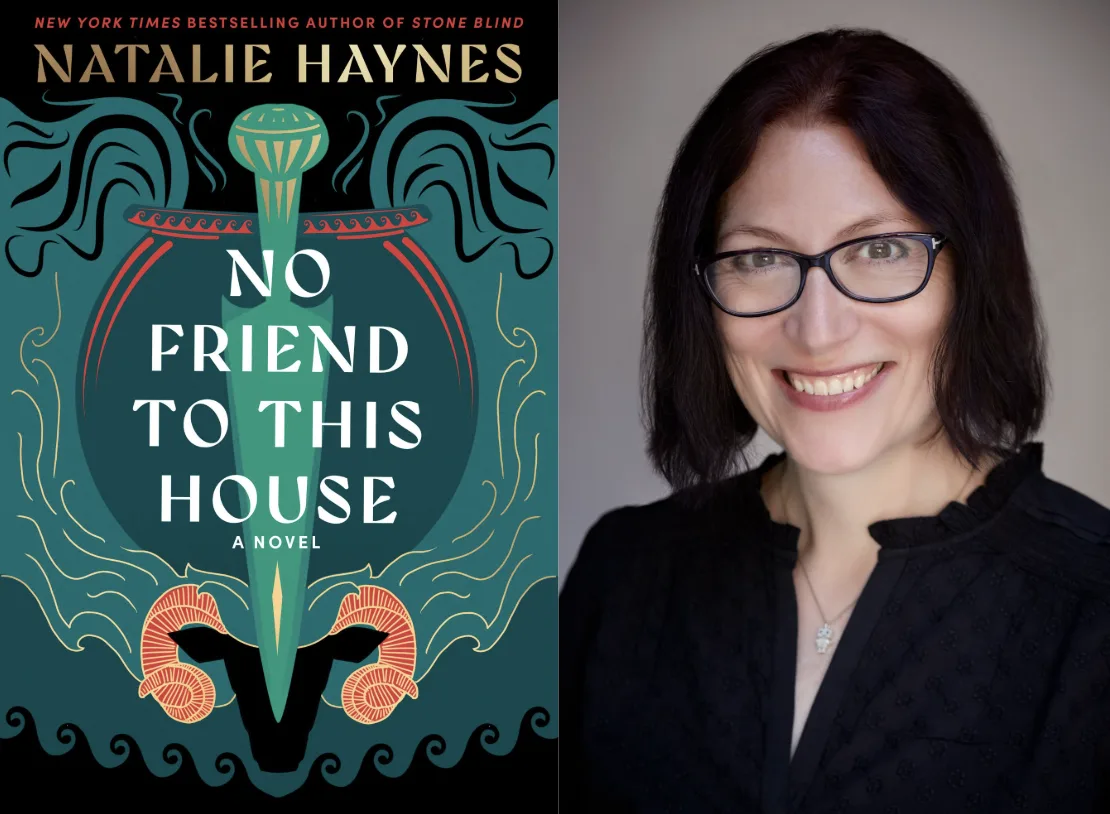
We’re in a golden age of Greek mythology retellings, with characters such as Medusa, Circe, Ariadne, and more getting their time in the spotlight thanks to contemporary authors and classicists. On March 12, one of the bright stars in this community of storytellers, author and mythologist Natalie Haynes, is headed to St. Louis to discuss her new take on Medea, No Friend to This House. The novel is out March 10 from Harper and has already been called a “Best Book of the Year” by The Observer.
Haynes, who has previously penned both fiction and nonfiction titles drawing on Greek mythology—Stone Blind, A Thousand Ships, Pandora’s Jar, and more—has been working her way toward telling Medea’s story for most of her life. Now, she’s ready to share No Friend to This House with readers everywhere, including attendees at her upcoming local stop, presented by the St. Louis County Library Foundation and Left Bank Books. Ahead of her visit to Clark Family Branch, we sat down with Haynes to talk myth, Medea, and why ancient stories still feel so relevant today.
Stay up-to-date with the local arts scene
Subscribe to the weekly St. Louis Arts+Culture newsletter to discover must-attend art exhibits, performances, festivals, and more.
Of all the myths you could choose, what drew you to Medea’s story?
This is the one I’ve been waiting to write.Medea is the first, maybe second, Greek play I read in Greek when I was still at school. So I would have been 17, I think, when I first read it. It’s the first Greek play I saw performed on stage. I saw Diana Rigg play her, and it was such an incredible production. My dad drove me down to London from Birmingham, where I grew up, about 110 miles away to see her play the role. It was such an incredible moment—this incredible, theatrical revelation toward the end of the play. I just remember sitting there in this little theater in North London, thinking I don’t think I’m ever going to be the same again. And I fully wasn’t ever the same again. I wrote a paper on it in my second year at university. I wrote my dissertation on it. I’ve probably seen it 20 or 30 times. I’ve seen it in Dutch. I’ve seen it in Japanese. I’ve seen it in Greek. I’ve seen it in English. And all this time I’m like, One of these days I’m going to do my version, and I don’t know what it is yet, but I’m going to get there. And then it was suddenly time. I was like, Yeah, this is it. This is the time when I write this book. So it’s been like 30 years in the making, this one.
To those with a more casual understanding of Greek mythology, Medea is shorthand for witchcraft, madness, and vengeance. Who is this character to you?
Right. She is the daughter of Aeëtes, the king of Colchis, and he is the man who has the golden fleece that Jason so desperately wants. In the most famous ancient version of their story—I think the most famous modern version is probably the 1963 movie Jason and the Argonauts—Apollonius’ Argonautica, Jason and the Argonauts sailed to Colchis, and then it is only with the help of Medea that they can get the fleece. Jason has to survive these impossible tasks…and Medea helps him with all of this. She is really the person who does all the heroics. That’s in other sources, too. In Euripides’ version from the fifth century, she says, “I got you a fleece, I did all this,” and he doesn’t argue. And they argue about everything in that play. So it’s definitely an old version of this myth that Medea is the one who comes in and does the heroics and Jason just sort of coasts by on her skills. She’s a super powerful witch. She is a priestess to the goddess Hecate, who is the Greek goddess of witchcraft, a Chthonic goddess. She is the princess of Colchis, so she’s often shown in quite an exotic way by our Greek authors. She’s a barbarian. She is the other. She is a dangerously clever woman. And she is somebody that, when she finds herself betrayed by somebody she believed she could trust, takes an almost unimaginable revenge.
Having spent so long considering this character, is there anything that surprised you during your research and preparation for this novel?
I translated the play to find the title of the book before I started writing it, and I don’t normally go quite this hard. Normally I translate the bits of Greek and Latin that I need for something, but I was like, No, you know you need to do the whole thing. Start at the beginning. I haven’t read it in that depth since I was an undergraduate. Very, very early on in the play, the tutor of [Jason and Medea’s] children comes back to the house and asks how things are with Medea. And the nurse of the children says [something like] “Pretty awful. She’s lying on the ground, crying and wishing she was dead.” And he’s like, “Oh, it’s about to get way worse than that.” She’s going to get burnished today by the king of Corinth, where the play is set, because Jason is marrying his daughter now and they don’t want her around and, The nurse says that that can’t be true. [She] can see how Jason doesn’t care if Medea is banished. She says, “old loves have been banished by new loves,” which is a pretty devastating reading. But she says surely he won’t let his children be just thrown out into the streets, and the tutor says, “That that man is no friend to this house.” So that’s where I took the title from, and it still seems to me extraordinary. I still feel slight goosebumps when I say it, because it’s such a devastating sentence. Jason, all the way through his own myth, he’s very persuasive. He’s got honeyed words or soft words or winged words in Greek. The cold hard truth of it seen by another man is just that he’s got no loyalty, even to his own sons, to his own children. And wow, that is ice cold. I think the awful emptiness that that suggests is at the heart of Jason—I must have thought about it before, but I don’t think I felt it as utterly as I did this time going through the text.
How has writing No Friend to This House changed your relationship to this story?
I was a little bit worried, truthfully, that the act of having been in such close dialogue with the play for the whole time I was writing would spoil it for me. I was a bit worried that I would have broken the play for myself, that I would go and see it and be like, “Oh, yeah, when I did this…” I would have been inside it too much. Then the first production I saw after I’d finished writing was a kabuki production. I was absolutely like, Is this going to work for me tonight? Have I overthought it? Seventy-five minutes later, I was both in floods of tears and on my feet, and I was like, It’s still fine. I didn’t break it. It’s alright.
How do you hope your book reframes the character of Medea for readers?
My last novel, [Stone Blind], was about Medusa, who, even if people don’t know her story—and they largely don’t—they know who she is. They know what she looks like. She’s the one with snakes for hair, she can turn you to stone. So I felt that that was a pretty good one in terms of people knowing who you were talking about. There’s a lot of brand recognition for the Gorgons. And I guess Medea doesn’t have that so much. I think drama students have often studied it. People who do a paper on Greek theater have probably done it. And it’s probably the most performed Ancient Greek play today. It’s probably been performed more in the last 50 years than at any time since ancient Greece. It is incredibly popular, because I guess the story of a warring couple, a divorcing couple, who weaponize their children against one another is perpetually, heartbreakingly relevant. I think generally if people do know the story, they think Medea is the worst mother in Greek myth. She does the absolutely unthinkable of injuring her children in order to injure her husband, even at the cost of injuring herself. That is a category of both harm and self-harm that makes her an extremist to a terrifying degree. What I wanted to say to people was that actually there are lots of versions of this myth that we don’t know, because they’re lost to us now. We’ve lost between 97 and 99 percent of ancient literature. These versions are lost, but there are references to them and allusions to them in ancient critical writing on Euripides, which survives to us thanks to the scholars of the Alexandrian libraries, and because of that we know there are versions of the story where Medea doesn’t kill her children, where she doesn’t do it on purpose, or she does it by accident, or other people do it. And I thought, you know, we’re so used to Euripides. I think it’s the best play ever written in any language. It bulldozes every version that comes before and after it. Everybody who writes this story after him is in dialogue with him one way or another. Everybody ancient, everybody modern, we are all thinking about Euripides as we navigate our way through it. And I wanted to say, even though I’m doing that too, there is a different path that she could take—and did take—that we just stopped paying attention to because there was this incredible version and it was all we could see. So I kind of wanted to see what happens if you strip away the label of the worst mother, then who might she be? I looked around for sources that confirmed my suspicions and for sources that absolutely refuted them, and I tried to incorporate the ones that sang to me and perhaps allude to rather than exclude the ones that didn’t sing. I just wanted to find a way of letting people see her as a whole person. The play documents one single day and everything that has brought you up to this horrific day when terrible, terrible revenge is taken, But how do you get this incredibly powerful witch that we meet when she is just a teenage girl and she and Jason first meet? How does this super powerful princess and priestess become a woman so at the end of her tether that she does the unthinkable and kills her children? How do you get her from that place to that place, and what happens next? And I was like, well, this is mine to tell.
What is it about these stories that you think continues to resonate with authors and readers after all this time?
The thing about Greek mythology, which isn’t true of every mythology, is that it operates at a very human level. The currency of Greek myth is human life, basically. It’s all about people living and dying. It’s all about them being. It’s about decisions that have an astonishingly high human cost and about having to make those decisions when there isn’t a good answer. There’s no version where no one gets hurt, there’s only versions where different people get hurt. I think that there’s a reason why therapists, psychiatrists, psychologists were so obsessed with Greek myth rather than, say, Norse mythology. Part of it was obviously a very European enthusiasm for the ancient Mediterranean world, but it’s because you can also find so much of human emotional experience in these plays, particularly in the myths in general, but in drama, in tragedy. I would hope most of us don’t know what it’s like to accidentally kill your father and marry your mother. But we do all know what it’s like to have done something terrible without meaning to, to have hurt somebody without intending to. We do know what it’s like to suddenly realize that you’ve made a terrible mistake after the fact. So when you read or watch Oedipus make that same discovery—albeit on a much grander, much more theatrical, dramatic and tragic scale—we have a tiny inkling of that emotion. And with Medea, unfortunately, we do all know parents who have weaponized their children in their war against their ex partner. And we do know people who have left their partner and children without looking back, and then felt like they were somehow being mistreated when people suggested they might not be the good guy. And we do all know people who damage their children irreparably in the process of trying to ruin their view of their other parent. I wish these stories didn’t resonate in some ways. I’d have to find something else to write about, but I’d accept that. But they are so elemental. At the beginning of Thucydides History of the Peloponnesian War, written in the fifth century BCE, he says it’s a possession designed to last forever, because human nature being what it is, we just don’t change very much. He’s talking about history rather than myth, but I think he’s right.
What are you hoping to share with folks during your stop in St. Louis?
I hope I’ll be able to tell them stuff about Greek myth that they might have been interested in but not known very much about. I really do live here. I started studying Latin when I was 11 and Greek when I was 14. If they have any questions about Greek mythology, I will do my best to answer them, particularly if they have questions about the quest for the golden fleece and the voyage of the Argo, I am here for those questions. I am here for questions on the Harryhausen movie. I am here for questions on Apollonius of Rhodes. I can do Euripides, I can do Homer. So I hope they’ll just come along and ask me whatever they would like to know. I will do my absolute utmost to make them realize that their interest in this extraordinary subject is a wonderful one and one they should always, always encourage.
Natalie Haynes will speak at the St. Louis County Library’s Clark Family Branch as part of the library’s Favorite Author Series on March 12. Doors at 6 p.m., event begins at 7 p.m. Books will be available for purchase via Left Bank Books.