Maryville University’s Dustin York had taught Communications 327: Social Media Campaigns for a half-dozen years before he made a key change this past semester. Instead of having students create campaigns for campus groups, he’d have them work for real-life brands.
Keeping their efforts confined to campus felt “too safe,” the professor says. “If I want these students to sit in a job interview at a social media agency and they were going to show their work, what would speak to that employer? Would it be your local Campus Activities Board, or would it be Chipotle?”
Stay up-to-date with the local arts scene
Subscribe to the weekly St. Louis Arts+Culture newsletter to discover must-attend art exhibits, performances, festivals, and more.
So York asked students at the private university in Town and Country to help list their 50 favorite brands, and then he reached out cold to whatever emails he could find for those brands, asking for their support. Just three responded, Chipotle, Ted Drewes, and Smoothie King, but the gift cards, schwag, and tacit blessing they offered was enough to get started—and for York’s students to create social media campaigns that succeeded beyond his wildest dreams.
Not only did four students create videos that reached well over 1 million people each, thereby earning the right to skip the final and finish the class with an A, but York has also had brands reach out to him, asking if they can be part of the course in a future semester.
Naturally, York said yes. Now that the students have had the real-life campaign experience, he says, “There’s no going back.”
And it wasn’t just the students who learned by crafting would-be viral videos. It was York himself. Before coming to Maryville 13 years ago, he worked for an agency, and he continues to keep his finger on the pulse by teaching workshops for corporate America. Even so, he was surprised in some cases by which videos took off and which fell flat. He still can’t believe the Reel where a student smashed a Ted Drewes frozen custard in his face wasn’t a hit.
“‘Student puts ice cream in professor’s face’—that one didn’t, right? That’s a couple thousand views or whatnot. But then a few seconds of students dressed up for Halloween who went into a Chipotle, that one was like 5 million, 6 million views on that one, right?” It’s the vagaries of the internet. Says the professor, in words that won’t surprise anyone who’s attempted to create compelling digital content: “Some of the stuff that you spend a lot of time with takes off. Some of it doesn’t.”
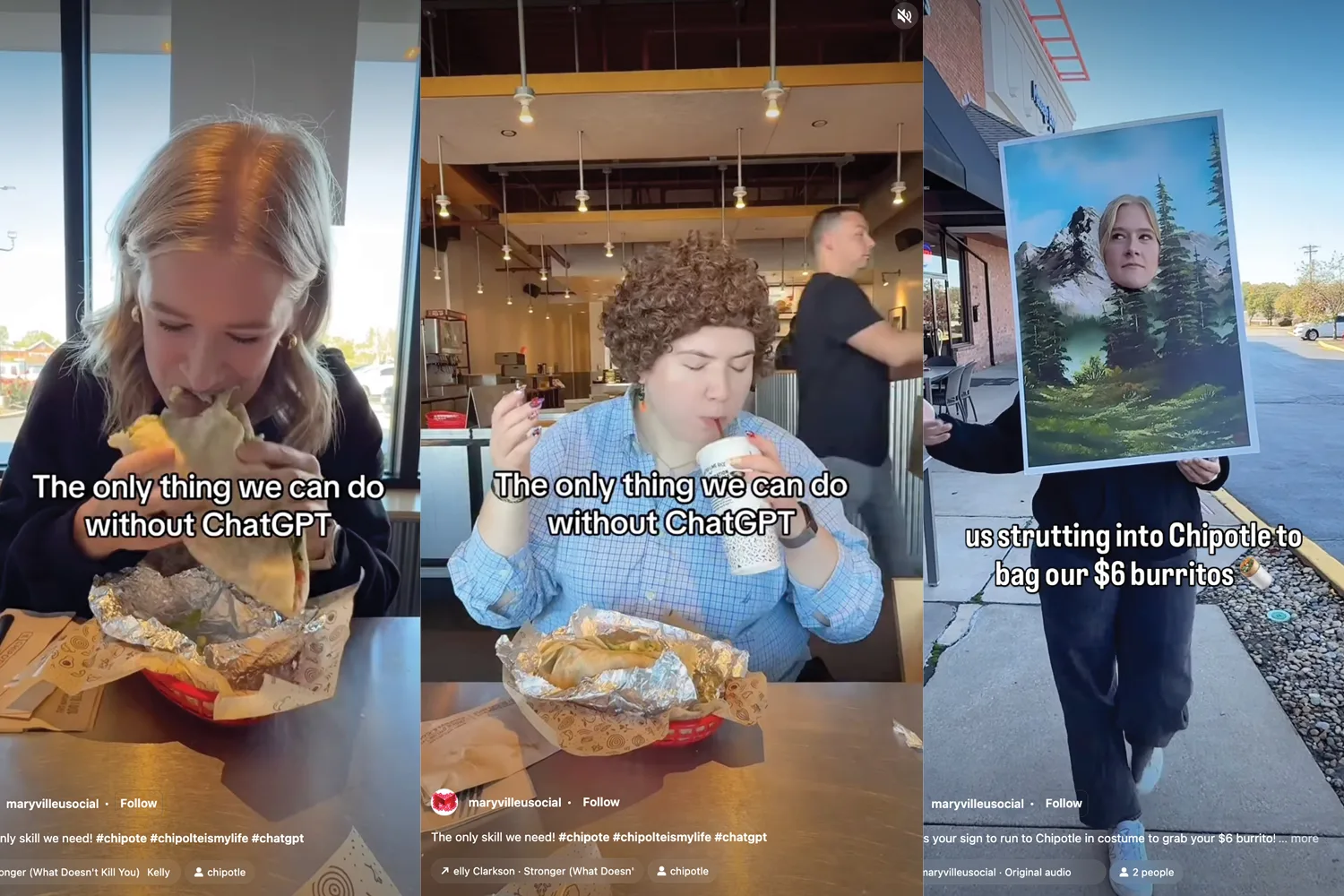
The Chipotle video that did take off, the highest performing content the students made for any brand over the course of the semester, was actually the second in a series. In the first video, creator Anna Kabbes walks into a Chipotle, dressed like a Bob Ross painting; her friend is dressed as Ross, complete with a bad wig. That one topped out at 96 likes. But a second video from the same visit, which shows the two friends scarfing Chipotle, blew up, with more than 803 likes on Instagram and 1.1 million on TikTok, and 5.9 million people in total viewing it. That one earned Kabbes an A.
The secret to the video’s success, York thinks, was “trendjacking”: The idea of trying to connect a video to whatever the internet is already talking about. In this case, Kabbes was aiming for Halloween—but the second video in the series layered a second trend, with text on screen reading, “The only thing we can do without ChatGPT” as the girls wolfed down their burritos, poking fun at both college students who are dependent on AI and perhaps also the elders who’d discount them for it.
“It’s that kind of that perfect storm, Halloween meets ChatGPT meets a burrito,” says York. “Also, we talk about this in class, where if they would have filmed that in their dorm room, I don’t know if it would have done as well as in a public place. So I think all of those elements that we cover in class—and then it was just lightning in a bottle.”
And that’s what York hopes his communications students can capture in the years to come. His goal is to have 10 brands on board for the students’ campaigns next semester, which he teases will include a professional sports team and a national chain restaurant along with the three brands for last year’s videos. All three, he says, were happy enough with the students’ work to sign on for another go-around.
Looking back, it’s interesting to wonder how different the fall semester would have been if neither Chipotle nor Smoothie King nor Ted Drewes responded. Would they have gone back to inwardly focused campaigns for campus activities? York says no way.
“I think if no one would have reached out, this is the honest truth, I would have emailed 50 more,” he says. “I think that speaks to you’ve got to do what you preach. So, yeah, just keep emailing.”