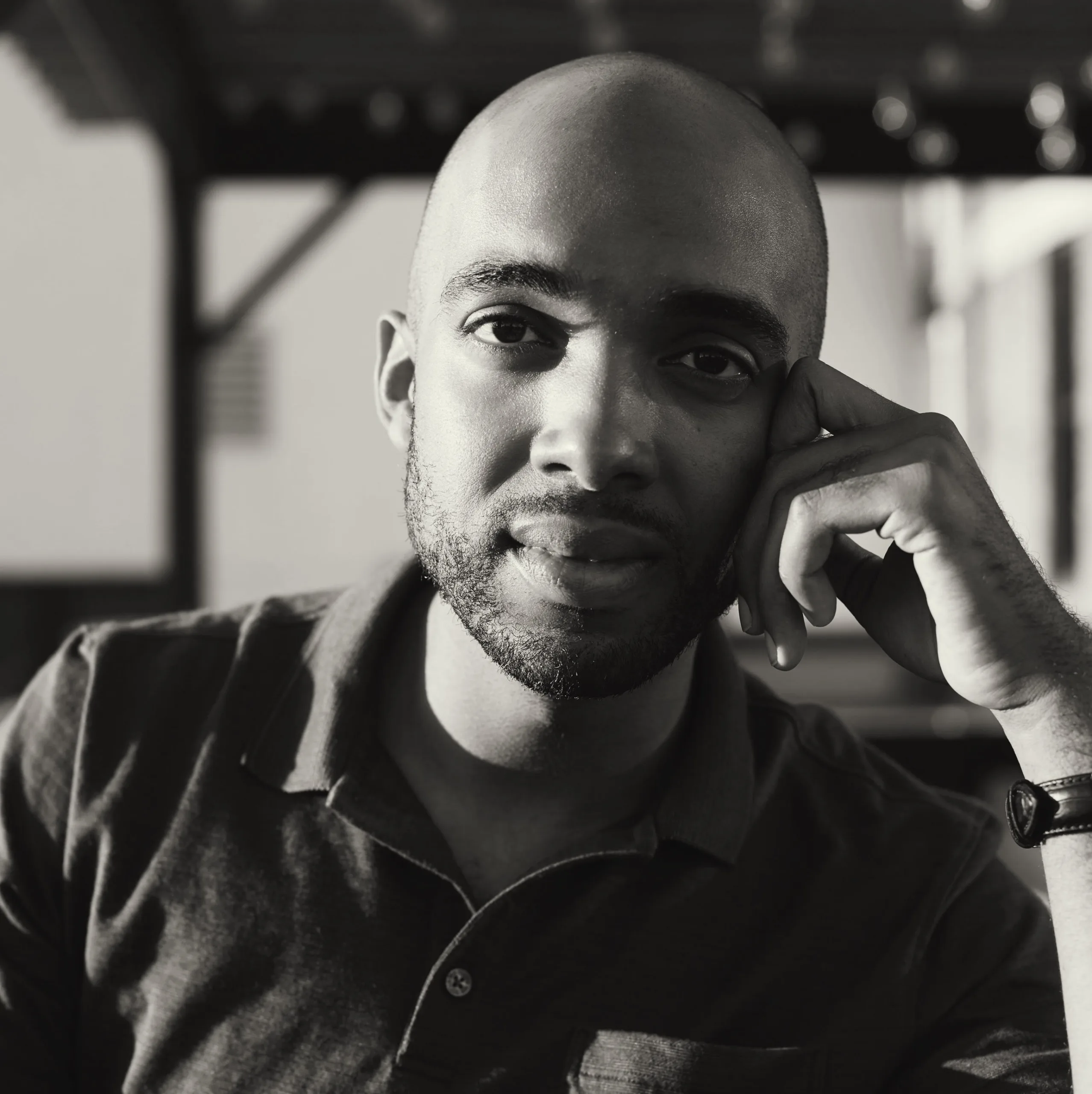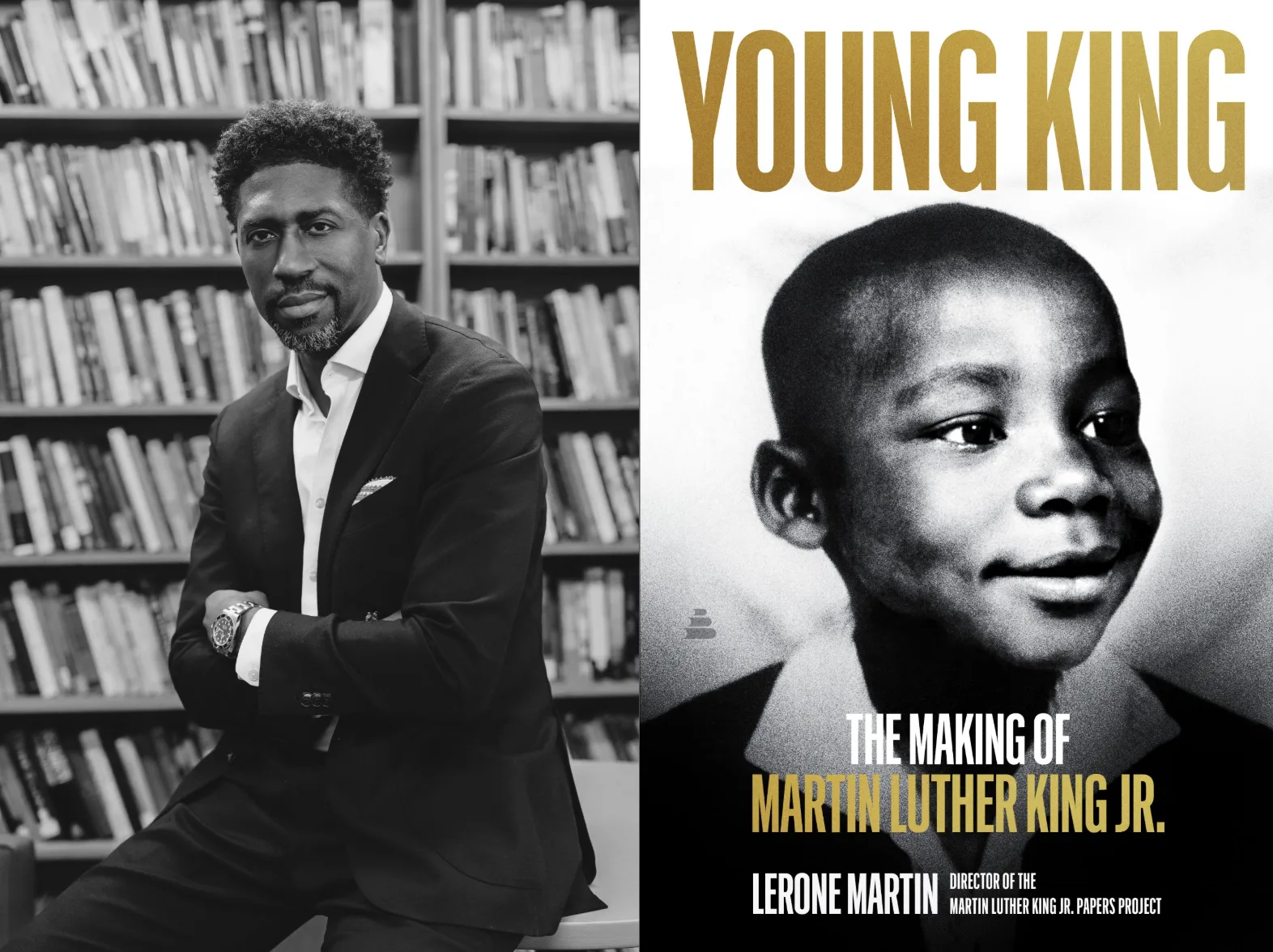
Before Lerone Martin joined Stanford in 2022 as director of the Martin Luther King Jr. Research and Education Institute, he spent years in St. Louis asking how religion moves through public life: through Black preaching, recorded sound, political institutions, state surveillance, and the moral vocabulary of American power. At Washington University’s John C. Danforth Center on Religion and Politics, he pursued those questions as a scholar of African American religious history. “I’m still asking questions about religion and public life,” Martin says.
In his new book, Young King: The Making of Martin Luther King Jr., Martin brings that lifelong inquiry to King’s beginnings. The book traces the young MLK—not yet a Baptist minister or civil rights leader—through the institutions that formed him: 501 Auburn Avenue, Ebenezer Baptist Church, segregated schools, Black libraries, Morehouse College, and the Connecticut tobacco fields where King first glimpsed a world beyond Jim Crow and began to feel what he later described as a call to service.
Stay up-to-date with the local arts scene
Subscribe to the weekly St. Louis Arts+Culture newsletter to discover must-attend art exhibits, performances, festivals, and more.
“However, King was not born a hero. Like all heroes, he was shaped,” writes Martin, whose book also includes rarely seen black-and-white photographs of King as a child and adolescent. “The man, the minister, the political theorist, and the activist that Reverend Martin Luther King Jr. became was not inevitable.”
On May 9, Martin will appear at the Clark Family Branch of the St. Louis County Library for a Westfall Politics and History Series event presented with the Missouri Historical Society, in conversation with Cicely Hunter of MHS’s African American History Initiative. It comes as the Missouri History Museum’s Mill Creek: Black Metropolis exhibition, which runs through July 12, asks St. Louisans to reckon with a Black neighborhood razed by government-backed clearance and eminent domain—and to consider what is lost when the institutions that form communal life are wiped from the map.
Ahead of the event, SLM spoke with Martin about the making of Young King, the institutions that shaped Martin Luther King Jr. before he became an icon, and why recovering the fullness of Black communal life matters in St. Louis and beyond.
Your work has long examined religion, public life, and institutional power. How does Young King continue those questions, and what has changed for you intellectually over the past decade?
Preaching on Wax, my dissertation and first book, was looking at religion and public life as it relates to religious broadcasting and celebrity in the 1920s. Then the second book was thinking about religion and public life as it relates to the FBI. I got turned on to that because when I finished Preaching on Wax, which was about the phonograph, I thought the next thing I probably should do is work on a book that looks at radio.
When I was going to do that, William Maxwell, who teaches in WashU’s English department, said, “When you do this book on radio, you should probably check FBI files.” Bill had just finished his book on the FBI’s surveillance of Black writers, and he said, “Well, if they’re surveilling Black writers, they might be surveilling Black radio preachers.” So I made my first Freedom of Information Act request in 2014, right before my book came out, after having coffee with Bill. That was in April. Later that summer, Michael Brown died.
Then I had some local clergy tell me that the FBI had reached out to them for their assistance, saying, “We don’t think the officer is going to be indicted; we’re really worried St. Louis is going to explode.” They were reaching out to clergy to help make sure St. Louis didn’t explode. So I thought: We often think about surveillance and the FBI. But how long has the FBI been asking clergy for help? That seemed interesting.
I finally got a Freedom of Information Act request back on a radio preacher by the name of Elder Lightfoot Solomon Michaux. I found out that he was working with the FBI to discredit Martin Luther King Jr. So I started pulling on that thread and got a bunch of different FBI files of folks I thought the FBI might like. That book ended up becoming The Gospel of J. Edgar Hoover, which again was asking about religion and public life—in particular, how the FBI was partnering with clergy to shape public understanding of faith, what faith is, and what kind of faith is appropriate.
For this project, it’s still religion and public life, but professionally, life changed. I started this new job in 2022. The Gospel of J. Edgar Hoover came out in 2023. And while being here, I started encountering things about King’s life that I had never heard before. For example, he went to Connecticut one summer. He wrote five letters home that we at the King Institute have. I read them for the first time and thought, What in the world? How have I never known this?
In the letters, he’s saying, “I’m seeing things I never thought a person of my race would ever see. I’m going to restaurants and sitting where I’d like. I’m going to movie theaters and not having to be sat in the balcony.” So I thought, This is interesting. Then, when I read his seminary application, it said that he began to feel called to ministry in the summer of 1944. He said it wasn’t anything magical. It was just kind of a gradual urge. And of course, I was like, Well, what happened in the summer of ’44? That summer was the summer in Connecticut, the letters he wrote home to his mom and dad that summer.
On a personal level, I’m married, I have children, and I also started thinking about this as a parent. My intellectual questions are still religion and public life, but on a personal level, I started thinking more about kids and parenting. How do you go about raising responsible, kind human beings who want to engage in a life of service? That compelled me to write this book about King’s childhood, about what shaped him, and to point out to people: This was not inevitable. There were things that happened in his life that really, really shaped him—the summer he spent in Connecticut, the first time out of the Jim Crow South; wrestling with wanting to be a lawyer; wrestling with agnosticism; wrestling with, as he says in his own words, being perilously close to hating all white people. How does all that change? That’s what got me writing this.
The book shows how many institutions had to hold King before he could hold the moral integrity of the nation. How did writing Young King change how you think about institutions as sites of moral and political formation?
I think that’s something that really jumped out at me: how all these institutions really shaped him. I hadn’t really thought about that — that there’s so much that goes into making a human being, a leader. The story is often told, especially in America, about the bootstrapper, the self-made man. And this story belies all that. This is not a self-made individual. This is an individual whose community wrapped their arms around him. They wrapped their arms around him and shaped him, not because they knew he was going to be Martin Luther King, but simply because this is just what they did. This was who these people were. They were loving, they were caring, they were educators, they were mentors. They were shaping people—especially all the women in his life, whom I really enjoyed chronicling throughout the book.
Now, thinking about what’s happening in America today, I do think it’s a call to remind us that we can’t be fooled by this kind of self-made human being idea—that you can fashion yourself and become great or successful without others. As we’re seeing some of our institutions chopped down or underfunded, some of the stalwart institutions and programs, I think it’s a call for us to look at someone like Martin King and see that none of us makes it to where we are in our lives alone. Institutions, communities, families—all of that is so important in creating and making a human being who is courageous and dedicated to live a life for others.
In St. Louis, the Mill Creek exhibition is asking people to reckon with a Black metropolis that was razed. Reading Young King alongside that history made me think about what happens when formative Black institutions are destroyed. How do you connect those histories?
What this book does, at least I think, is it shows the importance of those communities to young people. Auburn Avenue, in all its beauty and all of its struggle, really shaped Martin King. He grew up around all these Black businesses. Segregation made it possible that he grew up around a whole host of people in terms of their class backgrounds. He grew up with the Black physician, the Black dentist, but also Black folk who were unemployed or dealing with addiction. It allowed him to see a plethora of Blackness.
You think about a little boy on Auburn Avenue: He got to see everything. The Atlanta Life Insurance Company. Citizens Trust Bank. He got to see all these things. From what we can tell, these were part not just of his informal education, but his formal education. In school, when they were doing math assignments, they would go to Citizens Trust Bank and figure out how interest works. They would use interest and savings accounts to do math homework. They would take a field trip and talk to the president of the bank. All of these things were baked into his life.
It’s really beautiful to see how this community shaped him, and not just him, but so many other young people growing up around that time. It goes to show how powerful these communities were, and that when you raze them, wipe them off the map, we lose so much—not just historically, but also in terms of shaping people’s futures. There are people who will not grow up in those communities. They’ll be dispersed, and they won’t get a chance to see themselves or utilize the community resources that are so important in shaping young people.
At a moment when Missouri’s HBCUs are part of a major funding debate, what does King’s Morehouse story show us about what HBCUs do beyond conferring degrees?
King says, in his own words, that going to Morehouse does three really important things for him. First and foremost, it exposes him to men like Dr. Benjamin Elijah Mays and Dr. George Kelsey. King says repeatedly throughout his life that those are the two individuals who allowed him to see: Wait a minute, I can be highly educated, respectable, believe in modern science, and still be a minister.
That was so powerful for him. He loved the way they dressed. He loved the way they spoke. He loved that they had the highest education possible in their field, with PhDs, and yet they were still ministers. That allowed him to see, Okay, I can still embrace my intellect as I have a quest for faith. Morehouse did that for him.
Had he started off at a place like the University of Chicago or Harvard, he would not have seen so many African-American professionals who would have allowed him to imagine himself accordingly. Number two, he was in an environment where George Kelsey taught him historical criticism of the Bible. He could have gotten that at a number of liberal arts institutions at the time, but to receive that education from someone who looked like him, and someone who was trying to articulate what historical criticism meant to the Black experience—that was so important. That’s the only class Martin got an A in the whole time at Morehouse, and he says that opened up the Bible for him.
Finally, what a place like Morehouse does, even though it’s an HBCU, is that they have relationships with Emory and other white institutions in the area through the Intercollegiate Council. That exposes King to talking with white students, his own peers, who were also going through college. He says those fellowship meetings really helped soften his heart, because he was still dealing with harboring anger and resentment toward white people. Against his father’s wishes, he joins this organization, and it exposes him. Being able to engage in those conversations in a structured way was so important for him, as opposed to being thrown into the deep end at an all-white institution. For Martin King, Morehouse was so important in shaping him and giving him a vision, and evidence and materiality, if you will, of what the kids now call Black excellence. That was so important. And then we know how important it was because even after that experience, when he goes to Crozer, a historically white institution, he says he was terribly self-conscious at first. You can only imagine how bad it would have been had King started off at a college that way. At the time, he was changing his personality because he was so terrified about the white normative gaze.
For King, Morehouse was so important in giving him a foundation of what it meant to be Black in America, what it meant to be educated in America, what it meant to be professional in America. It gave him, as you said so beautifully, so much more than just a degree. It gave him a sense of self.
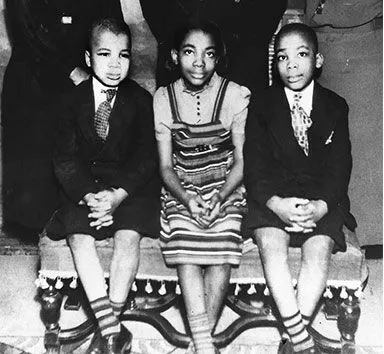
The book has a striking intimacy, especially through letters and family material. What do those sources reveal that public speeches and institutional records cannot?
You really get a chance to feel the emotion—the pathos, if you will—in Martin King and his family. You get a sense not only of the emotion, but also the ethos: how things operate and the spirit in which they operate in the family. The little letters King is typing on his little kiddie typewriter to his dad—as I was reading them, he always comments on his behavior. Always. He’s always like, “Hi Daddy, we miss you, I’m being a good boy.” Even from Connecticut: “I’m not doing anything here that I wouldn’t be doing in front of you.” It lets you know that part of their relationship is very much based upon discipline. His desire to please his dad is very important to him, or at least to appeal to his father and say, “I’m being a good boy, Dad.” He wants his dad to be proud of him. That kind of intimacy is powerful. Rarely in those childhood letters did he say, “Love you, Dad.” He would tell his mother that, but not necessarily his dad. And his dad’s published autobiography and unpublished autobiography, to Daddy King’s credit, kind of admits that. He says, “I didn’t always have great patience. I would use a belt oftentimes rather than just sit and talk with them.” It’s very instructive about how that relationship worked. That relationship was predicated upon discipline and how King conducted himself.
The few love-letter exchanges between Martin and Coretta offer a level of intimacy while they’re dating. For many of us who are past our 20s, you can read it and laugh and cringe at the same time, because you see the games people play when they’re in love and they want to be vulnerable, but they’re terrified of being vulnerable. So they play these games of cat and mouse and hide and seek. Coretta, to her credit, is very honest in some of her unpublished interviews. She’s like, “I liked him, but I didn’t want to like him. So I played it cool. And I also knew there were other women who liked him, but he was really like, ‘Hey, I want to get married.’” And she’s like, “I’m not sure I want to marry a minister.” So she played it cool, and that drove him crazy. But he also responded by playing games—taking her to parties and trying to make her jealous, like, “Look at all these girls that like me, Coretta.”
That kind of intimacy makes the book real. What I hope it also does is allow people to see themselves in it, and laugh and cringe, and maybe remember some of the games they played and mistakes we all made in our love lives and intimate relationships. It’s more than just his report card. That can tell us things about the grades he got, but it can’t tell us the conversations with his professors, or the interviews they gave in the ’60s talking about him. It really means a lot.
You’re directing the King Institute as the papers are being digitized and public history is politically contested. What does it mean to make King more available, especially when he is so often flattened or misquoted?
Since I’ve been at the MLK Institute, my goal has been to make it possible for people to have a conversation with Martin Luther King Jr. Digitizing, having a word-searchable database—which we’re working on diligently with our library—makes it possible for people to have a conversation with King for themselves.
I think this is what Coretta wanted. I think why Coretta started the King Papers Project was because she wanted people to have a direct conversation with him, one that was not mediated through others—not politicians who were misquoting him or quoting him for nefarious purposes, or people quoting him in ways that are completely at odds with how he lived his life.
I want to do this for Martin, and I want to do this for Coretta, so the world can actually behold and read things that he wrote—and not just the “I Have a Dream” speech or the “Promised Land” speech, but the day-to-day, regular Sunday-morning sermons he gave. He was preaching about how to overcome insecurity, how to overcome self-centeredness, how to overcome divorce, how to deal with wealth, how to deal with poverty. He addressed all of these things. He was a pastor. He had to. He was walking people and shepherding people through their daily lives before he was this famous icon. And he continued to do that even after he was a famous icon and activist.
It’ll give people the ability to assess for themselves. When they hear politicians quote him and try to use him to argue for colorblind policies, people will be able to say, “Wait a minute—that’s not what King was saying. That’s not consistent with his entire life, his entire public life from 1955 and the bus boycott to his death in 1968. That’s not consistent.”
I hope our new searchable database, with the technology we have, will allow people to have access to him at their fingertips. King reminds us of this in his Nobel Peace Prize speech. He talks about how our technology has advanced. This is in the ’60s. He’s like, we have computers that can calculate numbers at the speed of light. We can fly through the stratosphere. We’ve shrunk time and space. There are so many things we can do with our technology, but our technological progress has not kept up with our moral progress. I hope maybe we can use our technology at Stanford to shorten that gap between our technological progress and our moral progress.
Martin will speak at the St. Louis County Library’s Clark Family Branch (1640 South Lindbergh Boulevard) on May 9 at 7 p.m. Books will be available for purchase via Left Bank Books. This event is free and open to the public.