Humans of St. Louis (HOSTL) got off to a bit of a rough start.
The project was inspired by the popularity of Humans of New York, photographer Brandon Stanton’s creation that collects stories and photographs from strangers he encounters around New York.
Stay up-to-date with the local arts scene
Subscribe to the weekly St. Louis Arts+Culture newsletter to discover must-attend art exhibits, performances, festivals, and more.
But when HOSTL founders Caroline Fish and Lindy Drew first attempted to replicate the project in St. Louis, by approaching individuals walking around downtown St. Louis, it didn’t go as planned.
“It was cold, and no one really talked to us. We were so discouraged,” recalls Drew. “We went back again and met someone who said he was a street pharmacist. We’re like ‘Can we take your picture?’ He said no and ran.”
But the two didn’t let those initial interactions discourage them. “I really wanted to do a project that had nothing to do with school. I just needed a break from all the studying,” says Drew, who at the time was a graduate student at the Brown School of Social Work at Washington University. Fish had originally approached Drew, who is also a photographer, about starting the project in St. Louis.
They continued to go out and approach people to interview, and eventually, found some St. Louisans willing to talk to them. By May 2014, Drew and Fish had collected enough stories to launch the HOSTL Facebook page. On the first day, the page received 300 likes. The next day, that number grew to 400.
“I was thinking ‘People are open to this, and they trust the Humans of New York brand. If we do it right, this could be fun,’” says Drew.
Just over three years later, the project’s Facebook page has more than 91,000 followers.
In August, I met with Drew at the Starbucks near Saint Louis University to talk HOSTL.
When she’s exploring an area and looking for people to interview, she does so by bike, with her camera strapped around her neck. She stores her bike in her trunk, so she can “HOSTL” at a moment’s notice.
“I’m not pulling over in a car and rolling my window down—I’d never do that,” she says. “People are always curious. They’re like, ‘Why are you in my neighborhood?’”
Drew tries to cover a wide range of neighborhoods, rather than restricting herself to places with higher foot traffic. But that can be a challenge. “I don’t want to be tethered to the Delmar Loop and South Grand, but once in awhile I know they’re going to bring diversity and people will be walking around.”
Drew doesn’t work in isolation. The editorial team, which includes Fish, Dessa Somerside, and Celina de la Croce, is instrumental in determining what part of someone’s story they want to share. “There are a lot of eyes on the project saying, ‘Pull back here. Push it there. Let’s go with this story. We already told a story like that, let’s choose another one,’” says Drew.
In the middle of our conversation at Starbucks, a man in an automatic wheelchair rolls up to our table. He’s neatly dressed in white pants, a white shirt, and a colorful tie. A speaker attached to his wheelchair is blaring “I’m Coming Out” by Diana Ross.
Drew is laughing as the man approaches. “What’s up Robert? How you been?”
“I captured this guy a while ago,” she explains.
Robert proceeds to get out of his wheelchair and dance, clearly trying to impress.
“Has she seen it?” he asks, talking about his photo.
“I’ll have to tell her about it,” says Drew.
The streets are clearly Drew’s office.
As Robert rolls away, Drew tells me that she captured Robert on his 80th birthday. He told her that he wanted a lap dance for his birthday, because he had never had one before.
The two met again when Robert attended the opening night of a HOSTL art exhibition that featured the photo of him. Drew later delivered a 20-by-30-inch print to Robert’s apartment. “I walk into his apartment, and all the walls were full of photographs of his family,” she recalls. “It was so cool because he found a spot for his picture.”
Drew explains that some interviews, like Robert’s, are quick, while others can take up to 30 minutes. “I’ll try to give someone as long as I can for them to come up with something that they want to share that’s personal.”
Some people jump right in. Others need time to feel comfortable enough to reveal something about themselves. Drew is careful to ask open-ended questions, so as not to lead the interviewee in a different direction than what they intended. “I don’t make it about me,” she says. “It’s really about the other person when I’m interviewing. I don’t talk about myself.”
“We’re not about getting skeletons in people’s closet—that’s not the point,” she adds. “The point is that two individuals who are strangers can talk to each other and find this moment. Then all these people chime in and create community.”
Most of the time, the HOSTL community is supportive, but the page is not without criticism. “This puts St. Louis in a bad light,” reads one comment on Facebook.
I ask Drew about it. “I think that there can be criticism. Sometimes we get comments like, ‘Why do you show such bad, dark, twisted stories?’ But I’m not choosing what these people talk about. I’m asking a question, and they’re answering it. This is their life,” she says. “We want you to think. We want you to be challenged. It’s not all like, ‘We’re so happy, and the great part about St. Louis is the zoo because it’s free.’ We all know that. We don’t need to talk about that.”
In the same year that HOSTL started, Michael Brown was killed by a police officer in Ferguson. The event and the community’s response dramatically affected how Fish and Drew approached the project.
“I learned so much in the process of asking different questions and really challenging people about how they feel about living in their own skin,” she says, “and what that means to socialize or not socialize with people who are very different from them.”
I accompany Drew as she goes out to collect stories—”HOSTLing,” as she calls it. Our first story is quick. We talk with a family as they leave an awards ceremony at Saint Louis University. The award winner, a young girl, is just as spunky as she is bright. She answers the questions with so much personality, the interview doesn’t last more than a few questions.

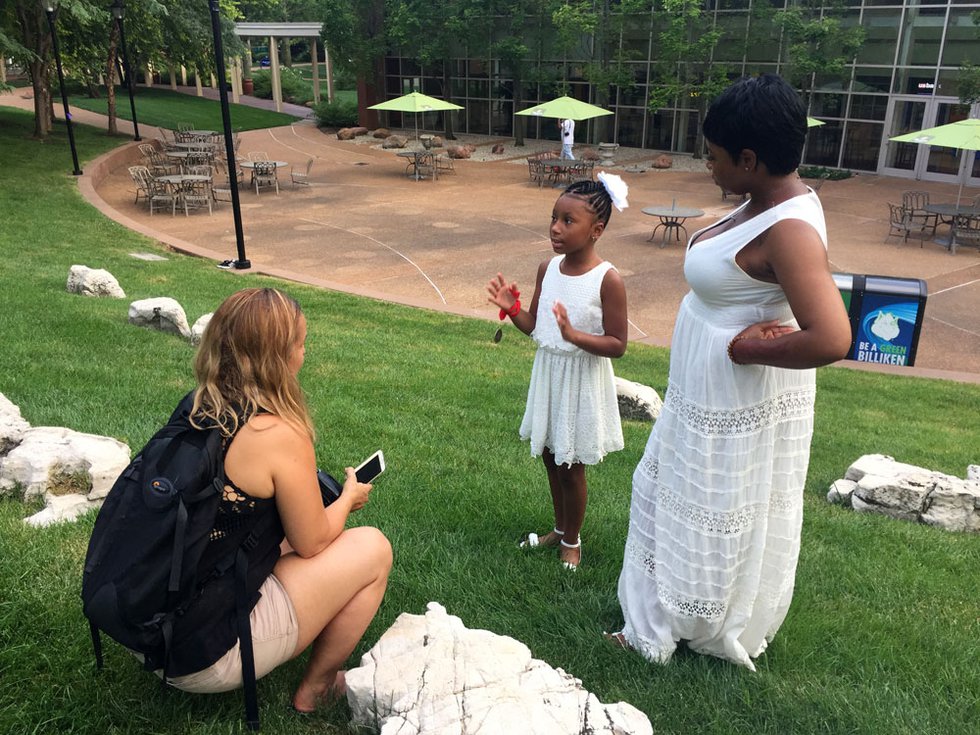
We approach another family leaving the same awards ceremony. A mother and daughter combo, both wearing white dresses, reluctantly agree to talk. The daughter is spirited, and the mom smiles and nods her head in affirmation as the daughter answers Drew’s questions. Drew asks the mom when was the last time she persevered, and the mom responds that she perseveres every day by being a black woman in the city. The response is powerful, and I assume that the interview will stop there. But Drew continues, and eventually we learn that the daughter makes slime. She tells us that, one time, she accompanied her mom to the police station and brought along her homemade slime. A police officer inquired about the goo and eventually purchased some for himself. Drew and I leave the interview smiling, amazed by the girl’s entrepreneurial spirit.

We walk past a middle-aged man near the intersection of Grand and Lindell. I ask Drew why she didn’t approach him, and she explains that construction would make it difficult to have a conversation.
We pass Strauss Park, where several acrobats are performing. I ask Drew how she would decide whom to interview when there are so many people. She tells me that, of course, the performers would be of interest, but she wouldn’t interrupt their show. So she’d probably approach the man sitting at a table by himself, so as not to disrupt the tables full of people.
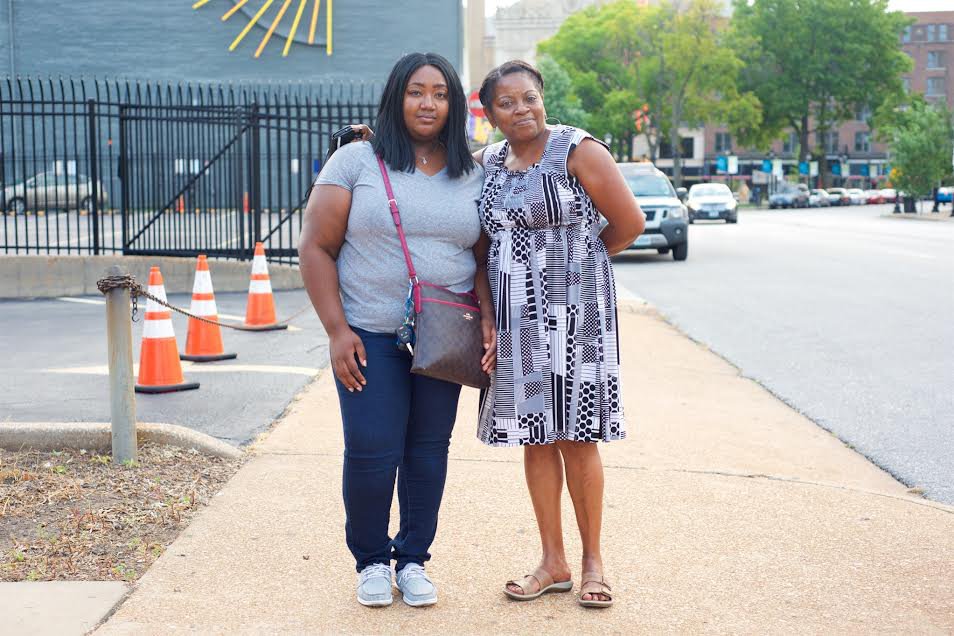
We pass the KDHX building and see two women standing near their car. Drew asks if they would like to participate in an interview, and they agree. The women tell us that they are headed back to the hospital, where one of the women’s fathers will be taken off life support. Drew is sensitive in her questioning, but she doesn’t shy away from difficult questions. As the conversation unfolds, the women share that they found the woman’s father unresponsive and were unaware of his heroin addiction. The story is painful, and we feel its weight as we say our goodbyes. We hug the women and walk back to Starbucks, mostly in silence.
“I would just love for people to realize that life is happening all around St. Louis,” says Drew. “The underlying issues that are really affecting St. Louis—like racism—need to be talked about. You need to open your world a little bit more than the neighborhood you live in because this place is super interesting. People are fascinating. We just have to talk to each other.“