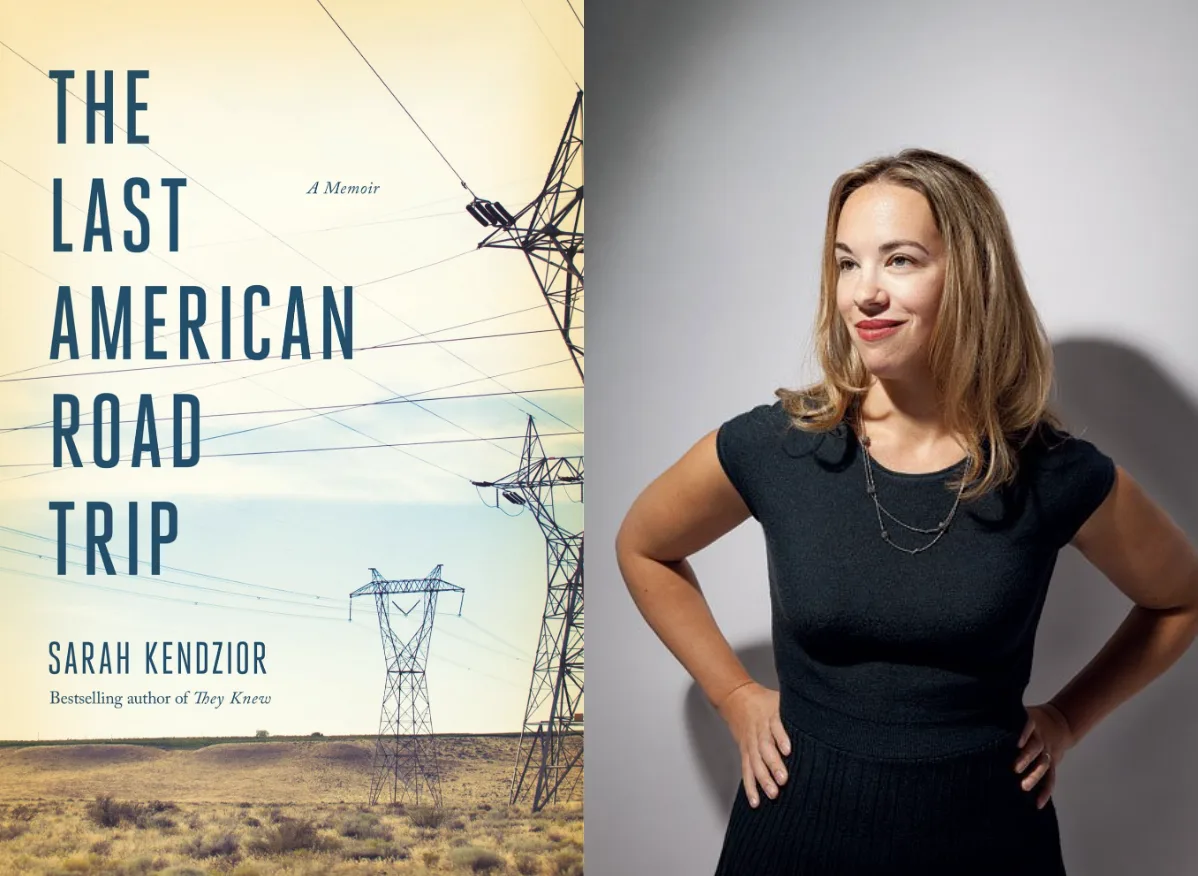
When Sarah Kendzior started writing about St. Louis in 2013, the journalist and researcher had already established a far-flung readership in a media landscape then in the throes of major seismic shifts.
She had just earned her doctorate in anthropology from Washington University in St. Louis, where she quickly became regarded as an expert in her field, examining digital media and politics in the authoritarian states of the former Soviet Union. “A year after that came the Ferguson uprising,” she says, “and suddenly there was the global interest in St. Louis, in the history of St. Louis, in North County, in poverty and racism and all these structural issues.”
Stay up-to-date with the local arts scene
Subscribe to the weekly St. Louis Arts+Culture newsletter to discover must-attend art exhibits, performances, festivals, and more.
In 2018, Kendzior published her bestselling first book, The View from Flyover Country: Dispatches from the Forgotten America, adapted from essays she wrote for Al Jazeera English about America’s social, political, and economic crises, followed in short order by Hiding in Plain Sight: The Invention of Donald Trump and the Erosion of America (2020) and They Knew: How a Culture of Conspiracy Keeps America Complacent (2022).
The Last American Road Trip, which she published last year, is both a travelogue of her family’s road trips across the United States and an elegiac history of the places she loves (and is loath to lose). Earlier this month, Flatiron Books released the memoir in paperback.
Ahead of her conversation with St. Louis Public Radio’s Rod Milam at the University City Public Library on April 15 at 7 p.m., SLM sat down with Kendzior to discuss historical memory, American myth-making, and life on the road.
What is the value of public history right now, and how do you think about doing that work through journalism and platforms like Substack?
Public history is tremendously important, and we’re seeing now a widespread attack on history from multiple sectors. We’ve seen this backlash coming from the right wing over the last three years or so, cloaked under different names. Sometimes it’s DEI; sometimes it’s critical race theory. But basically they want to annihilate an accurate history of the United States, which includes the history of the oppression of Black Americans, Native Americans, and many other marginalized groups.
Now we have an even more dire situation where this is codified in law. It was always sort of there within our government, this reluctance to tell the full truth about things. But now we’re seeing people penalized for doing so. We’re seeing history eliminated from official government websites, books taken out of libraries. On top of that, we see suppression through social media, and I am worried about that.
I combine a lot of different genres in my writing, and a lot of it is history writing. But I don’t have faith that any social media platform is safe. I learned a lot of history in the years when I was on Twitter—I still am, I just don’t use it as much—and I learned a great deal from other scholars and experts in subjects I didn’t know much about. I think a lot of people did, and others saw that as enormously threatening. I think it helped spur a lot of the activism and organizing we saw over the last decade and a half. They wanted to make sure that couldn’t happen again.
Platforms like Substack are among those now providing accurate history, or histories of groups and cultures that often aren’t well represented in the mainstream media. So I do worry that they will fall under further attack, no matter what kind of pledge to free speech they claim to be making. There are ways of censoring people that are so subtle they’re nefarious—simply shadow-banning, allowing people to publish things but not allowing those things to be reached. Then you have no idea whether you’re actually seeing the same things as anyone else, or whether people are seeing your work. I certainly see this happen a lot, because there are folks I like to read and I can’t find them unless I manually look for them. There are people who speak, for example, about abolition and other subjects that I think a lot of powerful people don’t want much scrutiny on.
Is that a sentiment you find shared among folks as you’ve been on tour for this book?
By far, the tour has been the best thing my publisher has done for me in terms of meeting people. It’s just been tremendous. I love meeting my readers. There’s been great turnout. A lot of people, I think, are using my book appearances as a way to voice a lot of concerns. They may voice those concerns online but not necessarily feel heard. I’ve had a lot of people tell me—in the signing line, or by email afterward—that it was a very cathartic experience to be in a room filled with people who are also very worried about what’s going on now. They felt safe expressing their views. They felt supported. I’m glad folks are attracted to my work, but also to each other—that communities kind of form around it.
My Substack newsletter has been a bit dormant since the tour started, but before that, people in the comment sections talked to each other and got to know each other. I’ve left comments open and I leave all articles open. I don’t paywall anything, because I think it’s wrong to paywall in times of peril. I know what it’s like not to have enough money to subscribe to something, and I don’t want to leave anybody out. I was astounded at how kind—and how much like good critical thinkers—the people who come in on my Substack are, given that it’s open to absolutely anybody. Trolls could come pouring in, and they really haven’t. It’s been a very thoughtful back-and-forth exchange for the most part, even when folks disagree. So when people think that’s impossible online these days, it really isn’t. That’s been heartening to see.
One of the points I try to bring home in all my work is that these illusions of red states and blue states—which I think are particularly irritating for us living in St. Louis, Missouri—are hostile; they’re created by political operatives. I try to break down those stereotypes and generalizations. Having been in Seattle, Portland, and San Francisco, and then driving down to Austin and Tulsa and back up to St. Louis, you can see how, in the national media’s fabricated mind, these are supposed to be wildly different places full of people who have nothing in common with one another. In reality, I think a lot of people are upset about the very same things: corruption, elite criminal impunity, the theft of their rights, the theft of their money—so many things. It’s not great that the thing binding everyone together is a shared sense of betrayal and pain. But I definitely think this idea that people all over America can be boxed into categories, or are naturally at war with each other because they live on the coast or in the center of the country, is a delusion peddled by political operatives for their own nefarious ends.
You’ve cautioned over the years against casting the country in the binary categories of red states and blue states, and you’ve talked about it being an atavism of punditry during the 2000 presidential election. Why is that fallacy so dangerous?
This isn’t an age-old phenomenon. This is something that was cooked up, I think, after the election. During the election it was just a way for TV anchors to show which states had voted for whom. Then people started using those categories more broadly. By 2004, Obama—then a rising star—was already making speeches cautioning against it, because it was such a powerful rhetorical device. It really began to worry me because of what I think the long-term goals are for a lot of political operatives—not just surrounding Trump, but plutocrats in general, including a lot of people connected to Silicon Valley and the tech industry. They go beyond political or partisan lines, and beyond national lines. The concept of the nation-state doesn’t mean anything to somebody who has five passports and a bunch of offshore accounts. They want to strip the country for parts.
What I’m worried they want to do is partition it. Because I think what they see as the ideal is what happened after the collapse of the Soviet Union, when oligarchs looted what was left of that territory, particularly in the authoritarian regions—places like Russia or Azerbaijan or Uzbekistan and so forth. Here, it’s harder to figure out where those boundary lines would even be drawn. When the Soviet Union collapsed, the Soviet Socialist Republics became independent states. Here, there’s no natural dividing line, as much as they try to push that there is. They’ll try North and South; they’ll try red states and blue states. But all of us living in a place as complex as St. Louis know that within the metro region itself there are a million little Americas. Honestly, I think that’s true of pretty much any metro region, but it’s particularly well defined here.
This has historically been such a struggle for the soul of the country. It’s been a place where a lot of these questions about American identity, and where certain regions begin and end, have been formed. They want to make these into hardened, immutable categories, whereas they are not. They’re trying to tap into people’s frustration at a political system that has betrayed them by getting them to turn on each other. For example, when Roe v. Wade was overturned, instead of getting sympathy from Democrats or liberals as a woman living in Missouri who had just had my bodily autonomy taken away by law, I instead got this response of, “Well, that’s your fault. That’s your fault for living there.” It doesn’t matter what I believe in, or who I am, or even that I’m a human being. And it shouldn’t matter—say I was a Trump supporter, say I did vote for it. I still think they deserve bodily autonomy, too. We all do. They really like to keep the focus on people hating each other and blaming each other instead of punching upward and asking: Who’s making these laws? Who’s funding these projects? Who are the donors behind these candidates? They don’t want people looking at any of that, so they’d rather have us hate each other. This is one way to do that, and it’s extremely contrived and manufactured.
How do you think about raising children in this country right now—without surrendering to cynicism and complacency in public life—and what does your love for St. Louis have to do with that?
There’s a part near the end of the book where I talk about love for country, and how difficult it is when your country has carried out evil acts. That has to be acknowledged. It can’t be buried; it can’t be whitewashed. But at the same time, there’s a deep love that you feel because it’s your home—your homeland. It’s full of people and places that you love. So it has to be an honest love. An honest love is not one that disregards criticism. I think an honest love is one that embraces criticism. Writers throughout American history have said the same thing. There’s a quote from James Baldwin—he says, essentially, that he loves America more than any other country in the world, and therefore feels compelled to criticize it relentlessly. I very much relate to that. In order for problems to be solved, they need to be identified and fleshed out, even if that makes people very angry with you. I think that’s the only way it can be resolved.
Raising kids is complicated, because depending on the age of the child there are certain things you might want to withhold. For example, when I was covering the Jeffrey Epstein case, I obviously didn’t want to give a 10-year-old all the details of that. But I could say there are very corrupt men who prey on children, and they use blackmail and those tactics to control people, without giving all the details. I didn’t want to lie about what was going on or reduce the stakes. I also try to emphasize that there are people fighting back. There are people trying to stop this. The majority of people are against this. That’s actually what I’ve seen. It’s a unifying issue across the political spectrum, where everyone pretty much hated him, except, of course, for many of the most powerful people in the world who were captivated by him.
In terms of American history, it’s interesting because we live in U. City and my kids go to University City Public Schools. They’re getting Black history incorporated as part of American history, which I think is the way it should be, and likewise with the history of other marginalized groups. I know kids who go to schools in more conservative regions—or majority white spaces—where really it’s just Black History Month, and that’s kind of all they get. So while there are problems with the U. City school system in terms of funding and resources, I do like the education they’ve gotten there and the fact that they seem free to discuss things openly. When we would be on the road looking at places like the remains of a slave plantation or something like that, I never would have skirted around that topic anyway. But also, my kids were already aware of this from school and from independent reading. From experiencing so much of America, they understand that it is possible to love it and also to be vigorously honest about what has happened here and is happening here. It doesn’t do any favors to this country to lie about it. It doesn’t help the people who have historically suffered, or are suffering now, to lie about it. So you need to be honest. That’s not an anti-American thing to do. I think it’s the most pro-American thing to do: to be honest about the crimes and sins of this country.
Parts of the book read like a natural history of the country, in terms of the seriousness with which you take on the search for the sublime, transcendent aspects of public land and wilderness. What role does beauty play in your project?
It was actually tough to do, to convey that. A lot of times in my newsletter I incorporate photos and things. I put them at the end so people are forced to read the text, and then they can physically see what I’m talking about. I was hoping to have photos in the book. I was also hoping to have maps. Both of those ideas were shut down.
Toward the end of these chapters about really luminous, beautiful places like national parks, I would think: My God, how many different ways are there really to describe this? I started reading a lot of James Lee Burke novels, because he’s very good at describing the natural world in all these creative ways, especially the South and the Southwest. What I realized in writing this is that it’s much easier to write something that’s polemical, or even a description of rot and ruin, in part because I’ve trained my mind to find the beauty in rot and ruin, or to find the interesting things about it—the ways it might surprise me or teach me something. Then when you’re looking at something that’s just obviously gorgeous—Glacier National Park, a place like that—you’re almost at a loss for words, in part because I was just taking it in and was really dazzled. But it’s so hard to convey with written language. I do hope that whatever people get out of this book, they feel compelled to preserve a lot of these places, because they’re now under vigorous attack from this government. They want to get rid of the national park system, state park systems—all of it is under threat. It was under threat from climate change beforehand.
I feel like the things I tend to get the most out of are unexpected beauty. It doesn’t have to be something big and glamorous like the Rocky Mountains or whatever. That’s why I like being here in Missouri, because I feel like we have a really gorgeous state and I don’t want to tell people about it, because if it gets too crowded we ruin it.
As it happens, Route 66 turns 100-years-old in 2026. How do you hope that centennial is understood or marked?
I was asked about that in Tulsa, because they’re also a Route 66 city. I kept thinking about the recent eclipses that went through our region and suddenly provided this giant boom for all these little tiny towns that normally don’t get many visitors. Everyone was flocking there, and it was a big part of their economy for that year. I wonder if that’s going to happen with Route 66, or if it’ll be more like the Reagan model, which I certainly think Trump and Musk and the rest embody: let’s just knock this down. It’s a weird thing, because Trump pretends to embody the mythic idea of something like Route 66—some vision of America where people were happy and felt safe and free — while he’s actively destroying the country and destroying any route, metaphorical or literal, that makes that possible.
My nightmare would be that they take the real people and places of Route 66 and replace them with some sort of facsimile, to stir up a very specific kind of nostalgia. As I say in the book, this is a complicated route. It meant different things for different people. I’m also concerned, in terms of Native Americans, because a lot of their territory is on that route or borders that route. I think this government has its eye on snatching back that territory. My guess is that people like Trump—or plutocrats in general—don’t care about Route 66. They don’t care about the people who live on it or near it. They’re interested in mining the country for resources. So I think this may end up being more of a local thing if there are celebrations or commemorations. But I think that’s a good thing. If there’s an economic benefit to a lot of these struggling communities, that’s a great thing. I’m glad people who don’t know the route and have never driven on it now want to. But I’ve also gotten good responses from people who do know it, and often they’re wistful. They remember all these different moments, including ruins and abandoned places that are gone now too. So it’s sort of layers of wistfulness going back decades.
In your book, you encounter Mark Twain’s legacy, the mythology that surrounds him and his legacy, especially in this state. You also talk about wanting your kids to discover Huckleberry Finn on their own.
When you shove something in a kid’s face—I mean, I think any kid, but certainly my kids—and say, “You have to read this,” especially if they’re teenagers, then they really don’t want to. If they find out about it on their own, even if it’s something really challenging to read, they’re much more likely to do it. My oldest was reading Dostoevsky by the pool for fun because she discovered it. If I were saying, “You have to read this; it takes place where we live; it’s so important,” then they’re not going to do it. So there’s that: I want them to come to things on their own. But also, of course, I’ve taken them to so many Twain places that they know of him, and I think they feel like they know it already. I want them to read it when they feel like it, so they’re going into it with an open mind and some enthusiasm, instead of, “Oh, this is the man Mommy keeps reading about and taking us to museums and homes and graves for.”
He’s always been someone I’ve read and thought about since I was a little kid. When I moved here originally to go to WashU for anthropology—I guess it’s now 20 years ago—one of the first things we did was drive up to Hannibal because I wanted to see all of that.
It’s funny to me, these parallels—living in those two particular states, Connecticut and Missouri, in times of intense civil unrest. He died at the end of his life worried about the very things that have come to fruition in this country: monopolies, hypercapitalism, imperialism, corruption, and so forth. His diaries are really interesting for me to read, because in public he seemed like he was on top of everything. People knew about his business disasters, but he seems like this funny, confident, thoughtful guy, and privately he’s a wreck. That’s why he didn’t want his diaries published for more than 100 years—it would have been too humiliating for him to get that personal.
This is the first time I’ve ever written a memoir like this. It’s the first time I ever wrote about my family. It was a hard line to strike because I also wasn’t completely revealing of myself. This is about as close as I think anyone’s going to get, just because some things are too private or too painful to express in a very literal, stark way. So I’ll tiptoe around some things or abbreviate some stories. But there was a lot I could relate to there. There’s also something reassuring in knowing that someone who’s thought of as a great American writer was also in a state of self-doubt and concern for his country, concern for his livelihood. All of those things were very relatable.
Kendzior will speak at the University City Public Library (6701 Delmar) on April 15 at 7 p.m. Books will be available for purchase via Subterranean Books. This event is free and open to the public.