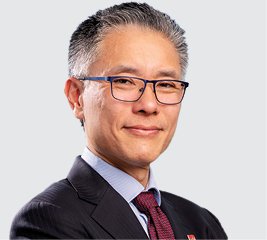
Early in his career, Cheng accepted a senior role at RGA’s Malaysia office in 1997—but he soon realized that enthusiasm alone was no replacement for experience. “Rather than viewing that as a failure, I treated it as invaluable feedback,” Cheng says. “The lesson: There are no shortcuts to expertise. That insight led me to a new opportunity at RGA’s St. Louis headquarters, where I gained hands-on experience and broadened my perspective. My time in St. Louis deepened my foundation and gave me the skills and confidence to seize future opportunities with purpose and resilience.”
2026 QUESTIONNAIRE
What advice would you give to the next generation of St. Louis entrepreneurs or leaders? My leadership philosophy is simple: grow with intention, persevere with purpose, and give generously. I’ve learned that staying committed to growth, resilience, and generosity is essential for meaningful leadership. First, stay curious and keep learning. Your growth shouldn’t be limited to your title or your field. Look beyond your immediate role and seek to understand the world around you. The most innovative leaders are those who never stop learning and expanding their skills. Second, embrace challenges with resilience. Don’t let setbacks define your path. Every challenge carries a lesson and an opportunity. Learn from the past, but don’t live in it. And finally, as you achieve success, look for ways to give back. Make it a priority to give back, whether through mentorship, creating access for others, or advocacy. Helping others reach their potential can be one of the most meaningful and lasting contributions you make—not only in business but also to your community. At the end of the day, leadership is about more than personal achievement. It’s about making space for others to rise with you.
What’s a risk you took in business that didn’t pan out—but taught you something valuable? Early in my career, I took what felt like a risk by accepting a senior role at RGA’s Malaysia office in 1997. I was young and ambitious and very eager to succeed, but I soon realized that enthusiasm alone couldn’t replace true experience. I underestimated how much wisdom is gained through time and exposure. Rather than viewing this as failure, I treated it as invaluable feedback. The lesson: There are no shortcuts to expertise. That insight led me to a new opportunity at RGA’s St. Louis headquarters, where I gained hands-on experience and broadened my perspective. My time in St. Louis deepened my foundation and gave me the skills and confidence to seize future opportunities with purpose and resilience.
What do you do when you’re feeling stuck or uninspired? When you’re feeling stuck or uninspired, it’s important to remember that these moments are natural, and often necessary, parts of any meaningful career journey. I’ve experienced them myself, and I’ve learned they’re usually signs that it’s time to grow with intention and reconnect with your purpose. For starters, I step back, get some physical distance from the problem, and create space for clarity. This usually means going for a long run to clear my head and think straight. There is something powerful about physical movement that unlocks mental breakthroughs. I’ve solved more complex business challenges while clearing my head on a run than I have sitting behind a computer screen. Once I’ve gained a new perspective, I focus on expanding my view beyond my immediate challenge. I seek out conversation with others, engage with the community, and dive into something completely new, because oftentimes, the most innovative solutions come from unexpected places, and feeling stuck is usually a sign to broaden the lens.
Who in your company (or industry) deserves more recognition for their impact? I feel very lucky to lead a workforce of such dedicated professionals, and it’s hard to single one person out. The people who truly deserve recognition are those who labor quietly, advancing our mission with unwavering commitment. These team members bring ideas to life, solve problems before they escalate, and support the entire organization. Their efforts may not always be visible, but their impact is profound. Without them, we couldn’t serve our clients and work toward our purpose of making financial protection accessible to all. Our success rests on their shoulders.
What’s a local organization, nonprofit, or initiative that more people should know about—and why? Since moving to St. Louis, I’ve had the privilege of partnering with organizations that are deeply committed to improving lives and strengthening our community. A few of my community commitments are outlined below:
- Concordance | Board of Directors: I’m honored to support the organization tackling one of our most urgent challenges—reducing reincarceration. Their holistic, evidence-based approach to reentry support is making a powerful impact, and I’m proud to stand behind their mission.
- Longer Life Foundation | Chair, Board of Governors: Founded in 1998 as a joint effort between RGA and Washington University School of Medicine in St. Louis, the Longer Life Foundation (LLF) is a not-for-profit foundation that funds early-stage research by the university’s physicians and scientists. As chair of this organization, I find it incredibly rewarding to support the groundbreaking research being conducted by the LLF grant recipients.
- Greater St. Louis, Inc.: I’ve had the opportunity to help advance inclusive economic development and advocate for the region’s long-term vitality. Their work to unify business, civic, and community leadership is a vital force in shaping St. Louis’ future. I’m particularly excited about our sponsorship of transformative infrastructure projects like the Brickline Greenway, which will create an urban trail network connecting people to some of St. Louis’ most treasured places while generating meaningful economic and social impact for our community. Each of these organizations represents a different but equally important part of building a healthier, more equitable, and more resilient city. I’m grateful to be part of that mission.
2025 QUESTIONNAIRE
PROFESSIONAL ACCOMPLISHMENTS & OPPORTUNITIES
What has you most excited about the future of your company or industry? The question that excites me most about the future of RGA and the broader insurance industry is: How will continuous innovation drive our success? At RGA, we are uniquely positioned at the intersection of biometric and asset risks, effectively managing both sides of the balance sheet as a global reinsurer exclusively focused on life and health risk. This strategic positioning allows us to navigate and capitalize on dynamic industry shifts – from demographic changes and medical advancements to higher interest rates and regulatory changes. RGA’s unwavering commitment to innovation is not just about adapting to changes but actively shaping the future of our industry. This includes our push toward digital transformation, developing new underwriting solutions, our proactive approach in markets like the U.S and Asia where we are setting benchmarks through innovative partnerships and products, and our continuous evaluation of the impact of medical advancements, and emerging technologies, such as artificial intelligence. As these markets evolve and industry trends advance, the potential for innovative products and services grows, making this an extraordinary time to spearhead transformations that redefine industry standards – further propelled by our dedicated global team of more than 4,000 employees who bring our vision to life every day.
If you could change one thing about your industry, what would it be and why? If I could change one thing about the life and health re/insurance industry, it would be to close the insurance protection gap. Millions of people around the world lack adequate coverage, which poses not only industry growth potential but also a broad social and economic challenge. At RGA, our purpose is to make financial protection accessible to all. We leverage technology, data analytics, and strategic partnerships to develop innovative solutions that expand access within underserved communities globally. Achieving this goal is not just a business objective;it’s a personal mission and a commitment to society. Furthermore, I believe it is crucial for our industry to be more vocal about its positive contributions. As re/insurers, we not only provide a safety net during life’s most challenging times but also generate substantial capital that fuels infrastructure projects and other beneficial programs. This dual role amplifies our contribution beyond individual protection to societal development, highlighting the noble nature of our work.
What’s the toughest business challenge you’ve had to overcome (excluding the pandemic) and why? One of the toughest challenges at RGA is navigating changes while preserving the organization’s culture of care. Change isn’t always easy, but it is a critical aspect for strong organizations that want to maintain strength and resilience in a rapidly evolving business environment. The challenge is to embrace change in a way that upholds the culture of care that defines who we are.
Keep up with local business news and trends
Subscribe to the St. Louis Business newsletter to get the latest insights sent to your inbox every morning.
MENTORS & PEERS
To whom or where do you go for sound business advice? When seeking sound business advice, I primarily turn to our board of directors, an invaluable sounding board for discussing complex issues and developing strategic solutions. Our incredibly talented and diverse board members, including our esteemed chair, bring collective experience of more than 500 years across various sectors. Their knowledge and expertise are crucial in guiding our decision-making processes. I maintain a transparent relationship with the board, valuing their advice and the trust they place in my executive team. Their insights don’t just inform our decisions;they fuel them, enabling us to navigate challenges effectively and strive toward making RGA the best it can be.
Do you have a business mentor? If so, who and why? Rather than having a single mentor, I leverage a diverse network of advisors who guide me in various aspects of leadership. Feedback from these interactions is invaluable, and I view it as a gift that helps me continuously improve and adapt. This network includes fellow CEOs and industry leaders I meet while traveling globally, who offer insights into the market dynamics and the broader industry landscape. I also firmly believe in reverse mentoring. I learn so much from everyone across the organization;they provide fresh perspectives and allow me to tap into the unique strengths and experiences of our diverse teams. I recognize that diverse viewpoints enhance team performance and foster a more inclusive environment, which in turn contributes to my personal growth and effectiveness as a leader.
What piece of advice has had the most significant impact on your career? One piece of advice that has significantly influenced my career came early on from a mentor who noticed my initial shyness in the corporate environment. He shared: “No matter how hard you work or how smart you are, you won’t be successful in a company unless you have ‘heart’ for what you do.” Having the “heart” meant doing everything possible for the good of the company, being deeply committed and aligned with the company’s purpose, vision, and strategies. Understanding what benefits the organization allows one to be more empowered and proactive in their role. From such a commitment comes empowerment. Being aligned with the company’s goals leads to decisions made with confidence and initiative. Importantly, while outcomes can sometimes deviate from what we anticipate, committing to decisions that prioritize the company’s best interests, based on the best available information, provides a solid foundation. As long as one learns from the experiences and operates within the established risk boundaries, challenges can be navigated successfully. This approach has not only guided my individual decisions but has also shaped how I lead teams, encouraging a culture where informed, heart-driven actions are valued and supported.
What is one thing you would change about the St. Louis metro area business environment and why? I would advocate for the availability of direct international flights from St. Louis. Having more global connections would significantly improve our ability to engage with and support our global workforce effectively. More destinations would facilitate smoother, more efficient travel for business purposes, while also strengthening St. Louis’s position as a competitive, globally connected business hub.
BACKGROUND
Where were you born? I was born in Hong Kong and moved to Sydney, Australia when I was nine months old.
What was your childhood aspiration? As a child, my aspirations were deeply influenced by my family’s values and my own early interests. Initially, my older brother introduced me to the field of actuarial science during his university studies. At that time, there were only six practicing actuaries in Australia, and he described the profession as a perfect blend of business and mathematics. Given my interest in business and strength in math, I was compelled to pursue this career path. Additionally, growing up watching my parents operate small businesses and seeing their dedication and the sacrifices they made—including moving our family to Australia for better opportunities—fueled my motivation to improve their lives. This inspired a childhood dream of mine, which was to work hard enough to one day buy a house for my parents.
What was your first job, and what did you learn from it? My first job was working at my family’s sandwich shop in Sydney, Australia. From a young age, even when I was barely tall enough to reach the register, I was tasked with ringing up sales. This early experience taught me the value of hard work firsthand and instilled a deep-rooted passion for business ‚Äì principles strongly modeled by my parents. Their relentless work ethic and dedication to providing for our family influenced my approach to everything I do professionally and is why I’m so dedicated to what we do at RGA.
What educational degrees do you hold, and where were they earned? Bachelor of Economics (B.Ec.) degree from Macquarie University in Sydney, Australia;M.B.A. from Washington University in St. Louis’ John M. Olin School of Business;Fellow of the Institute of Actuaries of Australia (FIAA)
HOBBIES & INTERESTS
If you were not in your current profession, what would you be doing and why? I’m deeply passionate about eating great foods from all around the world, so I’d likely be a food and restaurant critic. It would satisfy my culinary curiosity while also allowing me to share my discoveries and insights, helping others appreciate global flavors.
What is your favorite St. Louis-area restaurant, and what do you typically order there? My favorite St. Louis-area restaurant is Sultan, a cozy family-owned spot in The Grove. It connects me back to my family’s roots in the food industry but also reminds me of the importance of supporting local, family-run establishments. I usually order their exceptional naan bread and eggplant dishes.
What is one item you recently crossed off your bucket list? I don’t really maintain a traditional bucket list; however, one personal achievement I’ve recently focused on is embracing healthier eating and finding a better balance in life.
What is one book you think everyone should read (or podcast everyone should listen to) and why? I think everyone should read Tara Westover’s Educated: A Memoir. It’s an exploration of the transformative power of education and the resilience of the human spirit, themes that align strongly with the values of continuous learning and personal growth I uphold.
What’s your hobby/passion? Running, which perfectly balances my passion for eating.
What is your most prized possession? My family.
What would people be surprised to learn about you—a fun fact? People might be surprised to learn that I’m actually an introvert; I’m often perceived as being very extroverted because of my public role and active engagement in various professional settings.